US tariffs and uncertainty over CUSMA are pushing Mark Carney’s government to accelerate efforts to diversify Canada’s economic and strategic partnerships
The European Union is offering deeper cooperation, including a proposed associate-membership framework, while Canada is also looking towards the Indo-Pacific
Canada’s diversification remains limited by its deep economic, defence and security integration with the United States, particularly through North American supply chains and NORAD
On Wednesday, European Commission President Ursula von der Leyen invited Canada to become the European Union’s first associate member, proposing deeper cooperation on security and economic issues. The announcement came as Prime Minister Mark Carney was in Europe meeting EU leaders.
Ottawa’s own framing of the visit was explicit. A Canadian government statement last week said the trip was aimed at “diversifying our partnerships abroad”, with trade, investment and security identified as areas for deeper EU cooperation.
The proposal marks a significant expansion of a relationship that already includes the Comprehensive Economic and Trade Agreement, or CETA, as Canada looks to strengthen ties beyond the United States.
Washington’s Shift
The immediate trigger has been the deterioration of the Canada-US trade relationship.
Earlier in August, Carney suspended trade negotiations with Washington, saying Canada had recognised that the United States had changed its approach to trade relationships and that Ottawa would not simply return to the previous arrangement.

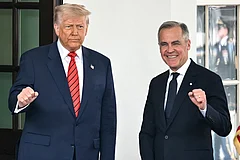

The decision followed a tariff escalation in July. The White House imposed additional duties on Canadian goods, describing them as a response to what Washington characterised as discriminatory Canadian measures affecting US commerce, including the automobile sector.
Ottawa disputed that justification and said the tariffs were imposed in violation of CUSMA, the Canada-United States-Mexico Agreement that was intended to provide a stable framework for North American trade.
CUSMA Under Strain
CUSMA has not been formally abandoned by either side. The agreement is subject to a scheduled review, and officials continue to discuss its future. But the trade dispute has challenged the assumption that the agreement alone can guarantee predictable access to the US market.
The Bank of Canada identified trade-policy uncertainty as a significant risk to the economic outlook in January. In May, Canadian federal, provincial and territorial trade ministers discussed the CUSMA review alongside the wider Canada-US relationship.
The agreement remains in force, but its role as a source of certainty has become more contested.
Too Deep To Cut
Any Canadian attempt to diversify has to contend with the scale of its existing relationship with the United States.
The US remains by far Canada’s largest export market. Automotive manufacturing, energy, agriculture and other industries depend on supply chains that cross the border repeatedly, while investment and business ties have developed around that integration over decades.
That makes diversification different from decoupling. Ottawa is not seeking to eliminate its economic relationship with the United States. Its objective is to reduce the extent to which changes in US trade and economic policy can determine Canadian economic outcomes.
The Defence Layer
The relationship goes beyond trade.
Canada and the United States operate jointly through NORAD, the binational command responsible for the defence of North American airspace and maritime approaches. Their defence industries and procurement systems are also deeply integrated, while intelligence-sharing and operational cooperation have developed over decades.
Canada has begun expanding its defence partnerships in Europe. At the 2026 NATO summit in July, Carney announced new defence arrangements, while Ottawa also joined the EU’s SAFE framework.
Those moves can broaden Canada’s defence options, but they do not replace the North American security architecture.
Beyond America
Europe is the most immediate alternative, but Canada’s diversification strategy is wider.
CETA already provides a framework for Canada-EU trade and investment, while Ottawa and Brussels are expanding cooperation in areas including defence, critical minerals and economic security. Von der Leyen’s associate-membership proposal would take that relationship further.
At the Canada Investment Summit on Tuesday, Carney described the broader strategy as “building our strength at home and diversifying our partnerships abroad.” He pointed to growth in non-US exports and outlined efforts to expand market access across multiple regions.
The Indo-Pacific is central to that strategy. Canadian policy has identified countries including India and ASEAN economies as potential areas for deeper trade and investment, while Ottawa is also looking to expand energy exports and infrastructure links towards Asian markets.
Critical minerals are another part of the strategy, particularly as Canada seeks to position its resources within supply chains that currently depend heavily on China and the United States.
The Real Limit
Diversification, however, cannot quickly reproduce the scale of Canada’s existing trade with the United States.
Canadian trade data shows the US remains dominant across goods exports, energy and manufacturing. European and Indo-Pacific markets can provide additional outlets, particularly for resources and selected industries, but replacing the volume and proximity of the US market would take years.
The same constraint applies to defence. NORAD, continental defence infrastructure and integrated intelligence systems cannot simply be replaced by new partnerships overseas.
Strategic Autonomy
Carney’s own formulation offers the clearest description of what Ottawa is attempting.
In his speech on Tuesday and his statement for suspending US trade negotiations, he maintained that the United States would remain an important partner and neighbour while arguing for stronger domestic capacity and wider international relationships.
That makes Canada’s strategy less about leaving Washington behind than reducing its dependence on it.
The EU’s offer of associate membership, deeper European defence ties, growing engagement with the Indo-Pacific and efforts to strengthen domestic industry all point in the same direction: giving Canada more economic and strategic options.
Canada is not breaking with the United States. It is trying to ensure that a future change in Washington’s policy does not leave Ottawa with any alternatives.