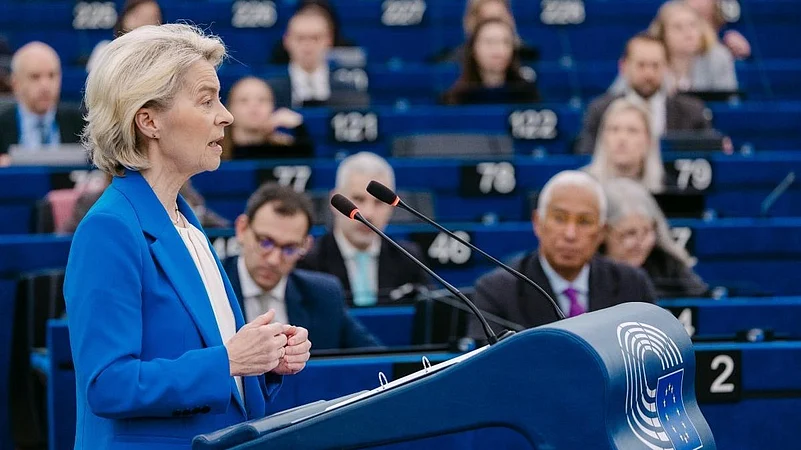
European Commission President Ursula von der Leyen has called for a coordinated EU mechanism to counter hostile drones, airspace violations and sabotage
The proposed plan includes €250 million for border surveillance, a European counter-drone centre of excellence and measures to strengthen protection of critical infrastructure
The initiative comes amid growing European security concerns over drones, suspected sabotage and airspace incidents, alongside deeper EU-Ukraine cooperation on drone and counter-drone systems
European Commission President Ursula von der Leyen on Wednesday called for a joint EU mechanism to counter hostile drones and sabotage, warning that repeated airspace violations and attacks on critical infrastructure had become a new security challenge for Europe.
Speaking during her State of the Union address to the European Parliament, von der Leyen presented an EU Action Plan on Drone and Counter-Drone Security focused on improving preparedness, detection and coordinated responses.
The plan comes after a series of incidents involving drones and other threats to European airspace and infrastructure, which von der Leyen described as part of a wider pattern of increasingly dangerous activity.
New Counter-Drone Measures
The European Commission's action plan proposes a range of measures to strengthen the EU's ability to detect and respond to hostile drones.
These include a €250 million call for land and maritime border surveillance, a European counter-drone centre of excellence, a system for identifying trusted drone equipment and a package to improve the identification and registration of civilian drones.


The Commission also plans to establish a counter-drone deployment initiative to protect critical infrastructure and external borders, explore rapid counter-drone emergency teams and hold large-scale EU-level security exercises each year.
The plan also calls for the development of European dual-use artificial intelligence systems for command and control.
Russia And The Leipzig Incident
Von der Leyen's announcement came as she pointed to an incident at Leipzig-Halle Airport in Germany, where authorities had identified Russia as being behind an attempted attack involving cargo aircraft.
In a joint press statement with NATO Secretary General Mark Rutte, she said the incident involved military-grade material and Russian operatives on EU territory.
"Europeans are faced with the hard truth that this is the new normal. We have to step up," von der Leyen said, calling for greater protection of everyday infrastructure.
She said the incident was part of a broader pattern involving airspace incursions, drones disrupting airports and interference with critical infrastructure.
EU-Ukraine Drone Cooperation
The European Commission is also expanding cooperation with Ukraine on drone and counter-drone technology.
The EU-Ukraine Drone Alliance held its first board meeting on September 11, bringing together 18 founding members from EU member states, EEA-EFTA countries and Ukraine.
The industry-led alliance aims to accelerate the development and production of drone and counter-drone systems, building on the EU-Ukraine defence cooperation announced earlier this year.
European Defence and Space Commissioner Andrius Kubilius said the alliance would focus on speeding up development and production, arguing that Europe needed to be able to deliver new systems in weeks rather than months.
Wider European Security Push
In her Letter of Intent to European Parliament President Roberta Metsola and Taoiseach Micheál Martin, von der Leyen also set out wider security priorities, including a European Security Strategy, an initiative covering offshore energy security and greater international data exchange for police cooperation.
The Commission's drone strategy forms part of a broader push to strengthen European defence capabilities as governments face growing concerns over drones, sabotage and attacks on critical infrastructure.
Von der Leyen said Europe needed to convert increased defence spending into stronger capabilities, while reiterating support for Ukraine as part of Europe's wider security strategy.