Russia’s jet-powered drone launches rose from about 450 in June to 2,850 in August, according to Ukrainian military data.
A July Ukrainian test showed interceptor drones struggled to control speeds exceeding 400 km/h, with some crashing.
Ukraine is testing cheaper guided missiles, networked electronic warfare and head-on attacks to counter Russia’s faster drones.
Ukraine is racing to develop cheaper and faster air-defence systems as Russia expands its use of jet-powered attack drones, putting pressure on Kyiv’s ability to counter the faster weapons.
The problem was laid bare in early July, when Ukraine’s military brought together a large group of producers to test a new generation of interceptor drones. The systems were designed to counter the jet-powered drones Russia has increasingly used in attacks on Ukraine. But according to two sources familiar with the exercise, the test did not go to plan: several interceptor drones became difficult to control at speeds sometimes exceeding 400 kilometres per hour, while others crashed into nearby fields and forests.
The setback comes as Ukraine heads towards another winter with insufficient Western air defences to counter Russian ballistic missiles and without a clear answer to Moscow’s faster and more powerful drones. Reuters reported, citing Ukrainian military data, that Russia increased its use of jet-powered drones roughly sixfold over three months this summer.
Much can change in two months in a war shaped by rapid technological development. But the scale of Russia’s progress has raised concern inside Ukraine. On Friday, Maksym Zhorin, deputy commander of the 3rd Army Corps, said Kyiv had again fallen behind in the development and use of jet-powered drones.

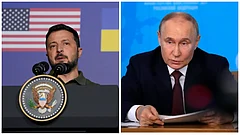


"With the jet drones, we completely screwed up the initiative again, that's a fact," Zhorin said on Telegram.
"The Russians have set up mass production and use of jet Shaheds, and we don't even know what to do about them."
Yuriy Cherevashenko, a deputy commander of Ukraine’s air force, acknowledged that producing interceptors capable of operating at higher speeds was difficult. But he said Ukraine was close to fielding several mass-produced, low-cost systems.
"I'm confident that soon we could fully have a class of weapons that will be effective at countering jet-powered UAVs (unmanned aerial vehicles)," he told Reuters.
Russia moves to faster attack drones
The expansion of Russia’s jet-drone arsenal has changed the challenge facing Ukrainian air defences.
Russia began launching thousands of cheap, propeller-driven Shahed drones at Ukraine in 2022. Kyiv developed increasingly effective ways to destroy them, pushing interception rates to around 90%.
Russia has responded by making its drones faster. The latest systems can travel considerably faster than the piston-powered Shahed-type drones used previously, creating a new problem for Ukrainian interceptors.
A typical Shahed-type attack drone, based on an Iranian design and powered by a piston engine, flies at less than 200 km/h. By contrast, Ukrainian military data seen by Reuters showed that Russia launched about 450 drones travelling between 240 and 500 km/h in June. That number climbed to around 2,850 in August.
Ukrainian defence intelligence estimates that Russia now produces about 3,000 jet-powered drones a month.
Some of the Russian drones resemble the triangular-winged Shaheds, while others have tubular bodies and small wings that make them more similar to cruise missiles.
Kyiv and its surrounding region have been the most heavily targeted, accounting for nearly one-fifth of all drones launched, according to the Ukrainian data. Cherevashenko said the areas around Kyiv and the Black Sea port city of Odesa had borne the brunt of the attacks. Odesa is a major hub for Ukraine’s seaborne exports.
"Going forward, the overall number of such drones in strikes will increase," Cherevashenko said.
In some attacks, he said, jet-powered drones already account for more than 70% of the weapons used.
Speed and guidance complicate interceptions
The newer drones have also been used against targets in central Kyiv in recent weeks.
Cherevashenko said their ability to change direction and altitude through operator commands made them particularly difficult to intercept.
"The main danger of these drones is that they're guided: meaning they can change their flight route and altitude, through an operator's command," Cherevashenko said.
The drone that struck the headquarters of Ukraine’s SBU security agency last week, hitting the office of its chief with pinpoint accuracy, is believed by officials and military analysts to have been manually guided.
Samuel Bendett, an adjunct senior fellow at the Center for a New American Security, described the wider technological contest as a continuing "sword vs. shield" struggle, in which new capabilities are quickly met by countermeasures.
"The current Russian advantage will eventually be eroded by Ukrainian counter capabilities in the form of fast and cheap interceptors capable of going after (jet powered drones)," he said.
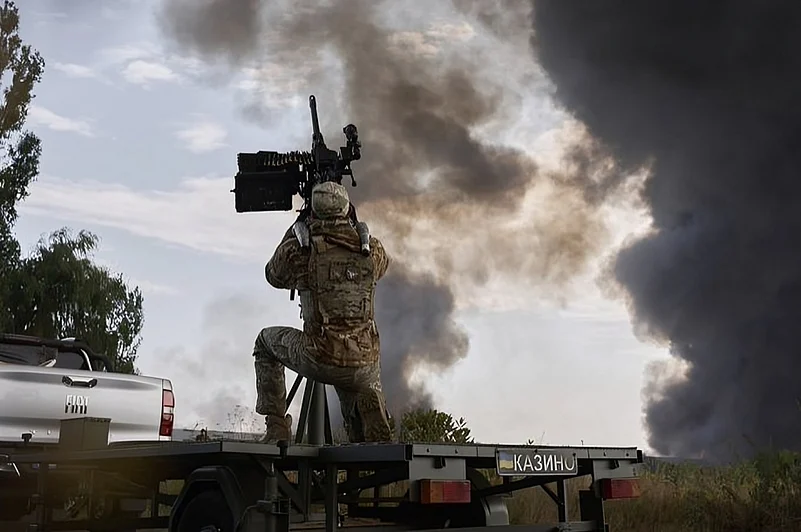
Ukraine already has more than 1,000 trained interceptor-drone crews. Companies are working to develop faster interceptors, including some powered by jets themselves. But the effort has produced uneven results.
President Volodymyr Zelenskyy has said more than 60 Ukrainian companies are working on systems designed to intercept jet-powered drones. Only a handful, however, have demonstrated results.
One Ukrainian drone-industry source said some prototypes were too large and slow to deploy in combat. The drone industry source said the brief opportunities to engage fast-moving targets made rapid deployment particularly important.
Existing interceptor drones struggle
Ukraine’s current interceptor drones were developed largely in response to the thousands of Shahed-type UAVs Russia launched last year.
Those interceptors typically cost less than $2,000 and have been able to destroy a high percentage of incoming drones. Their speed, however, is becoming a problem against Russia’s newer systems.
Borys Dolyna, a commander of an interceptor-drone company, said some jet-powered UAVs could be intercepted when they slowed down to manoeuvre.
But Russia is already adapting. Dolyna said Moscow was deploying and refining onboard systems that can detect approaching objects and automatically accelerate the drone.
The failed July test demonstrated another difficulty. Even when Ukrainian interceptor drones could reach speeds of more than 400 km/h, some proved difficult to control and crashed into fields and forests, according to the two sources familiar with the exercise.
Cheaper missiles offer another option
Ukraine is also looking beyond interceptor drones.
One potential solution is a new generation of cheap guided missiles. Ukraine’s stocks of expensive Western-supplied air-defence missiles are limited, and those weapons were not designed to deal with mass attacks involving jet-powered drones.
Cherevashenko said some of the new rockets were already undergoing tests. He said they would be significantly cheaper than the drones they are intended to destroy.
Electronic warfare is another part of Ukraine’s response, although newer Russian systems are making it more difficult.
Ukraine had previously been able to divert some Russian drones by feeding them false GPS data. But a Ukrainian drone-industry source said many jet-powered drones were now operating with advanced 16-channel antennae, making them highly resistant to jamming and signal disruption.
Anatoliy Khrapchynskyi, director of development at defence company Fly Group Ukraine, said Ukraine would need to move beyond relying on individual systems.
He argued that several devices should instead be connected and used as a single network to confuse Russian navigation systems.
"The drone continues to think it is flying toward its target, but its own autopilot, relying on the false coordinates, gradually changes course on its own and steers the craft away from cities into safe areas."
Head-on attacks could change interceptor tactics
Ukrainian industry is also considering a different way of using interceptor drones that are slower than their targets.
Instead of trying to pursue Russian jet drones from behind, existing interceptors could be adapted to attack them head-on. A Ukrainian drone-industry source said this would require AI-driven targeting systems capable of accurately calculating an incoming drone’s flight path.
Cherevashenko said Ukraine had already recorded successful head-on interceptions involving both automated guidance software and manually piloted drones.
He said the technology still needed further development before it could be deployed on a large scale, but that head-on interception represented the future of air defence.
For the moment, Ukrainian military aircraft remain an important part of the response because they are fast enough to keep pace with jet-powered drones.
But their ability to do so is also being constrained by dwindling supplies of air-to-air missiles. Pilots are increasingly being forced to rely on cannons instead, a hazardous tactic that carries the risk of collision with debris from intercepted drones.