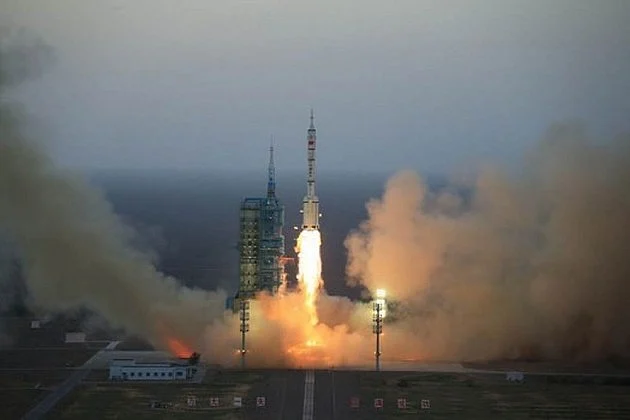
US Secretary of the Air Force Troy Meink publicly confirmed in Maryland that America has operational weapons stationed in orbit.
The announcement marks the first official public disclosure of deployed US space control capabilities intended to deter hostile adversary action.
Meink declined to share operational details, test history, or specific weapon classifications to safeguard deterrent strategic value.
The United States has, for the first time, said it has weapons in orbit, making public a capability that had not previously been disclosed. US secretary of the Air Force Troy Meink announced it on Monday at the Air & Space Forces Association’s Air, Space & Cyber Conference in Maryland.
Meink framed the disclosure as a deterrent signal to adversaries. “This is why the United States now has on-orbit space control weapons capable of defending the joint force against hostile adversary action,” Meink said at the conference.
He later told reporters that the wording had been chosen carefully to send a message. He also said revealing more would erode the deterrent value. That made it the first public US admission that weapons are already operating in orbit.
Weapon Details Withheld
Meink did not identify the weapon or say when it was placed in orbit. He also repeatedly declined to say whether it had been tested, what type of system it was or what targets it could engage.


“Not going to go into specifics on the type of weapon,” he said at a press roundtable, according to The War Zone. That left open basic questions about whether the system is meant to disable satellites, destroy them or interfere in other ways.
The US Space Force then gave only a general explanation. It said “space control” covers missions designed to contest and control the space domain through both kinetic and non-kinetic means. The service said such systems can disrupt, degrade or, if needed, destroy an adversary’s space systems. It said the capabilities could support offensive or defensive missions and may also include systems that interfere with satellites without physically destroying them.
That broader description widened the field of possibilities. It fuelled speculation that the newly acknowledged weapon may be a jammer or some other non-kinetic system rather than a direct strike weapon.
Victoria Samson of the Secure World Foundation told Financial Times that it could be a space-based jammer, noting that the US has generally tried to avoid kinetic attacks that could create dangerous orbital debris. Clayton Swope of the Center for Strategic and International Studies, however, said Meink’s announcement was too vague to provide a clear deterrent. For China or Russia to understand the threat, he said, they would need at least a broad idea of the weapon’s destructive potential and what actions could trigger its use.
Golden Dome Push
The disclosure comes as the Trump administration expands US military capabilities in space.
Meink said the US now had “flight-ready hardware” for space-based interceptors. Those interceptors are a key part of the proposed “Golden Dome” missile defence system, which is intended to destroy incoming missiles while they are still in space.
Modern militaries depend heavily on satellites for communications, surveillance, navigation and targeting, which makes orbital systems central to military operations.
The US Space Force has warned that China is developing and operating space and counterspace capabilities as part of its military modernisation. It has also said Russia sees space as a warfighting domain and views control of space as important to future conflicts.
Washington has already signalled a more open push in this direction. In 2025, President Donald Trump issued an executive order that reinforced the Space Force’s role in protecting US assets and in developing capabilities to attack adversary systems. Meink framed the latest disclosure in those terms, saying, “It is critically important that we maintain our dominance not only in the air, but in space.”
Russia China Counterspace
The wider backdrop is growing military competition in orbit.
In 2024, Washington said Russia had launched a satellite that it believed could be capable of attacking other spacecraft. Reports have also indicated that two Russian satellites may have intercepted communications from at least a dozen European satellites since Russia invaded Ukraine in 2022.
China, too, has invested heavily in counterspace technologies meant to disrupt or disable an adversary’s satellites. Taken together, those moves have sharpened concern that space is becoming a more active military domain and that public acknowledgment by the US could speed up an arms race already taking shape in orbit.
Samson warned that the US move could “backfire as a deterrent” if China or Russia answered by publicly acknowledging similar weapons.
Under the 1967 Outer Space Treaty, countries cannot place weapons of mass destruction in orbit. But the treaty does not ban conventional weapons or systems designed to interfere with or attack satellites. The US Space Force said its operations would comply with international law, including the Outer Space Treaty and the law of armed conflict.