ISRO successfully launched the GSLV-F17 rocket carrying the advanced EOS-05 geo-imaging satellite from the Satish Dhawan Space Centre in Sriharikota.
Weighing 2,367 kg, EOS-05 is the heaviest payload ever delivered into a transfer orbit by an Indian GSLV launch vehicle.
ISRO Chairman V Narayanan confirmed that the satellite achieved its intended orbit smoothly and that solar panels were deployed successfully.
ISRO successfully launched the GSLV-F17/EOS-05 mission from Satish Dhawan Space Centre in Sriharikota on Friday, placing India’s first imaging satellite in geo-orbit into a precise path. The over 2,300 kg payload gave the space agency its maiden success of 2026. As one senior scientist involved in the mission described it, EOS-05 is “The eye in the sky”. It is designed to provide real-time imagery for agriculture and disaster management.
ISRO chairman V Narayanan announced the result soon after lift-off. “I am very happy to announce that the GSLV F-17 vehicle has successfully and precisely injected the advanced EOS-05 geo imaging satellite in the intended and required orbit,” Narayanan told reporters after the launch.
Prime Minister Modi took to X, hailing the launch as a proud moment for India. He wrote, "The growing partnership between ISRO and Indian industry is adding new strength and scale to our space programme and expanding India’s capabilities across the entire space ecosystem."



Orbit and Payload Details
The insertion was quick. EOS-05 entered the intended sub-geosynchronous transfer orbit about 18 minutes after lift-off.
The satellite is set to move to a geosynchronous orbit at roughly 36,000 km above Earth, where it will match the planet’s rotational speed. At more than 2,300 kg, it is the heaviest satellite ever carried by a GSLV. Narayanan said the satellite was perfectly ahead in its trajectory.
He also put the mission in a longer context. “This is the 107th launch from Srihariharikota and the 19th mission of GSLV,” Narayanan said. Recalling that the first GSLV launch, D1, carried a 1,536 kg payload, he added: “Today, we have injected the heaviest satellite 2,367 kg using this launch vehicle.”
Once operational, EOS-05 will become India’s first dedicated imaging satellite from geo-orbit, providing “strategic data” for the country. Narayanan said all systems were working well and the solar panel had been deployed. “The health of satellite is perfectly alright,” he said. He added: “This is a great achievement for our country's space programme because this is the first EOS that will be placed on the geo platform for the national activities.”
Narayanan says, "We have got a historical achievement for the country. The GSLV-F17 vehicle has successfully placed the advanced Earth observation satellite 05 in the required orbit... The importance of this satellite is this is the first satellite that is going to be placed in the geo-platform 36,000 km platform for the earth observation purpose of our country for multiple uses."
He added that this is the second successful mission in this financial year.
Mission Team And Capability
The mission carries a specialised payload. Mission Director Thomas Kurien said EOS-05 was uniquely configured and capable of near real-time imaging.
Kurien also stressed the payload milestone for the launcher. “It is the heaviest satellite ever launched by GSLV into a GTO or sub-GTO orbit,” he said.
Project Director (Satellite) Imteyaz Ahamad described EOS-05 as a one-of-a-kind platform with multi-band operating capabilities. “It is a complex satellite in terms of configuration, content and capability,” he said. Narayanan added that the success reflected teamwork across ISRO and its industrial partners.
Launch Sequence And Context
The countdown ran smoothly. The 27-hour process began at 23.30 hours on Wednesday before the rocket lifted off at 2.55 AM from the second launch pad at the Satish Dhawan Space Centre.
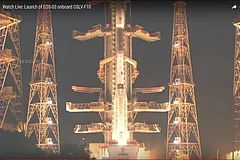
Rain and the pre-dawn timing did not keep people away. Members of the public turned up in good numbers, many carrying umbrellas, to watch and cheer the launch. The GSLV is a 3-stage, 51.7 metre vehicle with a cryogenic third stage and a lift-off mass of 420.5 tonne. The satellite was mounted inside the rocket’s nose cone.
The mission also carries weight because of past setbacks. GSLV-F17/EOS-05 is a replacement for the unsuccessful GSLV-F-10/EOS-03 mission of 2021, when an onboard computer aborted the flight at 307 seconds. ISRO later informed that an anomaly in the Cryogenic Upper Stage had caused that failure.
This success follows another setback this year. On January 12, ISRO’s PSLV-C62 rocket carrying 16 satellites failed to place them in the intended orbit after an anomaly in the critical third stage. PTI reported that Narayanan had also visited the Tirumala Tirupati Lord Venkateshwara Swamy temple days ago and prayed for the mission’s success.