Houthis tell the Trump administration that US ships will not be targeted in the Red Sea.
Houthis claim missile and drone attacks on Riyadh and a Saudi Aramco facility in Yanbu.
Trump faces domestic political pressure as the Iran war drives fuel-price concerns ahead of the midterms.
The Iran-backed Houthis have assured US President Donald Trump’s administration that they will not attack American vessels in the Red Sea, even as the group continues its military confrontation with Saudi Arabia and warns other countries against joining Riyadh in Yemen’s renewed civil war.
The assurance comes after the Houthis fired a ballistic missile towards Saudi Arabia’s capital over the weekend and claimed attacks on targets in Riyadh and the Saudi Aramco facility in Yanbu. The developments have drawn a clear distinction between the group’s approach towards American shipping and its continuing campaign against Saudi Arabia.
The developments come amid wider diplomatic activity in the region, with Iranian Foreign Minister Abbas Araghchi due to stop in Qatar before travelling to New York for the United Nations General Assembly.
Houthis assure US vessels will not be targeted
Mohamed al-Bukhaiti, a member of the Houthi political bureau, said the group had given Washington assurances over shipping through the Red Sea.
“We confirmed that we are not targeting the United States, or any other nation, in the strait, with the sole exception of the Saudi enemy,” al-Bukhaiti told The Associated Press in a Zoom interview from Sanaa. “That remains the case.”

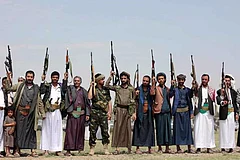


Reuters reported that US officials and Houthi representatives held talks in Oman with Omani assistance, with the Houthis assuring Washington that they would not attack US vessels.
The Houthis have expanded their control along Yemen’s western Red Sea coast, including areas near the Bab el-Mandeb Strait, which connects the Red Sea with the Gulf of Aden.
Al-Bukhaiti said the group did not intend to close the waterway.
“The goal of our military operations is not to close the Bab el-Mandeb Strait, but rather to ensure freedom of navigation through it for everyone, including Yemen,” he said.
He also warned countries against joining Saudi Arabia in the conflict.
“Today, Yemen is capable of waging battle - not merely an internal conflict, but an international one as well,” he said.
AP reported that Trump has acknowledged contacts with the Houthis, while the group has maintained that US vessels are not targets.
Riyadh hit by Houthi missile and drone attacks
The assurance to Washington has not stopped the Houthis from escalating their attacks on Saudi Arabia.
The Houthis claimed responsibility for missile and drone attacks on what they described as “sensitive” sites in Riyadh. They also said they targeted a Saudi Aramco facility in Yanbu, a major oil export centre on the Red Sea coast.
Saudi authorities said their air defences intercepted a ballistic missile fired towards Riyadh. Authorities issued warnings to residents before later announcing that the immediate threat had passed.
The attacks came amid renewed fighting involving Houthi forces and the Saudi-led coalition in Yemen.
The Houthis have blamed Saudi Arabia for military action against their positions, while Saudi authorities have described the Houthi attacks as a threat to the kingdom.
US-Houthi contacts continue amid Yemen fighting
The discussions between Washington and the Houthis come as the rebels have strengthened their position along Yemen’s Red Sea coast.
Their presence near the Bab el-Mandeb has added to concerns over shipping through the waterway. The waterway is a key route for vessels travelling between the Red Sea and the Gulf of Aden.
The Houthis have previously attacked commercial shipping in the Red Sea and have linked those attacks to the war in Gaza. Their latest position, however, distinguishes between American vessels and Saudi-linked targets.
Trump Faces Midterm Pressure As Iran War Drives Up Fuel Costs
The Houthi developments come as Trump faces growing political pressure over the wider Iran war ahead of the November midterm elections. Reuters reported in August that the Trump administration was seeking to ease pressure on US consumers from rising petrol prices linked to the Iran conflict, with the White House concerned about the economic impact ahead of the elections.
The political pressure has continued. A Reuters/Ipsos poll published on September 14 found Trump’s approval rating at 35%, while 44% of respondents backed Democrats and 37% Republicans on the generic congressional ballot. Reuters reported that disrupted oil supplies and higher fuel prices linked to the Iran war had hurt Republican support and weakened the party’s advantage on economic issues.
Trump has also said oil prices that surged because of the Iran war may not fall until after the midterms. AP reported that he made the comments as Brent crude rose above $100 a barrel.
Iran, Qatar and Egypt pursue wider diplomacy
The Yemen escalation is unfolding alongside diplomatic activity involving Iran, Qatar, Egypt and the United States.
Iranian Foreign Minister Abbas Araghchi is due to stop in Qatar before travelling to New York for the UN General Assembly. Qatar has maintained diplomatic channels with Iran and the United States and has previously been involved in regional mediation.
In Egypt, CIA Director John Ratcliffe met President Abdel Fattah el-Sissi as Cairo continued its diplomatic engagement over the regional crisis.
AP reported that el-Sissi backed efforts to resolve the Iranian crisis and supported freedom of navigation while rejecting attacks against Arab countries. Egypt has also remained involved in diplomatic efforts connected to Gaza.
The Houthis have continued their attacks on Saudi Arabia while maintaining that US vessels will remain outside their campaign.