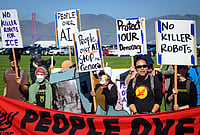
We need to move away from the traditional and inherited colonial way of dealing with student protests. Other protests can follow for examination. But student-protest response brooks no delay on how the governments of the day, rework, train, deploy and respond. I am proposing a graded, dialogue-first model of protest management where unarmed, youth-based civil-defence teams serve as the first responders, followed by civil police, and only in extreme cases, specialised riot control units. The aim is to stop the distraction, reduce conflict, prevent escalation and rebuild and maintain the trust between citizens and the State. The proposal seeks to ensure that management of the student demonstration in which policing is seen as protection, dialogue and service to democracy.
I write this with great pain. The recent confrontation between students and the police should never have become the defining image of a movement that began and developed as a demand for educational reforms. Somewhere along the way, the focus shifted. The conversation moved from examinations and reforms to confrontation and conflict. On several fronts. With the original cause remaining: education reforms as a whole with examinations being the focus.
For many of us who have spent our entire lives in the Indian Police Service, building trust between the police and the people has been a whole life’s work. Trust takes decades to build and moments to diminish. One incident can become a weight around our necks for ever.


I remain deeply aggrieved. But I refuse to give up. What if we fundamentally rethink how democratic societies respond to peaceful student protests? What if our first response is not one of confrontation but of engagement, empathy and protection? As is the case in most of the instances even though informally.
Could India create a graded architecture for protest management that preserves both order and dignity? My proposal is simple, but I believe it will be a break from the colonial past. The first line of engagement should not be the regular police. It could be a specially trained civil defence and youth peace corps drawn from our existing civil-defence framework, National Service Scheme volunteers and trained civic youth participants. Young men and women, representing the energy, idealism and conscience of India, could become the first visible face of the State during seemingly peaceful protests.
The civil defence be unarmed, carry no lathis, no instruments of coercion, nothing with which to strike back. But with body armour, helmets and even head-cameras.
This is a deliberate moral and constitutional design choice. A State that seeks trust must first ensure that its first responders are not agents of fear. They would be trained rigorously in dialogue, mediation, crowd psychology and conflict de-escalation. They would be supported by women officers and volunteers in leadership roles wherever appropriate, ensuring inclusivity, sensitivity and emotional intelligence in engagement. They be equipped with body-worn cameras and supported by modern technology to ensure transparency, accountability and protection for all sides. Their role would not be to control a crowd, but to communicate, reassure, facilitate and protect.
If protesting students encounter young people much like themselves—listening, speaking calmly, standing peacefully between them and the instruments of force—the psychology of confrontation changes fundamentally. The protest ceases to be an ‘us versus them’ situation and becomes a human interaction between citizens of the same republic.
Will students wish to attack those who resemble their own peers, who are there only to listen, to de-escalate and to ensure safety? If some individuals still choose violence despite every opportunity for peaceful engagement, technology will faithfully record the truth. Accountability will be clear and narratives of confusion, misinformation, or selective perception will lose ground.
The second line of protection would then be the civil police. Their role would not be to immediately enter confrontation but to remain visible as protectors of life, liberty and property. Their presence would act as a stabilising force, a reminder that the State stands behind order, but equally behind rights. The police, in this framework, are not adversaries of protest but guarantors of constitutional space.
Only when circumstances genuinely deteriorate and all dialogue mechanisms fail, should specially trained public order or riot control units be deployed. Even then, their deployment must be strictly governed by law, proportionality, necessity and clear operational protocols. Force must always remain the last resort, not the first image of the State. Force should become the last response—not the defining symbol of governance.
Many mature democracies have gradually moved towards dialogue-based policing, liaison systems and graded responses during protests. The most evolved systems increasingly recognise that communication is often more effective than coercion and that legitimacy is strengthened when citizens feel heard rather than controlled.
India need not imitate any nation. Our contribution to democratic policing can be uniquely Indian in character and philosophy. Youth handling youth. Dialogue before deterrence. Protection before force. Women leading from the front. Technology ensuring transparency.
Police not as aggressors, but as the final guardians of peace when all other democratic mechanisms have been exhausted. This is not a weakening of the State. It is a strengthening of its moral authority. My idea of India is one where a student returning home after a protest says, “The police protected my right to be heard.” Equally, it is one where a police officer returning home says, “Today, not a single child was hurt.” That would be a true victory for democracy and for policing.
The finest police force is not one that is feared. It is one whose greatest strength lies in the trust reposed in it by its people. That is my idea of India—where policing in a democracy thrives without becoming coercion and where order is maintained without losing humanity.
(Views expressed are personal)
Kiran Bedi IPS (Retd.), Former Lieutenant Governor, Puducherry

MORE FROM THIS ISSUE


(This story appeared in Outlook magazine’s August 31 issue, 'Whose Idea of India?', in which India’s noted public intellectuals, policymakers, cultural practitioners, political leaders, scholars and economists write in detail about the idea of India they believe can best secure the nation’s future as we celebrate 80 years of independence.)