Indian authorities have identified “Green Boots” as climber Dorje Morup
Morup died during a 1996 ITBP expedition on Everest's Northeast Ridge
India is preparing to recover his remains nearly 30 years later
For 30 years, Dorje Morup has helped climbers find their way up Everest, even after he could no longer make the journey himself.
Morup died on the world's highest mountain in 1996 while descending from a summit attempt with an Indo-Tibetan Border Police (ITBP) expedition. His remains stayed high on Everest's Northeast Ridge, where the distinctive green boots near the body eventually gave rise to the name “Green Boots”.
Over the years, the remains became more than a grim reminder of Everest's dangers. For climbers navigating one of the mountain's most unforgiving sections, the recognisable location became a point of reference on the route towards the summit.
Now, three decades after Morup's final climb, India is preparing to bring his remains down.
Indian authorities identify the remains as those of Morup and have issued a government tender for their recovery. If the operation succeeds, a climber who spent almost 30 years on the mountain could finally begin the journey home.
The identification also revisits one of Everest's enduring mysteries. For years, Green Boots was widely believed to be Tsewang Paljor, another member of the 1996 Indian expedition. But Paljor's body was never found, while a contemporary account records Morup being found dead near Camp 6.
The story of Green Boots, therefore, is not only about a body left on Everest. It is about how a climber who died trying to reach the summit continued, unknowingly, to guide others towards it — and may now finally be brought back down.



Who Was Dorje Morup?
Morup was part of the 1996 ITBP expedition to Everest's North Ridge, climbing from the Chinese side. The expedition was led by Commandant Mohinder Singh. PM Das, another member of the team, later documented the expedition and its final days in the Himalayan Journal.
Das's account provides an important chronology of what happened during the descent.
Japanese climbers encountered Morup alive between the First and Second Steps. He was later found dead near Camp 6.
Paljor disappeared during the same expedition, but his body was never located.
That distinction became significant decades later because the remains that came to be known as Green Boots were widely attributed to Paljor. The original expedition account, however, did not formally establish that identification.
Morup's remains remained on Everest, while his name gradually disappeared from the story surrounding them.

How Did He Become ‘Green Boots’?
The body became known as Green Boots because of the distinctive green mountaineering footwear visible near the remains.
Situated high on the Northeast Ridge, it became a recognisable reference point for climbers approaching Everest's summit. The location was familiar enough that the remains became part of the collective memory of the route.
The body was not necessarily visible throughout the entire period. Snow and ice movement have periodically concealed remains on Everest. But the Green Boots identity endured.
Behind the nickname was a climber who had once been part of a specific expedition, with colleagues, a recorded name and a journey of his own.
The mountain eventually turned that individual story into a landmark.
Why Has His Body Remained On Everest?
Recovering a body from Everest can be almost as dangerous as climbing to it.
Green Boots was located in the death zone, generally understood as the region above 8,000 metres where the human body cannot acclimatise indefinitely. Oxygen is severely limited, while cold, exhaustion and exposure make prolonged work increasingly dangerous.
A recovery team must first reach the remains and then move them through steep, technically difficult terrain while carrying additional weight. Snow and ice can also conceal or shift remains, while weather and the condition of the body can make an operation more complicated.
The result is that remains can stay on Everest for years or decades. The problem is not simply getting to the dead; it is getting them down without putting the living at comparable risk.
Nepal's Mountaineering in Nepal: Facts and Figures 2026 recorded 15 mountaineering deaths across expedition peaks in 2025, including two on Everest during the spring season. The same publication recorded 468 climbers for Sagarmatha (Everest) in its spring 2025 royalty data.
Those figures show the continuing traffic on a mountain where even reaching and recovering a known body can expose rescuers to considerable danger.

How Was Green Boots Identified?
Indian authorities now identify the remains as those of Dorje Morup.
According to AFP, Indian government documents show that an ITBP verification process in 2024 involved the collection of DNA samples. However, the laboratory report itself has not been publicly released.
The identification should therefore be distinguished from the underlying forensic evidence that has been made public. The remains are now formally identified by Indian authorities as Morup's, while AFP's reporting establishes that a DNA verification process took place based on government documents.
The historical record provides an important clue. Das documented Morup's body being found near Camp 6, while Paljor's body was never located.
For decades, the climber who helped others find their way along Everest's route was remembered by a nickname that may not have belonged to him.
Why Is India Recovering Him Now?
India has issued a government tender for the recovery of the remains, potentially allowing Morup to be brought down nearly 30 years after his death.
The operation could give his family the possibility of receiving his remains after decades in which he remained on Everest.
But the recovery itself is far from routine.
The team will have to reach the remains at extreme altitude, secure them and transport them down while limiting exposure to the death zone. Snow and ice cover, the condition of the remains and the terrain around the location will determine how difficult the operation becomes.
The task is therefore not simply to find Morup. It is to bring him down safely.
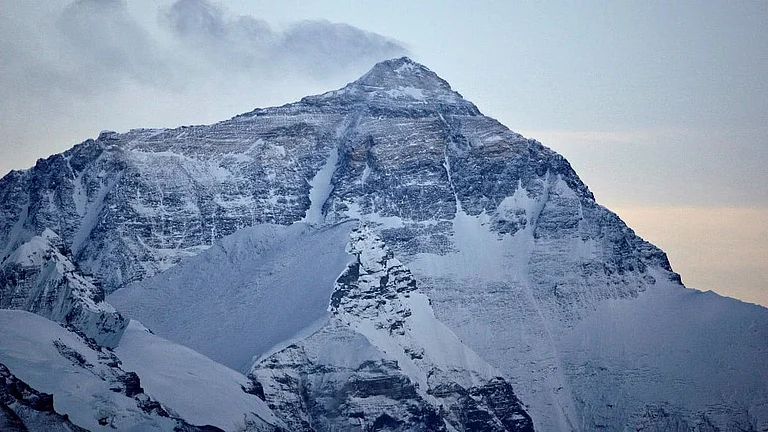
What Would The Recovery Mean For Everest?
Morup's story has acquired an unusual symmetry.
He went up Everest as a climber in 1996. After his death, his remains became a point of reference for others making the same journey. Now, 30 years later, India is preparing to reverse that direction — to bring him down.
Nepal's 2026 mountaineering regulations include provisions governing expedition waste and deposits, including an 8-kg garbage deposit requirement per climber and support staff at Base Camp.
Yet the mountain's highest reaches remain governed by the same physical limits that have kept bodies there for decades.
If the recovery succeeds, Green Boots would cease to be a landmark on the route.
But Morup's story would not end there. The climber who became a guide for others long after his own journey ended could finally make his own journey home.