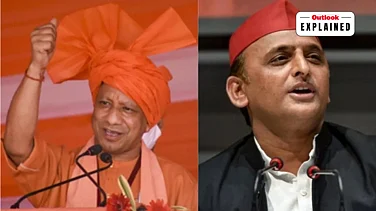
Yogi Adityanath invokes bulldozer politics while taking a swipe at Akhilesh Yadav.
Bulldozer demolitions spread beyond Uttar Pradesh, becoming a political symbol across states.
Supreme Court guidelines and continuing judicial scrutiny raise questions over punitive demolitions.
Uttar Pradesh Chief Minister Yogi Adityanath on Saturday invoked his government’s bulldozer politics while responding to a question about Samajwadi Party (SP) chief Akhilesh Yadav’s recent visit to Gorakhpur, saying that operating a bulldozer may be easy, but not everyone can handle its steering.
Speaking at an NDTV event in Varanasi, Adityanath said the task required the right resolve and determination to act, taking a swipe at the SP’s attempt to ride the bulldozer.
The chief minister also claimed that the BJP had won all seats in Gorakhpur in the 2017 and 2022 Assembly elections and the 2024 Lok Sabha polls, adding that the party and its allies would secure a similar mandate across Uttar Pradesh.
As Uttar Pradesh heads towards the Assembly elections in the first quarter of 2027, the Bharatiya Janata Party (BJP) is seeking a third consecutive term, with law and order remaining one of its central political claims over the past decade. However, the rise of “bulldozer justice” under Adityanath, once projected as a symbol of a tough administration, has increasingly drawn judicial scrutiny over its implications for the rule of law.



From ‘Bulldozer Baba’ To A Political Brand
During his first term, Adityanath registered cases against around 15,000 people under the Uttar Pradesh Gangsters and Anti-Social Activities (Prevention) Act. His government also claimed to have seized properties and demolished houses allegedly constructed illegally.
The measures were presented as a departure from the lawlessness associated with the previous Samajwadi Party government. They helped build Adityanath’s image as a tough-on-crime chief minister, earning him the moniker “Bulldozer Baba”.
The political messaging became explicit during the 2022 Assembly elections. Addressing a rally in Mainpuri in February, Adityanath warned that those who became aggressive would be silenced by bulldozers after the elections. The BJP returned to power, and demolitions followed soon after, including actions against properties of people accused of rape, allegedly to pressure them into surrendering.
The authorities maintained that the structures targeted were illegal. However, questions over whether demolitions were being used as punitive measures, particularly against accused persons and their families, continued to grow.

A Model Adopted Beyond Uttar Pradesh
The bulldozer soon became a political symbol beyond UP. Madhya Pradesh’s former chief minister Shivraj Singh Chouhan adopted the “Bulldozer Mama” image after communal clashes in Khargone in April 2022, when his government demolished 16 houses and 29 shops or other structures.
Other BJP-ruled states followed similar actions. In Haryana, demolitions took place after communal violence in Nuh in July 2023. In Delhi, the BJP-led North Delhi Municipal Corporation demolished several structures in Jahangirpuri after communal clashes in April 2022, including parts of a mosque.
Assam, under Himanta Biswa Sarma, also witnessed demolitions linked to allegations of arson. In Chhattarpur, Madhya Pradesh, authorities demolished the house of local leader Shahzad Ali in August 2024 after stone-pelting at a police station during a protest.
The practice was not confined to BJP governments. Rajasthan’s Ashok Gehlot government demolished a coaching institute linked to people accused in a paper leak case, while the Brihanmumbai Municipal Corporation, under the Maha Vikas Aghadi government, demolished part of actor Kangana Ranaut’s bungalow in 2020. The Bombay High Court later described the action as mala fide.

Supreme Court Draws A Line
The legal challenge to bulldozer justice reached a turning point in October 2024, when the Supreme Court, hearing petitions against demolitions, proposed pan-India guidelines.
“Can anybody’s house be demolished only because he is an accused?” the court asked, adding that even a convict’s property could not be demolished without following the procedure prescribed by law.
In its subsequent judgment in Re: Directions in the Matter of Demolition of Structures, the Supreme Court prohibited punitive demolitions and laid down safeguards to ensure due process. The central principle was clear: executive authorities cannot assume the judiciary’s role by imposing punishment through demolition.
Judicial Scrutiny Continues
The concerns have persisted in Uttar Pradesh. In February 2026, the Allahabad High Court expressed apprehension that properties of accused persons or their relatives continued to face demolition despite the Supreme Court’s directions.
Hearing a petition by a Hamirpur family, the court observed that demolition notices were often issued soon after an offence was reported, followed by the razing of structures after the “ostensible fulfilment” of statutory requirements.
The bench stressed that demolition as punishment violates the separation of powers, since the authority to punish rests with the judiciary. It framed questions on compliance with the Supreme Court judgment, the state’s duty to protect dwelling places, and whether an apprehension of demolition could itself give a citizen grounds to approach the court.
The Political And Democratic Question
A reportby Amnesty International in 2024, analysed 128 demolitions across Assam, Delhi, Gujarat, Madhya Pradesh and Uttar Pradesh following communal violence and protests in 2022. It said the actions affected at least 617 people and described punitive demolitions as forced eviction and collective punishment under international law.
In Prayagraj, the demolition of Javed Mohammed’s family home in June 2022, after his detention over alleged involvement in protests, became one of the most prominent examples cited by the organisation.
As the BJP seeks another term in Uttar Pradesh, bulldozer politics remains closely tied to its law-and-order narrative. Yet the Supreme Court’s intervention and continuing High Court scrutiny raise a fundamental question, can a government claim to uphold the rule of law while using executive demolition as a substitute for judicial punishment?