A series of incidents in Bihar and Uttar Pradesh in August brought renewed attention to food quality and irregularities in school meals.
Delayed funds, uneven implementation and gaps in monitoring can affect how the scheme is delivered across states.
Experts say the programme must look beyond meals served to assess nutrition, dignity and what children actually receive on their plates.
In August, around 34 schoolchildren in Bihar's Nalanda district were rushed to hospital after eating detergent powder, mixed into their mid-day meal at a government school in Noorsarai block. The 17 boys and 17 girls, who complained of burning throats and stomach pain, were taken to a district hospital, where officials later said they were "out of danger."
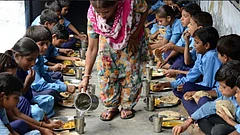
Around the same time, in Arwal district, students across 75 schools looked down at their plates and found worms in the soybean curry and rice. They lined up and threw their lunches into the dustbins, while videos of the incident circulated on social media.
Toward the end of the month, a separate case surfaced in Uttar Pradesh's Ballia district, where students of Classes VI to VIII said they had not been served a mid-day meal for nearly two years.
According to a media report, they wrote to the District Magistrate, prompting an inquiry that found falsified records showing that meals were being served to 200 students daily. The inquiry also flagged alleged misappropriation of nearly ₹14 lakh, including underpayment of cooks and misuse of funds under the Pradhan Mantri Poshan Shakti Nirman (PM POSHAN) scheme.


The National Human Rights Commission has taken suo motu cognisance of the report and issued a notice to the Uttar Pradesh Chief Secretary, seeking a detailed response within two weeks.
A fourth incident, involved a video from a government primary school in UP's Sitapur, that circulated on social media showing heavily diluted potato curry served alongside visibly burnt rotis. A second clip showed rotis being tossed onto students' plates rather than being served by hand, drawing criticism over food-handling practices.
These incidents, reported from different states and involving different aspects of the mid-day meal, brought the focus back to how the scheme is implemented on the ground. A government school teacher, who spoke on the condition of anonymity, said the challenges around mid-day meals often begin with the availability of funds and basic ingredients.
“We are expected to provide the prescribed meal to the children, but there are several practical difficulties at the school level. When funds are delayed or the available resources are insufficient, arranging the required ingredients and preparing the meal on time becomes difficult. At times, teachers and school staff also have to step in to ensure that the meal is served," the teacher added.

When The Money Doesn't Reach the Kitchen
Separately, in Punjab's Jalandhar district, the Mid-Day Meal Society issued tightened compliance directives, instructing schools to strictly follow the prescribed menu and holding school heads responsible for deviations. This came even as cooking-cost funds for nearly 1,435 government primary and middle schools in the district had reportedly been pending since April, according to a report by The Tribune.
Under the scheme, the government allocates ₹6.78 per child for primary classes and ₹10.17 for middle classes towards cooking costs. With the funds delayed, mid-day meal workers said school staff had been using their personal funds to procure rations such as pulses, cooking oil, spices, milk, curd and fruit.
“The Centre sets national norms, but states operate with very different fiscal resources, procurement systems and administrative effectiveness. Some add resources and diversify menus; others operate close to the minimum. Some variation is healthy, but when a child’s dietary intake depends on the fiscal health of the state in which she lives, a national programme begins producing unequal outcomes,” Vikas Singh, Senior Economist and Professor at IIM Nagpur.
Dr Aruna Sharma, a practitioner development economist and former Indian government secretary, said the scheme's objective "is not to provide a budget but one hot, nutritious meal in school."
"If the intention is to design a nutritious menu based on local preferences, then decisions will definitely align with it. Local ownership of the programme is a must and should not be looked at as just a scheme. That is the crux of the same and it is possible to provide within budget rather than centralising it as a business,” Sharma added.
Notably, the Centre increased the material cost under PM POSHAN by 9.5% from May 2025, taking the allocation to ₹6.78 per child per school day for Bal Vatika and primary classes and ₹10.17 for upper-primary classes. The scheme, whose current five-year approval runs through 2025-26, has also been temporarily continued beyond March 2026, until September 30, 2026.
Singh said the initiative's central weakness is the gap between administrative reporting and physical reality. He added that local prices can move faster than national averages. “The real threat is rarely total collapse; it is silent dilution. The meal stays on the ledger while deteriorating on the plate."
The allocation, commonly called the cooking cost, covers pulses, vegetables, cooking oil and condiments, while foodgrains are provided separately. The material cost is shared between the Centre and states at 90:10 for the North-Eastern states, the two Himalayan states and J&K; 100% for Union Territories (UTs) without a legislature; and 60:40 for other states, Delhi and Puducherry.
At the implementation level, reviews by the Programme Approval Board have identified corrective measures across states, including social audits, health check-ups, nutrition gardens in schools and monitoring of various indicators. The reviews have also continued to emphasise community monitoring and social audits.
The programme has established monitoring systems at the block, district, state and national levels, along with community-based monitoring mechanisms and social audits. Its guidelines also provide for social audit findings and action-taken reports to feed into programme planning and review.
“The key challenge is not the absence of monitoring structures but timely verification and corrective action. In many schools, meal testing and social audits are missed, while follow-ups and retesting are often inadequate. In reality, coordination and timely release of funds remain issues,” said Shyamal Santra, Practice Director, Transform Rural India.

When The Meal Shapes School Choice
The mid-day meal has also figured in discussions around school enrolment and attendance across different parts of the country. In some areas, enrollment increased after the scheme was introduced, while in others, changes to the menu have been accompanied by reports of children dropping out or parents choosing not to send them to school. These reports have included decisions to remove or restrict items such as eggs and non-vegetarian food.
For some children and families, the issue goes beyond whether a meal is available. It is also about what is served, whether it is acceptable to them and how they experience receiving it at school. Alka Kapur, Principal, Modern Public School, Shalimar Bagh told Outlook that dignity is an important but often overlooked dimension of a school meal.
"A meal provided to students is about more than just food. It needs to be nutritious, safe and served with respect. Factors such as food quality, cleanliness, seating arrangements, as well as food processing, should be duly considered. It's worth carrying out the programme evaluation from the viewpoint of the child, as nutrition and education are closely intertwined,” Kapur added.
According to the Unified District Information System for Education Plus (UDISE+) 2025-26 report, total school enrollment across the country was 24.72 crore, compared with 24.69 crore in 2024-25. However, the distribution of enrollment across school management categories has changed. While recognised private unaided schools have gained students, government schools have experienced a decline in enrolment.
Experts cautioned that changes in enrollment cannot be attributed to the mid-day meal alone. Migration, demographic changes and movement towards private schools can all influence enrolment, while changes in the way schools record and report student numbers may also contribute to fluctuations.
“Multiple factors can influence changes in school choice, including demographic changes, local access to schools, household preferences and quality of education. In terms of PM POSHAN, changes in government school enrolment directly affect the number and profile of children reached under the school nutrition programme,” said Santra.

From Meals Served To Nutrition Delivered
The question of enrollment also brings the focus back to what the mid-day meal is expected to achieve beyond providing food. PM POSHAN was designed not only to address hunger and improve nutrition but also to support school attendance and participation. That makes the quality and regularity of the meal relevant not just to what children eat at school, but to their experience of the school itself.
The programme's material-cost allocation is indexed to the Consumer Price Index for Rural Labourers. Singh said that while indexation is preferable to arbitrary budgeting, a national price index may not capture the economics of an individual school kitchen, where ingredients are often bought locally and in small quantities. Prices of pulses, vegetables and cooking fuel can vary from one place to another.
“When budgets are squeezed, nutrition does not vanish overnight; it disappears ingredient by ingredient, less dal, fewer vegetables, less oil and less variety,” Singh said. “The real test is not whether the budget increased, but whether its purchasing power can still buy the promised menu.”
The same question extends to how the programme is assessed. PM POSHAN has mechanisms for monitoring the delivery of meals, including reporting, inspections, social audits and community participation. But recording that a meal was served does not necessarily establish what was served, how it was prepared or what nutritional value it provided.
Singh said the focus of the programme should move beyond counting meals towards measuring nutrition. “India should move from counting meals to measuring nutrition. What gets measured today is delivery; what matters tomorrow is whether children are better nourished,” he said.
Santra said the programme should not be viewed simply as a food-delivery system. It sits at the intersection of nutrition, education, attendance and local governance, with its guidelines providing for social audits, community participation, monitoring institutions, school-level reporting and corrective action.
“A school reporting that a meal was served is not, by itself, evidence of nutritional quality or community satisfaction,” Santra said. “The system needs to ask whether the meal was served regularly, safely and in accordance with prescribed nutritional norms, and whether children are actually benefiting from it.”
The August incidents brought each of these questions into view in different ways. In some schools, the concern was what children found in their food. In others, it was whether there was enough money to buy the ingredients, whether the meal was being monitored or whether it was being served at all.