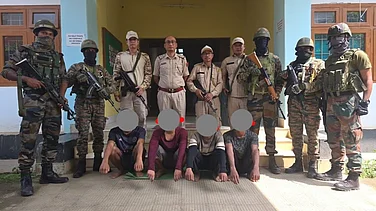
NCB brings alleged drug kingpin Virender Singh Basoya back from UAE.
Basoya is accused of masterminding an international drug syndicate.
Centre intensifies crackdown on overseas narcotics networks.
Union Home Minister Amit Shah on Friday said the Narcotics Control Bureau (NCB) has secured the return of fugitive drug kingpin Virender Singh Basoya from the UAE, marking a fresh development in the Centre's crackdown on international drug trafficking networks.
Shah said the government was relentlessly pursuing drug traffickers hiding abroad and working to dismantle their networks.
“Modi govt is relentlessly tracking down drug traffickers hiding abroad and destroying their entire ecosystem with a ruthless approach,” Shah said in a post on X.
He said the NCB's action against Basoya marked a “new milestone” in the government's zero-tolerance policy towards narcotics.
“By tracing the criminal through a top-to-bottom and bottom-to-top approach, our agencies have once again proven that no matter where drug traffickers hide, they cannot escape the long arm of Indian law,” he said.
Who Is Virender Basoya?
Virender Basoya is accused of being the mastermind of an international drug syndicate. His name had earlier emerged during the Delhi Police investigation into a Rs 5,000-crore drug racket.
As Outlook India reported in 2024, a Look Out Circular (LOC) had been issued against Basoya, a suspected Indian-origin businessman based in Dubai. He was suspected of running the drug cartel with the help of Tushar Goyal and Jitender Gill alias Jassi, both of whom had been arrested by the Delhi Police.



Basoya, a resident of Sarojini Nagar in South Delhi, was believed to be staying in Dubai.
His name had also surfaced in connection with a drug seizure in Pune, where police had seized 'Meow Meow' drugs worth around Rs 3,000 crore.
What Was The Delhi Drug Racket?
The investigation involving Basoya followed a major drug seizure in Delhi on October 2. Police claimed to have recovered more than 560 kilograms of cocaine and 40 kilograms of hydroponic marijuana from a godown in Mahipalpur in south Delhi.
The seized drugs were estimated to be worth around Rs 5,620 crore.
A case was registered under relevant sections of the Narcotic Drugs and Psychotropic Substances (NDPS) Act, with investigators looking into the wider network behind the seizure.

Centre's Three-Year Plan Against Drugs
Basoya's return comes as the Centre is pursuing a wider three-year plan to dismantle drug trafficking networks.
In June this year, Shah unveiled the government's Vision Document on Drug Control (2026-2029) and the Narcotics Control Bureau Annual Report-2025. The documents were released alongside a three-year national plan focused on dismantling the narcotics ecosystem.
Shah said the Centre would target the entire narcotics ecosystem with such force that it “will not be able to recover for decades”.
More than 40 ministries and departments are part of the plan, which seeks to tackle drug trafficking through coordinated efforts in enforcement, intelligence, prevention and rehabilitation, Hindustan Times reported earlier.

The Centre is also examining gaps in the NDPS Act. The government is reviewing the classification of precursor chemicals and psychotropic substances that can be used in the manufacture of illegal drugs.
The return of Basoya from the UAE is therefore being presented by the Centre as part of its wider effort to track down drug traffickers operating from abroad and dismantle the networks behind the illegal drug trade.
NDPS Act
The Narcotic Drugs and Psychotropic Substances (NDPS) Act, 1985, prohibits activities related to narcotic drugs and psychotropic substances, including their production, cultivation, sale, purchase, transportation, storage and consumption.
The law aims to prevent, combat and regulate activities involving such substances, besides providing for the forfeiture of property derived from or used in illicit drug trafficking. It also seeks to give effect to India’s obligations under international conventions on narcotic drugs and psychotropic substances and allows changes to the list of psychotropic substances covered under the Act.
Under the law, “narcotic drug” includes coca leaf, cannabis (hemp), opium, poppy straw and manufactured drugs. A “psychotropic substance” refers to any natural or synthetic substance, natural material, salt or preparation included in the list specified in the Schedule to the Act.