



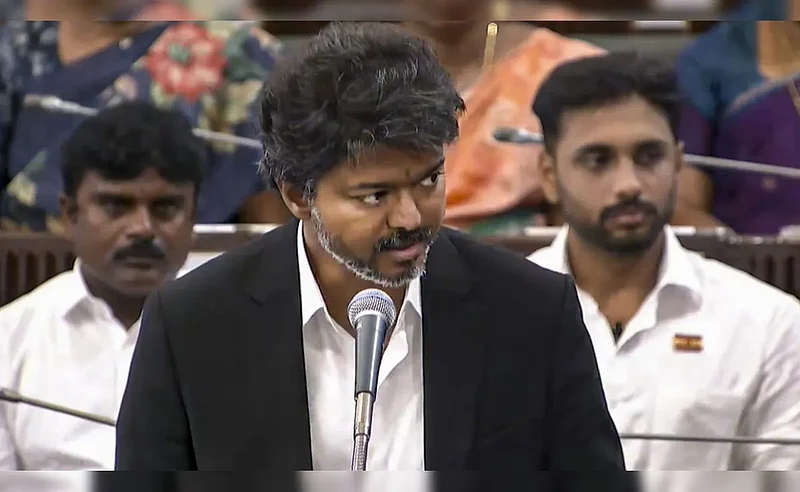
State Health Minister KG Arunraj moved the resolution in the Chennai assembly under the TVK-led government of Chief Minister C Joseph Vijay.
The resolution was supported by the ruling TVK, Congress, DMK, and AIADMK, while the lone BJP MLA staged a walkout.
The Tamil Nadu government proposed that state medical admissions should be determined by Class 12 examination marks instead of a single-day test.
The Tamil Nadu legislative assembly on Tuesday passed a resolution urging the Centre to abolish the National Eligibility-cum-Entrance Test (NEET). State Health Minister KG Arunraj moved the resolution under the TVK-led government of Chief Minister C Joseph Vijay.
The ruling TVK, its allies, including the Congress, the main opposition DMK, and the AIADMK, supported the anti-NEET resolution. The lone BJP MLA staged a walkout.
The resolution comes amid a paper leak row that led to BJP leader Dharmendra Pradhan's resignation as Union education minister last month. The resignation followed protests led by the Cockroach Janta Party.
Impact on Students
Arunraj argued that the test gravely undermines medical education opportunities of rural and socio-economically disadvantaged students. “This test gravely undermines medical education opportunities of rural, socio-economically disadvantaged students,” Arunraj said. He noted that Tamil Nadu under successive governments has consistently emphasised that “NEET is against social justice, equality, and rights of states”.


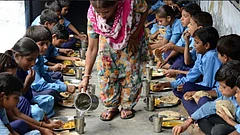

Arunraj also said the test has led to the “proliferation of coaching centres that charge exorbitant fees”. “NEET has diverted focus of students from school curriculum to coaching alone,” Arunraj said.
Vijay wants school board results to decide medical admissions. His administration proposed using Class 12 marks for selection, matching the stance of the previous DMK government.
The resolution points out that the Tamil Nadu assembly unanimously passed Bill No 43 of 2021 to exempt the state from the test. However, the bill remains pending without presidential approval.
The resolution states that a single-day entrance examination after 12 years of schooling has become the deciding factor for higher education. Citing continuous question paper leaks and irregularities, it notes that NEET-UG was cancelled and re-conducted. This caused immense distress to eligible students and eroded their trust in the examination system. The resolution also refers to student suicides linked to examination-related distress and concludes that the system must be abolished.
Call for Reform
The resolution demands central action. It asks the Union government led by PM Narendra Modi to scrap NEET nationwide by rewriting key legislation. This change requires amending the National Medical Commission Act, 2019, the National Commission for Indian System of Medicine Act, 2020 and the National Commission for Homoeopathy Act, 2020.
Following paper-leak controversies, Karnataka, led by the Congress, and West Bengal, governed by Mamata Banerjee's TMC, passed resolutions to completely scrap the exam.
Kerala, under the CPI(M)-led LDF and Congress-led UDF, has successively been against NEET. Legal challenges also came from Andhra Pradesh and Telangana.
Evolution of Admissions
The government first proposed NEET in 2013. It aimed to consolidate a fractured selection process where the All India Pre-Medical Test filled a 15% national quota and states ran separate exams for the remaining 85% of seats.
Top institutions like AIIMS managed separate entry tests. Private colleges also organized individual assessments. Fierce court disputes over NEET ended in 2017, making the exam compulsory across the country. The system absorbed elite colleges by 2020, cementing NEET as the sole gateway for Indian medical aspirants.
States argue that a centralised exam violates India's idea of federalism. They contend it strips their right to manage local healthcare needs.















