



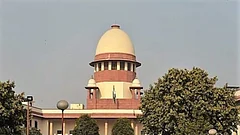
A Supreme Court bench led by Chief Justice Surya Kant issued a notice to the Bar Council of India, restraining all state bar councils from taking punitive action against NALSAR University of Law students.
Chief Justice Surya Kant strongly defended the students, stating that they have a fundamental right to protest peacefully and the regulatory body has no business interfering in internal university matters.
The legal row erupted after seventy NALSAR graduates objected to Chief Justice Surya Kant attending their convocation as chief guest due to his previous oral remarks on student protests.
A Supreme Court bench led by Chief Justice of India Surya Kant issued a notice to the Bar Council of India (BCI) on Friday. The bench restrained all state bar councils from taking punitive or criminal action against students or faculty of NALSAR University of Law or any other university. The apex court directed the regulatory body to immediately halt its intervention into the student protests.
Kant said: "The BCI is unnecessarily taking action in this matter. If students have a cause or a reason to protest, they have a right to protest. Nobody can stop them, and we will not allow this."
The bench, which included Justices Joymalya Bagchi and V Mohana, directed the BCI to file a counter-affidavit within two weeks. This judicial intervention followed a rapid policy reversal by the legal regulatory body. Just hours before the court hearing, BCI Chairman Manan Kumar Mishra said the council decided to close all proceedings against the NALSAR 2026 graduating batch.
Court Rebukes Bar Council
Senior advocate K Parameshwar said the BCI overstepped its mandate by policing internal university matters. He said the actions of the regulatory body directly violated the fundamental right to freedom of speech and expression of the students.


Kant told Parameshwar: "We are with you. This is absolutely uncalled for. They had no business to interfere."
The Chief Justice shared his personal reflections on campus dissent to underline the importance of democratic expression in educational institutions. Kant said: "In my younger days, I was also actively involved in student activities...So long as they are lawfully and peacefully protesting, they have a right to raise their voice."
At another point, Kant said: "We have to be large-hearted. They should be allowed to speak. Even if they are wrong, they have a right to speak."
The legitimacy of the directives of the regulatory body faced heavy scrutiny during the proceedings. Parameshwar said a BCI member from Kerala said no council meeting actually took place to authorise the punitive actions. Consequently, Bagchi questioned BCI advocate Radhika Gautam on whether the council actually convened to pass the resolution.
Concluding the arguments, Kant urged NALSAR students to complete their registration processes without fear. He instructed Parameshwar to advise the graduates to enrol immediately and join the Supreme Court Bar Association (SCBA).
Genesis of the Dispute
The controversy started on July 23, 2026, when 70 NALSAR LLB graduates objected to Kant attending their convocation as chief guest. This representation was a direct reaction to oral remarks made by the Chief Justice on July 22 concerning student protests in Delhi.
Kant had dismissed an offer to watch video evidence of alleged police excesses by stating, "Don't waste our time, and don't waste your time," and adding, "We are not interested in videos; we don't have time to watch," as per news reports.
In response to the student campaign, the BCI executed multiple rapid policy shifts. The council initially froze all NALSAR 2026 enrolments on Thursday. It subsequently modified the order to target only the alleged "instigators" before fully closing the proceedings on Friday morning.
The university administration pushed back against the regulatory overreach. NALSAR Vice-Chancellor Srikrishna Deva Rao said the university would examine if the BCI's inquiry demand fell within its constitutional powers under local governance regulations.
Announcing the final retreat on Friday, Mishra advised graduates to maintain discipline. Mishra said: "Voice your opinions freely, but with respect and institutional decorum. The highest judicial office is our collective pride."















