



India’s first bullet train could begin passenger services between Surat and Bilimora by August 2027.
Trials on the 50-km section are expected to begin in April-May 2027, with the indigenous B28 trainset.
The Surat-Bilimora journey will take around 10 minutes, compared with 50 minutes on the fastest existing train.
India's first bullet train is expected to begin passenger services on a 50-km stretch between Surat and Bilimora by August 2027, with trials slated to begin in April-May, at the start of the next financial year, officials familiar with the development told Outlook.
The construction of the Mumbai-Ahmedabad High Speed Rail (MAHSR) project is progressing, with the government aiming to inaugurate the two-station elevated section around Independence Day in 2027, an official from the Railway Ministry said.
“Currently, the fastest train takes about 50 minutes to travel between Surat and Bilimora. But the bullet train will cover the distance in about 10 minutes,” the official told Outlook.


The official described the bullet train project as "very complex and technology-intensive", adding that exact timelines for passenger services can be determined only after the completion of civil structures, track, electrical systems, signalling, telecommunications and the supply of trainsets.
Before any new railway line or train service is opened for public operations, it must receive statutory safety clearance from the Commissioner of Railway Safety (CRS), which functions under the Ministry of Civil Aviation.


Out of the 12 stations in the project, eight are in Gujarat: Sabarmati, Amdavad, Anand-Nadiad, Vadodara, Bharuch, Surat, Bilimora and Vapi. So far, the Ministry has maintained that the entire section in Gujarat between Sabarmati in Ahmedabad and Vapi will be completed by December 2027, coinciding with the assembly election in the state.
The connection to the remaining four stations in Maharashtra – Boisar, Virar, Thane, BKC (Mumbai) – was expected by December 2029, coinciding with the scheduled assembly election in the state.
The foundation stone of the project was laid in September 2017, with December 2023 set as the original completion deadline. However, the project has faced delays caused by land acquisition, the lack of progress in Maharashtra and the Covid years.
The bullet train corridor spans 508 km, of which 348 km is in Gujarat, 156 km in Maharashtra and the remaining four km in the Union Territory of Dadra and Nagar Haveli. The Mumbai-Ahmedabad journey is expected to take around two hours, compared with approximately eight hours by existing trains.
Last week, the project achieved a milestone with the installation of the Overhead Equipment (OHE) system on the Surat-Bilimora section, the National High Speed Rail Corporation Limited (NHSRCL), which is building the corridor, said.
“Energisation will be carried out progressively in smaller sections, under the close supervision of the technical teams to ensure safety and compliance with prescribed procedures,” the NHSRCL said.
The corridor is equipped with an advanced 2 × 25 kV Overhead Traction System, one of the most “sophisticated electrification technologies used for high-speed rail systems worldwide,” the agency said.


Made-in-India Train
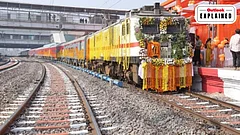
The trials have been scheduled keeping in mind the production of the trainset, the official said. Manufacturing of rolling stock for the first Made-in-India B28 train is underway at the BEML facility in Bengaluru, Karnataka. The train is being designed to operate at speeds of up to 280 kmph, while its operational speed is expected to be around 250 kmph.
“The signalling-related work is expected to be finished by the end of January 2027. The train is expected to be ready by April and after that the trials can be started,” they added.
The over 200 metre long train will have eight coaches: four motor cars and four trailer cars, with a capacity of around 560 passengers. There will be seven standard-class cars with 3×2 seating and one executive-class car with 2×2 seating.
Initially, India was expected to use Japanese Shinkansen E5-series trainsets, which currently operate in Japan at speeds of up to 320 kmph. But now the project is opting for the indigenous B28 train as Japan will provide its next-generation E10 series Shinkansen trains only in the 2030s. The E10 is still under development and will be introduced simultaneously in India and Japan.








