



Prime Ministers Narendra Modi and Balendra Shah virtually flagged off the Saryu-Kamala Express, linking Ayodhya with Janakpur in Nepal.
The weekly train will cover 604 km in about 19 hours, with regular service scheduled to begin on November 28.
The route connects two cities associated with the Ramayana: Ayodhya, linked to Lord Ram, and Janakpur, revered as Sita’s birthplace.
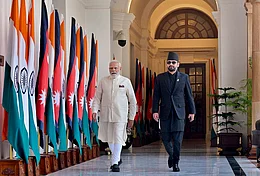
The Saryu-Kamala Express will turn a celebrated Ramayana connection into a direct rail journey. Prime Minister Narendra Modi and his Nepalese counterpart Balendra Shah virtually flagged off the train on Monday, linking Ayodhya, associated with Lord Ram, and Janakpur, revered as Sita’s birthplace.
The weekly service will cover 604 km in about 19 hours, with regular operations scheduled to begin on November 28.
The launch gives a practical dimension to the two countries’ shared religious heritage. It is also part of a broader push to improve movement across the India-Nepal border through rail, road and border infrastructure.

Route, Journey Time And Schedule
The train will run between Ayodhya Cantt in Uttar Pradesh and Janakpur Dham in Nepal. It will depart Ayodhya Cantt every Monday at 5.50 pm and reach Janakpur Dham at 12.40 pm on Tuesday, Nepal time. On the return journey, it will leave Janakpur at 1.10 pm on Saturday, Nepal time, and arrive in Ayodhya at 8.10 am on Sunday.



The route includes stops at Mankapur, Basti, Gorakhpur, Narkatiaganj, Raxaul, Sitamarhi, Shisho, Madhubani and Jaynagar. The stations connect parts of Uttar Pradesh and Bihar with Nepal and are expected to serve pilgrims, families and other cross-border travellers.
The 17-coach train will have eight air-conditioned coaches, seven sleeper coaches, one luggage and accessible coach, and a power car. The AC section includes AC 2-tier, AC 3-tier and AC 3-tier Economy coaches.
Ayodhya And Janakpur In The Ramayana Tradition
Ayodhya is traditionally regarded as the birthplace of Lord Ram. Janakpur, in Nepal’s Madhesh province, is revered as the birthplace of Sita, or Janaki. Their association through the Ramayana—and the account of their marriage—has shaped religious and cultural ties between the two regions.
The connection comes alive each year during Vivaha Panchami, which commemorates the wedding of Ram and Sita. Janakpur hosts ceremonies at the Ram-Janaki Vivah Mandap, while Ayodhya observes the occasion with rituals and traditional songs.
Uttar Pradesh Chief Minister Yogi Adityanath described the train as a revival of the bond between Ayodhya and Mithila. “The sacred and mythological confluence of two cultures, Ayodhya and Mithila, is being revived today in the form of the Saryu Kamala Express connecting Ayodhya Dham with Janakpur Dham,” he said.
Adityanath said the train would allow Nepali devotees to visit Ram Lalla in Ayodhya and Indian pilgrims to travel to Janakpur to seek blessings at sites associated with Sita. He described India-Nepal ties as rooted in shared faith, rivers and families, a relationship often referred to as “roti-beti”.
“During Vivaha Panchami, as festivities unfold at the Ram-Janaki Vivah Mandapam in Janakpur, traditional wedding songs, known as ‘mangala geet’, resound in Ayodhya,” Adityanath said. He added that people in Ayodhya regard Janakpur as the home of their relatives, while people in Mithila refer to Ram as “Pahun”, or son-in-law.
Janakpur’s Significance For Nepali Pilgrims
Janakpur is one of Nepal’s important centres of devotion to Sita. Its temples and sites associated with the Ramayana draw worshippers throughout the year, with Vivaha Panchami bringing particular attention to the city. The direct train will offer Nepali pilgrims a rail connection to Ayodhya and Indian devotees a more convenient route to Janakpur.
Modi said the service would make it easier for people visiting Ayodhya to continue their pilgrimage to Janakpur. “With the Saryu-Kamala Express train service launched today, we are giving a new dimension to this sacred relationship. It will make it easier for devotees visiting Ayodhya to travel to Janakpur and seek the blessings of Mata Sita,” he said.
The religious links between the countries extend beyond the Ramayana. Modi said India and Nepal would work to improve connectivity between Buddhist and Shiva-Shakti pilgrimage sites, including Lumbini and Bodh Gaya.
Yogi Adityanath also cited the Buddhist heritage shared by the two countries. The Buddha was born in Lumbini in Nepal, while important sites associated with his life and teachings include Piprahwa, Shravasti, Sarnath and Kushinagar in Uttar Pradesh.

A Railway Link Within A Wider Diplomatic Push
The launch took place during Shah’s visit to India and alongside announcements on other cross-border infrastructure. PM Modi said the two countries had inaugurated a road bridge connecting Dharchula in Uttarakhand with Nepal and laid the foundation stone for an Integrated Check Post at Banbasa. Work on the Dodhara Chandani Integrated Check Post on the Nepal side is also expected to advance.
India and Nepal plan to improve road, rail and border links connecting Nepal with Bihar, Uttar Pradesh and other Indian states. Modi also said India would provide Nepal access to the ports of Kandla and Paradip to support its transit trade.
The Saryu-Kamala Express adds to existing cross-border rail projects, including the Jaynagar-Bijalpura-Bardibas and Jogbani-Biratnagar links. The proposed Raxaul-Kathmandu railway is another part of the broader connectivity plan.
Modi has repeatedly used shared heritage to describe the relationship between the two countries. Recalling his 2018 visit to Janakpur, he said: “Without Nepal, our dhams are incomplete; without Nepal, our Ram is also incomplete.”
He also pointed to cultural and youth exchanges as part of that engagement. “Today, the story of the Ramayana is reaching the new generation and the entire world through films and modern technology. We want young creators from India and Nepal to come together and present our shared heritage to the world through new media,” he said.








