Sep 27: Nearly 30 students and two faculty members injured at Kolkata’s Satyajit Ray Film and television Institute as an RSS-affiliated group clash with students
*Aug 21: Midnapore College; ABVP and Students’ Federation of India (SFI) supporters clash; around 25 students were reportedly injured.
Presidency University; ABVP and SFI-linked students have a physical confrontation outside the campus.
*Aug 20: Jadavpur University; the ABVP clash with Left student groups; several students were injured.
Student politics in West Bengal has never followed the Gandhian script. But the frequency of recent clashes has made even the cynical observer of politics sit up and take note.
For decades, Bengal’s campuses were shaped first by the Left and, later, by the TMCP. The ABVP, the student organisation aligned with the Rashtriya Swayamsevak Sangh (RSS), remained a relatively marginal presence in much of the state. That is changing rapidly. However, post-2026 Assembly election, with the Bharatiya Janata Party (BJP) winning a thumping majority, the ABVP has been muscling into campuses. The troubling part of the ABVP’s rise has been the speed with which organisational competition has spilled into physical confrontation. The clearest example is Jadavpur University (JU).
On August 19–20, a dispute surrounding a general body meeting of the Faculty of Engineering and Technology Students’ Union developed into a prolonged confrontation between the ABVP and Left-leaning student groups. Several students were injured and some were hospitalised. Both sides accused the other of bringing outsiders into the campus.


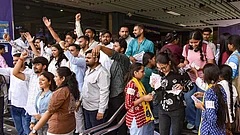
The ABVP’S objective is to displace the organisations that currently control or influence campus space in the state.
The significance of JU goes beyond the injuries. The campus is one of Bengal’s most important symbols of independent and Left-influenced student politics. To establish itself there, the ABVP has to do more than recruit members. It has to demonstrate that it can organise, mobilise and withstand opposition. That is precisely why JU has become a battleground.
The confrontation has not been restricted to Kolkata. At Midnapore College, around 25 students were injured in a Students’ Federation of India (SFI)-ABVP clash in August. The SFI had been holding a meeting to protest violence at JU when alleged ABVP activists arrived. SFI supporters alleged that they were attacked with sticks and iron rods. The ABVP gave the opposite account. The clash therefore illustrates a recurring pattern in Bengal’s new campus politics: each organisation presents itself as the victim and the other as the aggressor. But the political consequence is already clear: the space in which the ABVP is expanding is becoming increasingly contested.
Even the most routine part of student life—college admission—has become politically charged. At North Bengal Medical College and Hospital in September, tensions broke out during the first-year admission process around a help desk run by the All India Democratic Students’ Organisation (AIDSO). The outfit alleged that ABVP members attacked interns and doctors at the help desk. The ABVP denied the allegations.
The dispute matters because the help desk itself is part of the new organisational strategy. Whoever helps a first-year student navigate admissions, accommodation, forms or university procedures gets an early opportunity to build a relationship with that student. In Bengal’s emerging campus contest, service, visibility and political recruitment are increasingly intertwined.
Saffron Spread
The ABVP is ramping up its presence across campuses in the state. In July, its state secretary Nilkantha Bhattacharya said that the organisation’s current membership had crossed two lakh. Its immediate ambition is much larger: 10 lakh members across Bengal. The scale of the claimed expansion is striking, although it is important to note that these are ABVP’s own organisational figures and have not been independently audited.
ABVP leaders said the organisation had units or a presence in only 96 colleges before the Assembly election. Within weeks of the BJP’s victory, they claimed that this had risen to more than 400 institutions, even before the formal membership campaign began.
The organisation has traditionally been strong in North Bengal and in districts such as Purulia and Bankura. Its next target is the more politically symbolic territory of Kolkata and its suburbs, including institutions where the Left has historically had a powerful ideological presence.
The ambition is particularly visible at Jadavpur and Presidency universities, campuses that ABVP leaders describe as strongholds of the radical Left.
“We want to strengthen the organisation’s foundation in every college and university across the state. However, we will place special emphasis on campuses like Jadavpur and Presidency,” says Bhattacharya.
Another ABVP leader Sukanta Mahapatra has described the target in even broader terms: organisational activity in hundred per cent of Bengal’s colleges and universities.
There is a simple political calculation behind this. Student union elections have been largely absent from Bengal’s higher education institutions for years. ABVP leaders believe that when elections eventually return, a ready-made organisation with thousands of members, campus units and trained workers could turn its present visibility into elected positions.
The organisation says that it wants elections to be held according to the recommendations of the Lyngdoh Commission. “We want them to be held in Bengal so that leadership can emerge from classrooms and campuses and contribute to society,” ABVP national general secretary Virendra Singh Solanki said at a student convention in Kolkata.
That is the institutional argument. But beneath it lies a more competitive objective: displace the organisations that currently control or influence campus space.

Membership Overdrive
The ABVP’s campaign has been carefully structured rather than left to spontaneous political enthusiasm.
Help desks have been established at colleges, particularly during admissions, ostensibly to assist new students. The organisation says these desks give its workers an opportunity to meet students, explain the organisation and identify potential recruits. It has also organised flag-hoisting ceremonies, cultural programmes, processions, meetings and what it calls “introduction to ABVP” programmes.
The formal membership drive began on July 9, the organisation’s foundation day, and was designed to run at scale across Bengal. ABVP leaders initially spoke of increasing the membership tenfold within 15 days.
The campaign does not stop at universities. The organisation has also begun recruiting students from schools, including students from Class IX, arguing that young people should be encouraged to participate in the improvement of education.
There is a second, more unusual feature to the recruitment process: screening. Debanjan Pal, a senior ABVP functionary, says potential members would be examined before induction. “We want to check the antecedents of our potential members. We plan to check whether the student had anything to do with the TMCP or what their role on the campus had been,” he says.
The message is carefully constructed. The ABVP wants to attract students who previously had little reason to join it while simultaneously presenting itself as an organisation that is different from the campus politics it says it is replacing.
Why are students joining the ABVP? Some students are attracted by the change in political power. A BJP government has transformed the perception of what is politically possible on a campus where the ABVP previously felt marginal.
There is also a generational factor. At JU, Nirmalya Pan, a newly recruited student says that he had never previously been involved in student politics. “Earlier, the campus was almost entirely dominated by the extreme Left. Students with different political views hardly had any space to organise or even express themselves,” he says.
From Margins to Mainstream
That sentiment is central to the ABVP’s pitch. Its argument is essentially this: the Left controlled the ideological space for years; the TMCP subsequently controlled organisational space; now students who identify with nationalism, the BJP’s politics or simply want an alternative can participate openly.
ABVP leaders also argue that the collapse of the old TMCP system has created a political vacuum. Students who once joined the TMCP because it was the dominant force on campus may now see little reason to remain there. ABVP leaders claim that some TMCP members have already approached them.
The SFI sees precisely the same phenomenon but interprets it differently. SFI state secretary Debanjan Dey has accused the ABVP of trying to occupy the space abandoned by the TMCP. “They are thinking of grabbing the space that has been left vacant by the TMCP,” he says.
The difference between these two interpretations is important. The ABVP describes its growth as the emergence of a suppressed political alternative. The Left describes it as an opportunistic expansion made possible by the transfer of political power.
“The campus spaces are being intentionally weaponised by both the Left and the saffron camps to destabilise the academic atmosphere of Bengal,” says Arup Chakraborty of Trinamool Chhatra Parishad.
The ABVP’s advance should not be measured only by its membership coupons. Its real achievement so far is psychological. A movement that once struggled to establish itself in many Bengal campuses now believes it can challenge the organisations that have dominated them. Its leaders are holding programmes at Jadavpur and Calcutta universities, recruiting across districts and schools, and openly discussing elections.
The BJP’s victory in the Assembly elections has given the ABVP something it lacked for much of its Bengal history: political confidence and access to organisational space.
New Political Era?
The next stage will be harder. Winning members is relatively easy when an organisation is new, politically ascendant and offering an alternative to a weakened rival. Winning elections is different. It requires candidates, local credibility, student support and the ability to operate without intimidation. Most importantly, it requires voters.
That is why the long-delayed student-union elections matter so much. Until elections are held, claims of a transformed campus landscape remain partly organisational claims. A membership coupon does not necessarily represent a committed political supporter, just as the presence of a flag does not necessarily represent electoral strength.
If elections return across Bengal, the ABVP will finally discover whether its remarkable expansion represents a durable change in student politics or simply the first rush of a new political era.

MORE FROM THIS ISSUE


Kunal Chatterjee is a freelance journalist based in Kolkata