Vince Cable argues that the West is not necessarily collapsing, but that its ability to shape the global order unilaterally is steadily being constrained.
China and India are central to this transition, although both face significant economic, demographic and structural challenges.
Rather than predicting a new hegemon, the book envisages a more fragmented and multi-polar world in which power is distributed among several major states.
For much of the modern era, particularly after WWII, the West and primarily the United States, sat at the high table of global leadership while dominating the international system. Its economic weight, technological advancements, military prowess and network of alliances gave it an influence which other countries, mainly the 'developing ' ones or the Global South failed to challenge. That certainty is finally being challenged with the rise of other nations, primarily China and India.
In Eclipsing The West, British economist, politician and former liberal Democrat leader Vince Cable examines what happens when the economic and the political domination of the 'rules-based international order' moves away from the established system towards the developing economies. Cable is a former UK Secretary of State for Business, Innovation and Skills and he has also written extensively on economics, politics and globalisation, including books such as The Storm: The World Economic Crisis and What It Means and After the Storm: The World Economy and Britain's Economic Future. His experience as both an economist and policymaker gives Eclipsing the West a perspective that combines economic analysis with an understanding of international politics.



While praising China for the speed at which it progressed and challenged the US-led international world order, he says that the West is not about to collapse while China would replace America. Rather, he claims that the world is moving towards an order in which the West is losing its superiority of being a 'hegemon' and its ability to shape events unilaterally is increasingly being constrained.
Eclipsing the West's starting point is uncertainty. The future, it says, cannot be predicted by extrapolating today's trends. There is a fundamental difference between risk, which can be quantified, and uncertainty which cannot. Cable therefore uses scenarios rather than conventional predictions to examine where the global economy and international system could be heading. This becomes extremely relevant in the time of Donald Trump. The American president’s return, Cable argues, has added another layer of unpredictability in the global order in which his tarrifs gamble has transformed trade into an instrument of strategic pressure.

Cable’s key emphasis is on the growth of China and India. China's rise in the global order and especially in the global economy has been extraordinary. Both China and India liberalised their economies during the same period but the former made higher leaps in the exporting domain and within a decade, became one of the biggest exporting market, challenging the US.
Today, China has made huge technological advancements, especially in critical minerals, scientific and engineering capabilities, artificial intelligence, electric vehicles, batteries, telecommunications and renewable energy. Its ability to combine industrial scale with technological development could create a new growth model, according to Cable.
But there are warning signs as well. Beginning from the decline in China's working-age population, major collapse in the property sector, financial pressures, weakening of household consumption and extraordinary investment-driven growth which has generated excess capacity.
Despite this, China still remains a key challenger to the US-led world order and still remains a formidable power.
Against this backdrop, India emerges as the book's most important counterpoint. Cable highlights India entering into a higher growth phase, helped by reforms, growth in infrastructure, improved transport connectivity and a more integrated domestic market. He feels that India's moment may finally be arriving. But the book further highlights that India's growth story or its rise at the global level is not a triumphalist story as its lags behind China in almost all growth indicators.
India's long-standing failure to replicate China's manufacturing-led employment boom remains one of its biggest structural weaknesses. There is also the vulnerability of energy as India remains heavily dependent on imported oil and gas. A prolonged disruption in the Middle East can lead to higher inflation, slower growth and pressure on the balance of payment.
While India has been focusing on renewable energy and has a larger aim in this domain but it cannot eliminate the short-term exposure.

The Two Traps
The book's discussion of the 'Thucydides Trap' is particularly relevant to the emerging US-China rivalry. The concept describes the danger that arises when a rising power challenges an established one. Historically, such transitions have sometimes produced confrontation and war.
Today, the contest is being played out across military power, technology, trade, critical minerals, supply chains and influence over international institutions.
With the rise of China and the challenge that it poses to the US across the domains discussed above, Cable does not suggest that conflict is inevitable. According to him, an interesting development is happening as there are countries that don't want to choose between the US and China and are opting for the concept of multipolarity, while maintaining relationships with everyone with a key emphasis of its own 'national interest'.
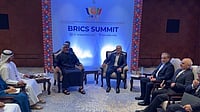
This is where India becomes particularly significant. India has moved closer to the US because of its concerns about China. At the same time, it has maintained deep links with Russia, participated actively in BRICS and sought a larger role in the Global South.
The book also discusses the Kindleberger Trap which is a geopolitical and economic theory stating that global instability and chaos arise when a dominant superpower fails to provide essential international public goods, and a rising power is either unable or unwilling to take its place.
The author explains this in detail regarding the eclipsing role of the West, primarily the US, in providing international public goods or providing security at the global level while on the other hand, both China and India have the potential to emerge as a global good supplier.

Who Replaces the West?
Although the title of this book might give the impression that it would give readers an alternative to the US-led world order, it suggests that there will be no single successor.
China has its own demographic and economic problems. India still faces economic challenges while Russia is engaged in a war and represents a smaller economic base. The US, meanwhile, continues to possess extraordinary military capabilities, financial influence and technological strengths.
The book says that the world could become more fragmented, with several major powers exercising influence in different domains. Its value lies less in offering a dramatic forecast than in encouraging readers to think about the structural forces that are reshaping the international system. China's rise, India's economic trajectory, the changing role of the US along with the dilution of its stature, Trump's approach to trade, and the emergence of a more multipolar world are all part of a larger transition. This is also what makes the book particularly relevant. It does not attempt to provide a clean answer to the question of who will rule the world next. Instead, it asks whether the very idea of a single dominant power may be becoming less relevant.