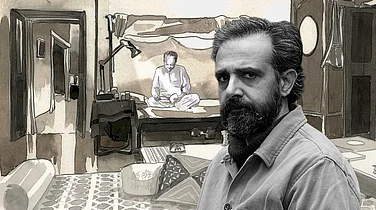
Suparn Verma's Haq released in 2025.
Drawing from the Shah Bano case, the film is anchored by Yami Gautam and Emraan Hashmi.
A year after release, Verma spoke to Outlook about the layers of research that went into the film, his idea of faith and the generous reception.
In our vitiated times, it’s rare to chance across a clear-eyed social drama. Inspired by the landmark Shah Bano case, director Suparn Verma’s Haq (2025) came as a measured representation of a woman’s fight for dignity. Sandwiched between films eager to dangle vicious agenda and rushing to tar marginalised communities, Verma found a neat, emphatically frank way that called out misinterpretation, never the foundational text. Led by a tremendous, career-best Yami Gautam and a carefully calibrated Emraan Hashmi. Haq’s plea was simple and powerful: Iqra (Read). The film endures as an incisive rebuttal to polarising narratives.
As the film completes one year of release, Outlook caught up with Verma for an exclusive interview, where he opened up on the precision of research, how he views faith, scrapped scenes and what he took back from the loving reception to Haq.
Edited excerpts from the conversation…
In interviews, you have spoken about not having real fear while making the film because you knew that you were approaching the making from an honest, truthful place. You’ve also spoken about how making Sirf Ek Bandaa Kaafi Hai empowered you to make this film, and that reflects when we watch it. But given the legal sensitivities, how did you approach and navigate the pre-release discussions and legal scrutiny? How did those concerns affect the writing process?


We took about a year and a half, researching the subject matter, the legal matter, the religious matter, the text, the book, the holy book, the culture. It was important for me to make a film that respected all of the above. When you are attempting something like this, you need to be very careful exactly what you're doing and what you're saying. A word can change a complete meaning, a gesture, a movement. Any minute thing gives the wrong indication or the wrong intent. While we were inspired by the story of Shah Bano and we created a character of Shazia Bano, there were quite a few differentiations between the two.
I needed to understand the milieu, the legality, the Quran and put across the idea to make her someone who had read the book while the husband had read the law and they both used the books per se. It's important to be correct.
How did the idea come to you originally? Did Jigna Vora's book come to you first?
Actually, I had been researching on ideas on what to do next. I thought of tackling this case but doing it in my way where I could tell the story more openly with a free hand and talk about a woman's courage. That's how we started out. We started researching and got all our material together. And at one point of time, Jigna Vora's book also was available for fall back on, so we grabbed that as well. So it helped in setting up the entire framework in general. Primarily it was Reshu Nath and me who researched and worked on the film for two years.
Once you lock a script, do you tweak it during production?
Of course it does. You are always tweaking dialogues and moments. In the script, there was no music per se, but in my head I was hearing music to bind together the entire narrative, whether it is shooting montages and taking extra shots to weave in a passage of time. You see them together and then slowly separating, or the period of time where the other wife comes in and how it works out. So you need to create these images. And it was a lot of back and forth with me and my DOP Pratham, where we would kind of think of ideas and talk about it. It's not like we had any choreographer come in for those bits.
That is one part. The other part is structurally; we changed the screenplay around when we were editing because that's the next stage of writing. So with me and Ninad Khanolkar, our editor, we sat down and we kind of worked out the framework and how we wanted to tell the story. Because there's a lot of material and timelines, and sometimes a shot can convey more than a whole scene, or sometimes you merge a scene or two into each other. So it's a process—it's a complete process. It's a team; it takes a village, it's never one person. My job is to kind of have everybody come along with my vision and have a clear vision at that, if possible. But you discover the film; you make the film as you go along till the very last day, till the day the print is ready, technically.
In the film, Shazia is very clear in her relationship with her faith and confident in what the Quran actually says, refusing to let anyone mislead her or make her feel ashamed. How critical was it to underline that she is not just fighting for her rights and dignity, but also rallying against the misinterpretations?
See, whether it was Bandaa or whether it is Haq, for me, they are part of the faith trilogy. For me personally, faith is very important. Faith is intimate. In today's world, globally, faith has become a very public phenomenon. Faith is a very one-on-one personal thing with you and your God, or lack of it, depending on where you stand in the spectrum.
And at the end of the day, more than weaponized, faith becomes politicized. Faith is very simple. What does faith tell you? Be good to each other, be good to society, be good to yourself, be good to your lovers. That's all it is. Everything else are add-ons, right? How you behave, what you wear, what you eat, where you go, what you do, what you don't do—then breaking down the genders and everything else. Faith started ages ago, thousands of years ago, right across all faiths and all religions. It started with telling people of all regions, who were barbaric in nature, who were governed by kings and rulers in every country on the planet, and trying to put somebody over their head: a super boss. Doing good to be good to each other, that's all it is technically at the end of the day.
Faith moves mountains. Faith helps you live your life. Just imagine yourself standing at a precipice and staring into the darkness of the universe; it's a scary thought. Our planet is not even a dot that registers in the larger scheme of things in the universe, and on that little small speck of dust, we are an even smaller speck, right? So faith helps you stay grounded. You need that strength—whether that strength is your family, your parents, or God. You need something to ground you. Technically, it comes down to that.
Faith is something that one should not meddle with. It does not need someone who comes in as a middleman and tells you what is right or what is written. Read for yourself, decode for yourself, make your mistakes, and learn from yourself. Because life is the biggest teacher and leveller in the world. Nothing teaches you better than life. You make your mistakes, you learn from them. If you don't learn from them, you'll make the same mistakes again and again until you do. You're condemned to, so leave it at that.
So coming back to this being part of the faith trilogy that I have in my head personally: Shazia's faith is very important. Manoj Bajpayee's character's faith in Bandaa is very, very important. Solanki's faith is very important as well. He uses his faith to make his final argument in court; she uses her faith to drive her entire life out and live it in the truest sense of the word. So I think when faith is used well, it can strengthen you, and then nobody can come between you and stuff. Here's the fun part about truth—it's a line I wrote in The Family Man Season 2: everybody wants the truth, but everybody finds it difficult to be on the side of truth because truth is tough. Truth is difficult. It's not easy being truthful; it's easier finding workarounds. So it's one of those things. You live in a modern-day world, you have to be practical, but at the end of the day, you pay a price for everything that you want. The right, the wrong, truth, fakeness—everything has a price to pay. You have to decide what price you pay at the end of it and what you are okay with.
The most interesting part is self-love. All religions actually teach you self-love, where it's about: read for yourself, decide for yourself, do it for yourself. At the end of the day, it's a very individual thing. We have made it out of mediations and those kind of things.

Later in the film, there's this indicated sisterhood between Shazia and Saira. Could you share your thoughts on building that relationship and how it functions in the story?
I wanted that. I don't think there's anything stronger than sisterhood. A woman can be a woman's worst enemy, but a woman can have no stronger ally than another woman as well. It works both ways; it's a double-edged sword. Technically, the enablers of men are women. Patriarchy exists because women also stand by it. Female feticide happens because a woman takes a girl child and drops her on her head or in a well, right? If women started dropping male children into wells, I'm sure all men would be scared. When the Lorena Bobbitt incident happened, every man was holding his hands between his legs. So I'm just saying, when a woman takes charge, a lot of things can be done away with. Patriarchy can't exist without the support of both genders. In my book, there's nothing stronger than sisterhood. She stands for what is right, and sometimes you don't need to scream and shout about being right. You can do the right thing in the quietest of ways. She tells her husband towards the end, 'Shazia is right.' He has no argument; he just asks her to shut up.

For Abbas, his behaviour is normalized by conditioning, but at what point do you think he turned this fight into a massive ego issue?
Ego is what started it in the first place, because she wanted an apology. Later, it became more about ambition for him. Somewhere down the line, his career would change if he managed to overturn the law that was being fought by two other women at the same time. If the only way to overturn that law and those judgments was in the Supreme Court, and he was the lawyer who ended up doing that, he would be in a very strong political position, a general or whatever.
I had shot a scene—which we removed because of length and pacing—that showed his political and career ambition of what he wanted to do in life. But it was coming across anyway when she has that scene with him where she says, 'The only reason you did this was because you deliberately lost in the High Court so this case would go to the Supreme Court.' He planned it all along once he realized it could be much bigger. That was the whole line of the film: it's a domestic dispute that turned into a national issue.

What facets of the case did you discover during your research that felt like revelations to you?
Honestly, more than the legal facets, a lot of it was how women are empowered in the holy book and how the Quran at times is misread or misinterpreted by men for their own use. For example, everybody loves throwing this WhatsApp forward around that Muslim men can have multiple wives, but they don't talk about the conditions laid out in it. If you actually read the conditions, it's very tough to have two wives simultaneously under those guidelines. Similarly, ‘meher’ is technically like a prenup given at the time of marriage to empower the woman beforehand so she has money provided by the man. But then, in love, people reduce that amount and everything. It gives a woman agency. Of course, it comes from a period of time when women were not working, but it still empowers them. Empowering a gender is important. If you have called them the weaker sex, then it's incumbent upon you to empower them.
Every religion changes, right? Everything evolves. Society changes along the years. The Hindu Code Bill came where women were given inheritance along with men, which was not the case earlier. Until the suffragette movement happened in the world, women didn't have the right to vote—and we are talking about Western countries, not even 100 years ago, like the 1960s. So society changes, everything changes. It has to evolve.

What is your process on set regarding takes? Do you usually do more than two takes, especially for intense monologues?
It depends. Honestly, with Haq, I never needed to take more than two or three takes because my actors came fully prepped. They were ready from the moment we started. There were times I would just take one take and scratch my head because you're not used to taking just one take! You get worried: 'Am I feeling happy too soon? Maybe I need to probe further?' At times, my actors would look at me, and I would look at them and say, 'Listen, this is the very first take. I think we should just take a second one for the heck of it, just to try something else out, because this one was really damn good.
What I do is rehearse beforehand to get everybody in sync so that everyone is ready on camera. I did a lot of single takes in this—not just long takes where the camera moves, but blocking everyone in-frame where everybody has to perform. For that, you do a couple of rehearsals and everyone is ready. I was blessed with very good actors. In general, I don't take more than three or four takes for technical adjustments or building up a scene. Once your master shot is done, the close-ups are a repeat of that—you know exactly which points to hit or dull down. It's like music.

Did you shoot the monologues towards the end of the schedule?
Yeah, that was literally the last two days of shooting. The last two days of shoot were the interiors of the Supreme Court, where, like good schoolboys and schoolgirls, everybody was drawing lots. Even Sheeba Chaddha had a closing monologue which I removed because I realized she had already spoken enough throughout the sessions and the High Court. It was more of the same, it was delaying my climax, and I needed the finale to be between the husband and wife. So we shot it and then removed it. Sheeba was very gracious about it; she understood because she saw the syntax of the film—she had already spoken and didn't need to repeat herself.
I originally planned for three to four days for that shoot, but it got over in two days. On day one, Yami—who had been building up to this for the whole month of shooting—was ready. I had three cameras on her, and we shot her entire monologue as a single take from three different angles, with just a few pickups of movement here and there. After the first take, I got what I wanted. We did a second take with a few alterations just to see if we wanted to tweak anything, but after that, it was done, we all clapped, and we wrapped for the day.
Then Emraan was ready, so we did Sheeba after that, and she was relieved as she had done her homework. The next day, Emraan started, and in one take he was done as well. We did a second take with him for the very same reason, but his single take had it all. Then we shot the Supreme Court judges' judgment, crowd reactions, wide shots, silent moments, back shots, and people standing. It was done very efficiently in two days. We shot the whole film in Lucknow—in and out. Some locations we propped, some were minor sets, but it was all shot there.
How was the experience with the Central Board of Film Certification (CBFC)? It’s a body that often gets criticism, but your film was passed without a single cut.
They were very gracious. They saw the film and came out saying, 'It's such a joy to watch a film like this and certify it so smoothly.' You never know with certifications—you can do a children's film and still be surprised! But they were very gracious, nice, and happy; they came out very emotional. They had a Supreme Court lawyer and various people from different parts of society on the panel, both men and women. The film was passed without a single cut because there's nothing contentious in it anyway.
Looking at your career, you have been remarkably genre-agnostic—covering horror, legal drama, period crime, thriller, and sci-fi. Do you actively scout for a change of gear, or do these projects just come your way?
I go for stories that excite me, and I don't believe in sticking to one genre. Life is colourful; I like experiencing every aspect of life. I can't stick to one thing. I need to be genre-agnostic because that's what I read, watch, or listen to musically—I listen to all genres. If you ask me to tell you my favourite genre, I'll end up telling you one, which will lead to talking about every genre one by one, because I have favourites in all of them and I want to do all of them. I mean, you have one life—why limit yourself to one?
The world wants to slot you; they want to figure you out and pigeonhole you. But I think once you start pushing yourself, pushing your boundaries, and showing your colours, they slowly start accepting you. Initially, the chat was, 'Okay, what is the one good thing? Are you an action guy or a thriller guy?' Oh, action-thriller, super! Now it's legal drama, action-thriller, super! I'd rather be that. You come to me with a great story, great lore, and great characters, and any genre is fine with me.
What conversations or reactions around the film have really stayed with you, and what do you choose to retain from the reception going forward?
Honestly, the reception has been very humbling. To date, I get messages and calls from more or less every actor, producer, or director in Bombay and Hyderabad. I have had the biggest stars getting my number and calling me. It has been gratifying and a lovely feeling to have your film appreciated the way it was. Lots of moments stay with you. One that came to me in my DMs was a guy saying, 'This is the story of my mother.' He spoke personally about how he saw his mother in Shazia. It's been a special journey, especially for me and Yami—she put a lot of herself into the film. On day one of her photo shoot—not even a film shoot—I told her that this will be a legacy film. In January, when the film completely blew up after hitting Netflix, it went to the next level. The reviews when it came out in theaters were all four to five stars, which was amazing, but on Netflix, the numbers worldwide—not just in India—were incredible. I used to tell her, 'When you're 78 years old, you'll look back at this as your best film.”
More than Emraan, it was his father's reaction that stayed with me. He came to see the film—he is a five-time Namazi and a practicing Muslim—and he had a very emotional reaction to it. Imran saw the film one day after the release because, for him, his father's reaction was enough. That was a very special moment for me.