JD(U) opposes implementing the Uniform Civil Code in Bihar despite supporting it in Parliament.
The party says consultations are necessary before changing religion-based personal laws.
Bihar’s sizeable Muslim population makes the UCC politically sensitive for JD(U).
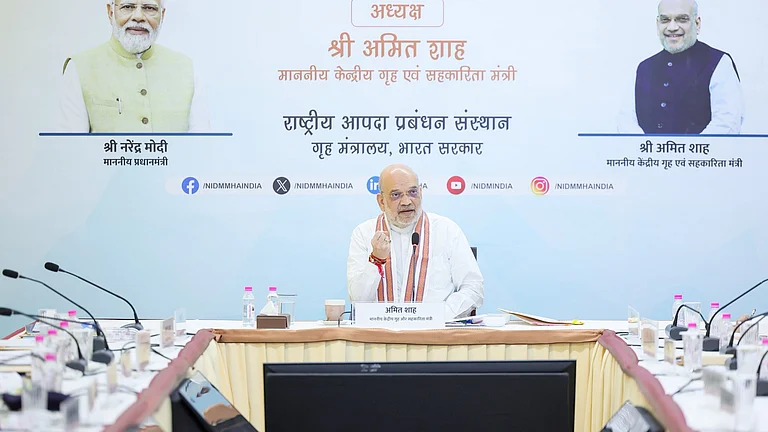
Union Home Minister Amit Shah’s plan to introduce the Uniform Civil Code in all 21 BJP-led NDA states before the 2029 Lok Sabha elections has exposed differences within the ruling alliance. While the Shiv Sena and Hindustani Awam Morcha (Secular) have supported the announcement, the JD(U) has opposed its implementation in Bihar.
Senior JD(U) leader Shyam Rajak said the party’s position had already been established by former chief minister Nitish Kumar. Although the JD(U) supported the UCC proposal in Parliament, it does not favour applying it in Bihar, he said.
The party’s resistance reflects Bihar’s distinctive social and electoral composition. Muslims account for around 17.7 per cent of the state’s population, as per the caste-based survey of 2023, and have a particularly strong presence in Seemanchal, making any decision affecting personal laws politically sensitive.
What Exactly Has JD(U) Said About UCC In Bihar?
Rajak said the party would not support the implementation of UCC in Bihar, citing Nitish Kumar’s previous position.
“Our stand on the issue was made clear by our leader way back. He had said that although our party was supporting the UCC Bill in the Parliament, it was not in favour of implementing the same in Bihar,” he said.


Asked whether the JD(U)’s position still carried weight after BJP leader Samrat Choudhary became chief minister, Rajak pointed to the coalition’s dependence on regional partners.
“The chief minister may be of the BJP but the government is being run with the help of allies... our stand is clear, the question of implementing UCC in Bihar does not arise,” he said.
Other JD(U) leaders have responded more cautiously. State minister Shrawon Kumar said party spokespersons would explain its position, while national spokesperson Rajiv Ranjan Prasad said national working president Sanjay Kumar Jha would discuss the matter with Shah.
Why Has JD(U) Been Cautious About UCC?
JD(U) supported the Citizenship Amendment Act and the Waqf Amendment Bill. However, it opposed the removal of Article 370 and the legislation criminalising triple talaq but walked out during voting instead of voting against the measures. It also distanced itself from celebrations surrounding the Ram Mandir consecration without opposing the temple’s construction.
This record has caused sections of the Muslim community to question the JD(U)’s commitment to secular politics. Opposing the implementation of UCC in Bihar allows the party to demonstrate that it retains an independent position within the NDA.
How Important Is The Muslim Vote For JD(U)?
Muslims constitute around 17.7 per cent of Bihar’s population. Their electoral importance is even greater in Seemanchal, where they account for an estimated 47 per cent of the population.
Seemanchal comprises Araria, Katihar, Kishanganj and Purnia and contains 24 Assembly constituencies—nearly 10 per cent of Bihar’s total seats. Kishanganj has the region’s highest Muslim population at approximately 68 per cent, followed by Katihar at 44 per cent, Araria at 43 per cent and Purnia at 38 per cent.
The 2025 Assembly results showed different political outcomes across these constituencies. The Congress won Kishanganj and Araria, while the BJP secured Katihar and Purnia.
The JD(U) fielded four Muslim candidates in the election, but only Mohammad Zama Khan won. Just 11 Muslim MLAs were elected across all parties, the lowest representation recorded in the Bihar Assembly.
The JD(U) has attempted to court Muslim voters for years, but its alliance with the BJP has limited its success. Supporting UCC implementation could make that task more difficult and strengthen the RJD’s charge that the NDA is acting against minority interests.
Why Does JD(U) Want Consultation Before UCC?
A UCC would establish common personal laws governing marriage, divorce, inheritance and adoption, regardless of religion. The JD(U)’s concern is that such a framework could affect different religious traditions and customary practices.
The party therefore wants broader discussions before any decision is taken. Its position is similar to that of LJP (Ram Vilas) leader Chirag Paswan, who has asked the government to release a draft and consult stakeholders.
“India’s social fabric is diverse. Every class has its own civic traditions and customs,” Paswan said, referring to constitutional protections and exemptions granted to tribal communities.
“Let the draft be made public, let there be an assessment of the interests of all stakeholders, let there be extensive discussions. Thereafter, after review, the party will state its position,” he added.
What Does Bihar’s Political Equation Mean For BJP?
The BJP cannot treat Bihar like a state where it governs without dependence on allies. Rajak has underlined that the state government continues to function with coalition support, despite having a BJP chief minister.
The JD(U)’s support is also important to the BJP at the Centre. This gives the regional party bargaining power on an issue that could affect its electoral base and political identity.
The RJD is seeking to use the disagreement to target both parties. Its spokesperson Shakti Yadav accused the BJP of returning to its “politics of hate” after facing political setbacks.
“But the BJP must remember that this is Bihar where secularism flows in the veins of the people. The RJD will not take it lying down if any step is taken that could hurt Muslims. We will not let them implement the UCC in the state,” Yadav said.
Can BJP Have A Common UCC Line?
The reactions from NDA parties suggest that the BJP does not yet have a uniform alliance position on UCC.
The Shiv Sena and HAM(S) have backed Shah’s announcement. The TDP has supported UCC but called for consultations before adopting it. The LJP (Ram Vilas) wants to examine a draft and assess its impact, while the JD(U) has opposed implementation in Bihar.
The BJP may push allies to support its 2029 objective, but the JD(U)’s importance to the coalition with 85 seats means that forcing the issue could create further tensions.