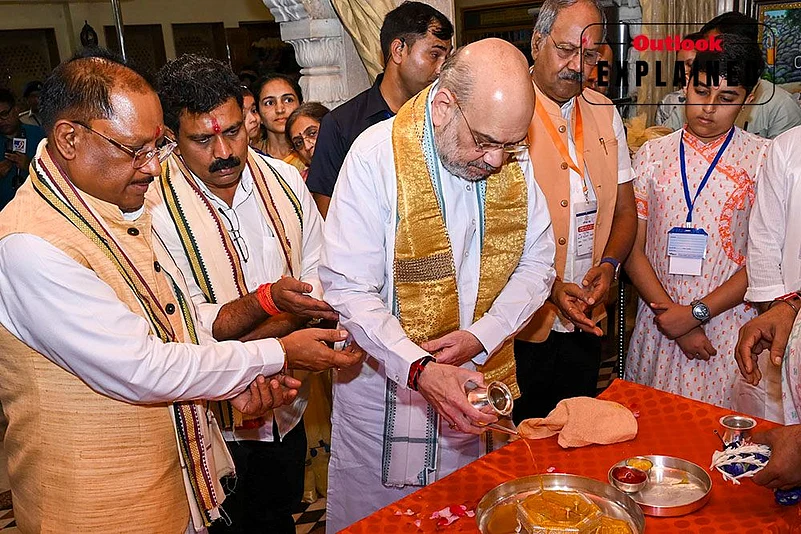
Amit Shah has set 2029 as the deadline for 21 NDA-ruled states to introduce the UCC.
Four BJP-ruled states have passed UCC Bills, with Uttarakhand already enforcing its code.
The state-first strategy could shape a future national UCC, but state laws do not automatically create one.
Union Home Minister Amit Shah has set a political deadline for the Uniform Civil Code (UCC), saying all 21 BJP-NDA-ruled states should introduce it before the 2029 Lok Sabha elections. The announcement is significant because the UCC has long been presented as a national BJP commitment, but the current strategy is to advance it through state legislatures rather than begin with a single central law.
The route is constitutionally possible because several subjects that a UCC would cover fall under the Concurrent List, giving both Parliament and state legislatures the power to make laws. But there is also a political calculation. A state-by-state approach allows the BJP to develop and implement different models, account for local customs and exemptions, and assess the legal and political response before attempting a nationwide framework. The Indian Express reported that the RSS had favoured BJP-ruled states adopting their own codes first, with an overarching central law potentially considered later.
What Exactly Has Amit Shah Announced On UCC?
On September 13, Shah said that the UCC would be introduced in all 21 NDA-ruled states before the 2029 Lok Sabha elections. Shah has framed the UCC as part of the BJP's broader push for common civil rules and equal rights.




The announcement does not mean that a national UCC has been passed or that one central Bill is currently before Parliament. It is a commitment by the BJP-led NDA governments to pursue UCC legislation in their respective states.
The New Indian Express reported that Uttarakhand was the first state to enact a UCC and that its law has been in force since January 2025. Gujarat, Assam and Madhya Pradesh have since passed UCC Bills, while Maharashtra, West Bengal and Chhattisgarh have begun work on draft legislation. As of the latest report, the Gujarat, Assam and Madhya Pradesh Bills were awaiting presidential assent.
Why Is The BJP Pushing UCC Through States Instead Of Parliament?
The constitutional basis is Entry 5 of the Concurrent List in the Seventh Schedule. It covers marriage and divorce, adoption, wills, intestacy and succession, joint family and partition, and matters connected with personal law.
This means both Parliament and state legislatures can legislate on these subjects. However, the state power is not unlimited. Under Article 254(2), a state law on a Concurrent List subject that conflicts with an existing parliamentary law can prevail within that state if it is reserved for the President and receives presidential assent, although Parliament can later override it.
That makes the state route constitutionally possible, but the resulting laws remain state-specific rather than a single UCC applicable across India.
The political calculation is equally important. A national UCC would have to address India's different religious personal laws, customary practices and constitutional protections for tribal and northeastern communities at the same time. The Indian Express reported that RSS and BJP sources had previously argued that these differences made a state-first approach more practical. The Uttarakhand model could be studied, modified and adapted by other states rather than immediately imposed as one national framework.
Shah's 2029 announcement has now turned that state-first approach into a time-bound political programme.
What Does Article 44 Say About A Uniform Civil Code?
Article 44 of the Constitution says that “the State shall endeavour to secure for the citizens a uniform civil code throughout the territory of India”.
But Article 44 is part of the Directive Principles of State Policy, not the Fundamental Rights. Under Article 37, Directive Principles are fundamental to governance but are not enforceable by courts.
So Article 44 sets out a constitutional objective; it does not itself create a UCC or prescribe exactly what such a code should contain.
The debate over the UCC is therefore not simply about whether the Constitution mentions it. It is about how uniformity should be achieved and how it should be balanced against religious freedom, customary practices and constitutional protections for particular communities.
The 21st Law Commission's 2018 consultation paper is relevant here. It said a UCC was “neither necessary nor desirable at this stage” and instead argued for reforming family laws across religions to make them more gender-just. The Indian Express reported that the Commission favoured achieving equality within communities rather than imposing uniformity between communities.
The present government has taken a different approach, treating a common civil framework as a policy objective.
Which States Have Already Passed UCC Laws?
Its UCC came into effect in January 2025 and covers marriage, divorce, inheritance and succession, while also regulating live-in relationships.
Gujarat passed its UCC Bill in March 2026, Assam followed in May and Madhya Pradesh in July. The New Indian Express reported that the three Bills were awaiting presidential assent.
Goa is a different case. Its common civil-law system derives from its Portuguese-era legal framework and predates the current BJP-led UCC exercise. It should therefore not be treated as another state that has recently adopted the BJP's model.
What Do The State UCC Laws Actually Cover?
Uttarakhand's law provides common rules on marriage, divorce, inheritance and succession and regulates live-in relationships. Gujarat and Assam broadly follow the same areas, including restrictions on polygamy and registration requirements.
Madhya Pradesh's legislation also covers marriage, divorce, succession and live-in relationships, while making registration mandatory and prohibiting polygamy.
The laws are therefore similar in their broad objective but are not identical codes. Each is a state law, with provisions shaped by that state's political, social and customary context.
That distinction matters when assessing the BJP's claim of uniformity: the current approach is creating common rules within individual states, not one identical law across India.
Why Are Tribal And Some Indigenous Communities Being Exempted?
The tribal question is one of the clearest complications in the idea of a “uniform” code.
The UCC laws in Uttarakhand, Gujarat, Assam and Madhya Pradesh exclude Scheduled Tribes. Madhya Pradesh's tribal population accounts for about 21 per cent of the state's population. The Indian Express has reported that the state-level UCCs have sought to protect tribal customs and identities through exemptions.
The rationale is linked to customary laws and constitutional protections. Several tribal communities have their own rules governing marriage, inheritance and other social matters. The Constitution also provides special protections to certain tribal and northeastern areas.
Shah has argued that tribal rights and customs will not be affected. But the exemptions raise a larger question: if substantial communities are kept outside a UCC to preserve their customary practices, how far can the resulting law be described as uniform?
Could A State-By-State UCC Eventually Lead To A National UCC?
It could provide a political and legislative pathway, but it would not automatically create one.
But a national UCC would still require Parliament to legislate. It would also have to address existing central laws, state legislation, religious freedoms, customary practices and constitutional protections.
There is already disagreement within the NDA itself. The Indian Express reported that the TDP and Shiv Sena backed Shah's announcement, while the JD(U) maintained that UCC should not be implemented in Bihar and stressed the need for consensus.
Shah's announcement is therefore best understood as a state-first strategy for advancing the BJP's longstanding UCC project, not as the announcement of a national UCC. The immediate objective is to expand common civil rules through NDA-ruled states. Whether those state laws eventually inform a national code will depend on their implementation, court challenges, political consensus and, ultimately, Parliament.