



Jamui incident revives debate around moral policing, women’s safety and public spaces.
Experts and women’s voices highlight concerns over scrutiny of women’s choices.
Political reactions bring focus on morality, culture and individual freedom.
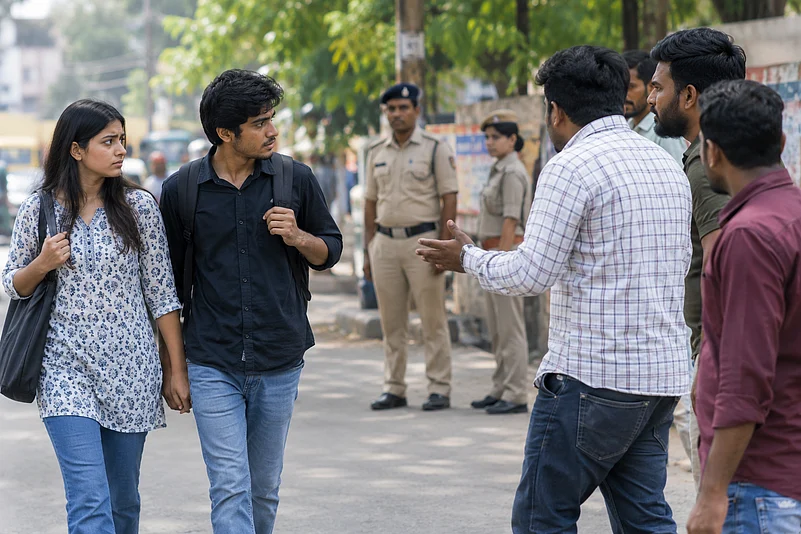
A teenage girl and a male companion were allegedly stopped and harassed in Jamui, Bihar, by a group of men claiming to enforce their own version of “morality”. What followed was not just an alleged act of harassment, but a familiar question: who gets to decide how women should behave, whom they can meet and how they can move through public spaces?
The incident has once again put the spotlight on the idea of “moral policing” and on the social attitudes that can turn control over women’s choices into a form of self-appointed protection.
Police registered a case after the incident came to light, triggering political reactions over law and order, women’s safety and the role of individuals or groups attempting to impose their own ideas of morality.
The police later arrested the prime accused, identified in reports as Nandan Yadav, after an exchange of fire. Reports said he sustained a gunshot injury to his leg during the police action. Police said the investigation into the remaining accused was ongoing.
Morality As A Tool To Police Behaviour
“Moral policing” is commonly used as a broad term to describe actions by individuals or groups who attempt to enforce their own interpretation of social, cultural or religious norms on others.


The term has often been associated with efforts to regulate behaviour considered unacceptable by certain sections of society. Such interventions have been reported in cases involving couples in public spaces, women’s clothing, relationships and personal choices.
While supporters of such actions have sometimes described them as efforts to preserve social or cultural values, critics have raised concerns over their impact on individual freedom and personal autonomy.
Moral policing is not a separate offence under Indian law. However, actions involving harassment, intimidation, assault or unlawful restraint can attract criminal provisions depending on the circumstances.
The Supreme Court has dealt with several cases involving individual liberty and personal autonomy.
In Shafin Jahan v Ashokan K.M. (2018), the court recognised an individual’s right to choose a partner as part of personal liberty.
In S. Khushboo v Kanniammal (2010), the court observed that unpopular views or choices cannot become grounds for criminal prosecution unless they violate the law.

Fears Of Vigilante Actions
For several women who spoke to Outlook after the Jamui incident, the reactions surrounding the case reflected a recurring concern — that discussions around harassment often shift towards questioning a woman’s choices, movements and behaviour.
“I was disheartened by seeing many people praising the accused for doing a good job and protecting religion. They were saying that the girl should not have stayed outside, questioning what she was wearing and suggesting that she had invited it. For me, it is not about women's safety alone. People with this mentality are roaming all around, and others are supporting them and normalising what happened,” said Manaswi Singh, a 23-year-old student from Rohtas, while speaking to Outlook.
Annie Singh, a 20-year-old master’s student from Bhagalpur, said incidents shared online can influence how women perceive everyday activities.
“Even if one incident happens in one particular area, videos like this can have an impact far beyond that location because people see them repeatedly on social media. For girls themselves, it can create an additional mental calculation before doing something as ordinary as going somewhere with a friend,” she told Outlook.

The Political Debate Around Morality
The incident also became part of a political conversation after Bihar minister and Jamui MLA Shreyasi Singh commented on the issue.
Singh said that moral policing could be done in a “decent and elegant fashion”, while also condemning the alleged actions of the accused.
Her remarks drew criticism from opposition leaders and others, who argued that the phrase could be interpreted as supporting interference in personal choices.
Singh later clarified that her comments had been taken out of context. She said her intention was to condemn the accused and ensure strict action against those involved.
The exchange highlighted how terms such as “morality”, “culture” and “safety” have become part of political discussions around incidents involving women.

“Who Gave Them The Right?”
Congress leader and Leader of Opposition in the Lok Sabha Rahul Gandhi reacted to the Jamui incident in a post on X.
“The video from Jamui, Bihar is deeply disturbing. Two Class 10 students were stopped on a road. Harassed. Humiliated. Molested. A young girl, hands folded, begged to be let go while goons groped her and dragged her away,” Gandhi wrote.
“Who gave these men the right to behave like this?” he asked.
“This is not ‘culture’. It is patriarchy: the belief that any man can police a girl’s body, her movement, her choice,” Gandhi said.
Writing in The Indian Express, Aditi Narayani Paswan, associate professor at the Dr Ambedkar International Centre, also commented on the broader issue.
“These are not isolated instances of spontaneous lawlessness. They are the outcomes of a society that uses the vocabulary of morality to subjugate women, police their bodies, and control their autonomy and independence,” Paswan wrote.
Crime Against Women
The discussion around women’s safety comes against the backdrop of wider crime statistics.
According to the National Crime Records Bureau’s Crime in India 2024 report, Bihar recorded 27,359 cases of crimes against women in 2024, compared with 20,222 cases in 2022.
The state also recorded 5,037 cases involving juveniles in conflict with law in 2024, according to NCRB data.
The NCRB does not maintain a separate category for “moral policing”. Such incidents are recorded under relevant offences depending on the nature of the complaint.

Women In Public Spaces
The debate around moral policing is closely linked to women’s access to and experience of public spaces.
Research by UN Women’s Safe Cities and Safe Public Spaces for Women and Girls initiative has examined how fear of harassment and violence affects women’s movement.
The research has found that safety concerns influence where women go, when they travel and how freely they participate in public life.
A UN Women-supported survey in Delhi found that 95 per cent of women and girls surveyed felt unsafe in public spaces, highlighting concerns around harassment, mobility and access to public areas.
UN Women’s research has pointed to measures such as improved lighting, safer transport, better urban planning and stronger institutional responses as important elements in creating safer public spaces.
A Debate Across States
The issue of moral policing has appeared in several states over the years.
In Uttar Pradesh, Anti-Romeo squads were introduced in 2017 as a measure against harassment of women. The initiative also faced criticism from some groups over concerns about possible misuse.
Similar controversies have emerged in different states involving couples, relationships and community groups intervening in personal matters.
The Jamui incident has once again brought attention to the intersection of crime, women’s safety, public morality and individual freedom — and how these issues continue to shape political and social conversations.















