Aradhana’s birthday is on October 6, 2015. She is the first child born to a Maoist couple under the government’s reverse vasectomy scheme. Her name means she who came from prayer. Aradhana’s father Bhagwat Jade joined the Maoist cadres in 2005 at 18. He met his future wife, Tijo, there. Like other men in the ranks, Jade was told that war had no place for children and he was sterilised. In late 2014, after he and his wife surrendered, he had a reverse vasectomy.
What began with one family is now a programme. By mid-June, camps at Maharani Hospital in Jagdalpur, the divisional headquarters of Bastar, completed 73 reverse vasectomies on surrendered Maoists. These operations will show whether the state can deliver what it promised surrendered cadres beyond a cash grant: the family the Maoist movement had denied them. Officials say the Maoist hierarchy allowed marriage but not children. A pregnant woman cadre was a handicap when the organisation attacked security forces, and so the men were sterilised before they got married. Security forces, quoting the surrendered Naxals, have been maintaining all along that young cadres who fell in love were made to undergo a vasectomy so that the women would not conceive and become a liability. Surrendered cadres say that the leaders did not want a member “being involved emotionally with his offspring”.
Raju Salam joined the movement in 2003 and married a woman cadre in 2009. A year later, he says, he was sterilised inside the organisation. He surrendered in 2025 and came to Maharani Hospital this year on his own free will. He wants to have a “normal life with children”. Shankar Podiami joined in 2008 and got married in 2018. He says that marriage was allowed only after sterilisation. Now, he wants to go home and do farming, and send his children to school. He hopes one of them will be a teacher or a government officer.
Rehabilitation in conflict zones is usually talked about in terms of jobs, housing and safety. The reverse vasectomy programme goes to a place far more private. The administration and the police call the initiative historic and humane.

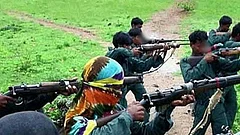


Shankar Muchika, once a divisional committee member with a Rs 8-lakh bounty on his head, was one of the 33 men operated on in the first phase of the June 2026 camp. He says that vasectomy operations were done inside the Maoist camps themselves. The Maoists brought doctors into the jungle, who trained tribal youths with hardly any schooling to perform surgeries, including vasectomies. These youths were part of the Maoists’ medical teams.
In 2013, the Union home ministry told Parliament that some surrendered male cadres in Chhattisgarh had said that their leaders forced vasectomy on them as a condition for marrying women cadres. In December 2024, former cadres told Union Home Minister Amit Shah the same at an event in Jagdalpur.
Years ago, Kosa, a Central Committee member, had claimed that women cadres chose sterilisation themselves. Many surrendered Maoists, including those who have had reverse vasectomy, now live within mainstream society. Police officials are reluctant to share their details, understandably, in order to keep them safe.
R.K. Vij who served as inspector general of police in the Bastar range and later in Durg, and retired as special director general, pioneered reverse vasectomy as a rehabilitation tool. It remains one of the more unusual, human-centred measures in Chhattisgarh’s Naxal rehabilitation policy.
Debriefings of surrendered Maoists have found that the Communist Party of India (Maoist) leadership had made vasectomy mandatory for lower- and mid-level male cadres who wanted to marry because it did not want family life to slow down cadres in the deep jungle. After surrendering, many of the men wanted children but they had neither the money nor the medical awareness to undo the procedure.

The Beginning
Vij says that it began with a single debriefing. “It all started during my tenure as IG (Durg). While debriefing a Maoist couple who surrendered in our division, we came to know that the man had undergone a vasectomy while he was part of the movement.” The police then looked for similar cases and found three men willing to have the operation reversed because they wanted children. A Raipur surgeon at a private super-speciality hospital and his team of urologists operated on all three. “One couple went on to have a child,” Vij says, “while another person was killed by the Maoists later.”
The funding for the reverse vasectomy operations followed. “Later, the Ministry of Home Affairs wrote to the Chhattisgarh government that expenses incurred for such reverse vasectomy could be reimbursed,” Vij says. It was then written into the state’s Naxal surrender policy that such facilities be extended to those returning to the mainstream.
Vij had argued that rehabilitation needs emotional sensitivity. A man who can build a family, he says, forms a lasting bond with mainstream society and will not turn to insurgency again. The Ministry of Home Affairs later directed nine other Naxal-affected states to copy the Chhattisgarh model and offer free reverse sterilisation to willing ex-cadres.
In 2018, Bastar’s inspector general said that 25 surrendered men had undergone the surgery. Seven had become fathers and the wives of six others were pregnant. In 2024, the police said that 26 men had been operated on after they surrendered. Ten of the men had become fathers. In April 2026, officials said that 56 surrendered cadres had had the reversal and 27 had become fathers. Add the June camps, and by the officials’ own count, over 100 surrendered men have now been through the operation.
Rajesh Kukreja, president of the Urological Society of India (USI), says the success rate of this microsurgery is generally limited. Sushil Rathi, a urologist from Maharashtra who joined the drive, puts it at 30–70 per cent. Patients who need more treatment will be referred to the All India Institute of Medical Sciences, Raipur.
Between Jade’s operation in 2014 and the June camps lies a decade. What was once a private arrangement for a few couples in Raipur is now a camp with more than 60 names on its list and volunteer surgeons from five cities. It opened barely two months after the official declaration that Bastar Maoist free.
Reverse vasectomy, also called recanalisation, is intricate microsurgery and it is not a routine procedure in a remote tribal district. The June camps were planned carefully. Ajay Bhandarkar who heads the USI’s west zone, says that about 66 men were examined and about 60 found suitable, with 30 operations planned for each of the two phases. Sanjay Prasad, the civil surgeon at Maharani Hospital, says in early June more than 60 men from across Bastar had been identified. By mid-June the camps had completed 73 operations; 33 in the first phase and 40 in the second, and all were reported successful.
The district administration, Bastar Police and the USI (west zone) ran the camps, with a team from AIIMS, Raipur. The surgeons dedicated their time for free. Kukreja came from Indore, Ninad Tamboli and Parth Manek from Mumbai, and others from Pune, Nanded and Raipur. Doctors from Gujarat joined, too. The surgery is free for the men and falls under a government-sponsored scheme.
The term “successful” in the camps’ reports describes the operation, not the outcome.
The administration and the police call the initiative historic and humane, and a move beyond security strategy towards building trust. Rehabilitation in conflict zones is usually talked about in terms of jobs, housing and safety. This programme goes to a place far more private.
Officials said in April that recently rehabilitated Maoists had also asked for the reversal and that action was being taken. The June camps cleared one batch, but did not meet the entire demand. At the close of the camps, the USI promised to back similar camps. If it does, Bastar’s camps may not remain a one-off.
The reversal operation restores a possibility, but it is not a guarantee. Deputy chief minister of Chhattisgarh, Vijay Sharma, who also holds the home portfolio, says that if a surrendered Maoist couple cannot conceive after a reverse vasectomy, the government would, if necessary, help arrange in vitro fertilisation (IVF) treatment. The state first spoke of test-tube baby facilities for surrendered cadres in 2025. The promise is that its responsibility does not end at the operating table.
The term “successful” in the camps’ reports describes the operation, not the outcome. The 73 men were operated on only in June and results take months to show. If the earlier record holds, close to half of the men may need more help, which is where the IVF offer and the AIIMS referral come in.
Renewed Hope
Officials say that the 73 operations represent more than a medical statistic as each reflects a family receiving renewed hope. In Maoist-free Bastar, this marks a different measure. Bastar, for the past four decades, was being regularly written about in the language of bloodshed, security, operations and surrenders. On March 31, 2026, the deadline the Centre had set to end Left-wing extremism, the government declared the region Naxal free. Sharma announced that armed Naxals had been completely eliminated. Officials say 532 Maoists were killed in the state in the past two years, about 2,000 were arrested and more than 2,700 surrendered.
Under the Chhattisgarh Naxalite Surrender/Victim Relief and Rehabilitation Policy 2025, a surrendered cadre gets legal help, skills training and livelihood support. The reported package includes Rs 50,000 on surrender and Rs 10,000 a month for three years. A cadre with a government reward of Rs 5 lakh or more may also receive a hectare of farmland or four decimals of urban residential land, or Rs 2 lakh where land is not available. An unmarried or widowed cadre may claim a Rs 1-lakh marriage grant within three years of surrender.
The policy also offers victims of Naxal violence, after a murder, a serious injury or permanent disability, 1.5 hectares of farmland or urban land, with reported cash alternatives of Rs 4 lakh in rural areas and Rs 8 lakh in urban areas. Families of civilians killed get Rs 15 lakh if no government job is offered and children of victims are provided support for their education.

MORE FROM THIS ISSUE




Joseph John is a Raipur-based journalist and writer