

If you are young and not a communist, your heart is not in the right place; if you are old and still a communist, your mind is not in the right place.” This popular saying captures the disillusionment of those who embraced communism in their youth but later abandoned it. Yet, for much of the 20th century, communism was more than an ideology for millions across the world. It was the promise of a more equal society, free from the exploitation of the poor by the rich.
The ideology of the Left took over the world in the early 20th century, especially after the Russian Revolution in 1917, when people across the world began to believe that a society based on equality was possible.
The Communist Manifesto, which urged the workers of the world to unite, became the war cry of a movement that threatened monarchies, oligarchies as well as democracies across the world. From Moscow to Budapest, and Prague to Warsaw, the world had its moment of searching for eternal equality, set to the melody of John Lennon, who imagined a world where everyone lived as one.
Yet, the communist experiment began to implode economically under the weight of sweeping policies and centralised decision-making structures that protected inefficiencies in a world competing for resources, with an ever-shifting definition of prosperity and dignity. History ended within three-quarters of a century with the collapse of the Soviet Union. With it crumbled the dream of equality, born of the hope that humanity could free itself from the tyranny of class. People discovered that revolutionaries, too, could become tyrants. The Gulag became the darkest paradox of this experiment, where people were imprisoned in the name of a freedom they would never live to see. It was a tragedy that tormented Camus, who saw in the pursuit of an ideal world the seeds of humanity’s undoing.


Questioning Inequality
Communists may not have the answers to the problems of the world, but they have always asked the right questions about inequality, exploitation and the unequal distribution of wealth and power, forcing societies to confront the uncomfortable truths they would rather leave unexamined. This is why the ideas of Marx and Lenin continue to find an audience among academics, intellectuals and student movements across the capitalist world, where dissent and resistance remain central to debates about the power of the state and the excesses of the market.
The student uprisings on the streets of Delhi, Mumbai, Ranchi, Chandigarh and Indore are symptoms of a deeper discontent.
Every time a generation of capitalists seeks to capture natural resources in the name of national progress, a new generation of young people takes to the streets, reminding those ensconced in ivory towers that the fruits of development cannot be deferred to an imaginary future. They question a system that asks the poor to endure deprivation today in the hope of an abundant tomorrow. For those who protest, prosperity cannot remain a promise held out by those in power. It must translate into dignity, opportunity and a better life in the here and now.
Today, the world is witnessing student movements that seek to challenge a world order dominated by a handful of oligarchs, who are consolidating wealth as well as control over water, land, air and even human thought, all in the name of making their nations great again. The democratic consensus is breaking down in a world where people have long sought to change governments every few years through the power of the ballot. As a 19th-century clock tower in central France, which had survived two world wars, was set ablaze by a mob earlier this month, the images evoked a rupture reminiscent of the storming of the Bastille. From France and Spain to Belgium, Italy and Greece, the young have taken to the streets, demanding better and more affordable education.
India and the Global Churn
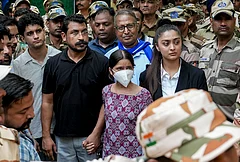
India is no exception to this global churn. The protests that claimed the education minister’s job three months ago have not ended with his departure, nor have students returned to their classrooms. Their representatives remain on the streets, backed by opposition politicians who see an opportunity to turn their fortunes by riding the tiger of youthful discontent.
The state’s response, with tear gas, batons, water cannons and the detention of prominent protest leaders, has done little to quell the anger. It takes considerable disillusionment for the young to stand before pellet guns when they should be holding the hand of someone they love, watching a film or simply imagining the lives they want to lead. When a generation chooses the streets over the ordinary pleasures of youth, it is a measure of how deeply it has lost faith in the promise of the system. Branding its dissent “anti-national” or infantilising its sentiments can’t be a political strategy to counter the protests. Dissent is a pressure-release valve of democracy. Blocking it can snowball into a bigger crisis and endanger the body politic of democracy.
Governments in India and elsewhere must recognise the crisis taking shape in a world where a handful of billionaires wield the power to shape public discourse through bots and digital platforms. Big capital’s growing control over real estate, education and health care is testing the patience of a generation that can see, in real time, the extravagant lives of billionaires and their children. For most, access to a decent home, quality education and health care remains a struggle; their prospects often determined by the accident of birth. The contrast is impossible to ignore. A generation constantly exposed to the privileges of the few is being asked to accept the deprivation of the many as an inevitable feature of the system.
Course Correction
India is home to 229 billionaires, according to Forbes’s list, more than any country except China and the United States. At the same time, around 55 per cent of its population depends on the government’s free foodgrain scheme. To argue that India has not progressed would be wrong. More Indians own cars, use mobile phones and enjoy amenities that were once beyond their reach. Yet, polluted air, potholed roads, shrinking opportunities for dignified employment and recurring education scandals are eroding public faith in the nationalist consensus that promises development for all.
The student uprisings on the streets of Delhi, Mumbai, Ranchi, Chandigarh and Indore are symptoms of a deeper discontent that has been building for some time. The government must look beyond the immediate protests and diagnose the failures fuelling this anger. It must be willing to correct course before a crisis of confidence in the promise of development becomes a crisis of faith in the system itself.
Neeraj Thakur is editor, Outlook