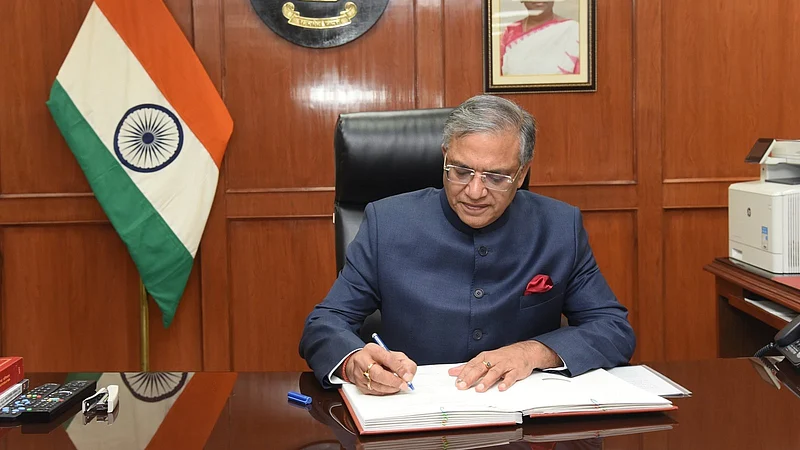
The Delimitation (Second) Bill, 2026, allows CEC Gyanesh Kumar to join the commission or nominate an Election Commissioner in his place.
Rahul Gandhi and other Opposition leaders have questioned the Election Commission's impartiality following the SIR controversy.
Kumar's tenure runs until January 26, 2029, potentially covering most of the delimitation exercise ahead of the next Lok Sabha elections.
Chief Election Commissioner (CEC) Gyanesh Kumar could become one of the key members of the proposed Delimitation Commission, which will redraw constituency boundaries across India, bringing him under renewed scrutiny from Opposition parties over the Election Commission's impartiality. The Centre's proposed Delimitation (Second) Bill, 2026, provides for the CEC to serve on the commission or nominate another Election Commissioner in his place, a provision that has prompted fresh criticism from Congress leaders.
The controversy comes amid the Opposition's continuing allegations of irregularities in electoral rolls during the Special Intensive Revision (SIR) exercise. According to News18, the proposed legislation would make the CEC an ex officio member of the Delimitation Commission, with the option of nominating either Election Commissioner Sukhbir Singh Sandhu or Vivek Joshi instead. The commission will be responsible for redrawing constituency boundaries across the country, making its composition a key point of contention ahead of the 2029 Lok Sabha elections.
How Will Gyanesh Kumar Be Involved In The Delimitation Exercise?
Under the proposed bill, the Delimitation Commission will have three members: a serving or former Supreme Court judge appointed by the Centre as its chairperson, the CEC or an Election Commissioner nominated by him, and the State Election Commissioner of the state concerned. For Meghalaya and Nagaland, however, the third member will be nominated by the respective state Governor.


The provision does not make Kumar's personal membership mandatory, as he can nominate either Sandhu or Joshi to represent the Election Commission. However, his position as CEC has brought him into the political debate over the proposed exercise.
On Saturday, Leader of Opposition in the Lok Sabha Rahul Gandhi questioned the Election Commission's role in delimitation, alleging that the institution had already been compromised.
“Gyanesh Kumar will oversee delimitation too," Gandhi said, while raising concerns about the electoral system. His remarks drew a response from the BJP, which suggested that he should step down if he did not have faith in the electoral process.
According to News18, the provision allowing the CEC to nominate another Election Commissioner follows a precedent set during the delimitation exercise in Jammu and Kashmir in 2020. At the time, then CEC Sunil Arora nominated Election Commissioner Sushil Chandra to serve on the commission.
Why Has The Opposition Repeatedly Targeted Gyanesh Kumar?
The latest criticism follows months of confrontation between the Opposition and the Election Commission over the SIR exercise. Opposition parties have alleged irregularities in electoral rolls and accused the poll body of failing to address concerns over the revision process.
Congress president Mallikarjun Kharge had also targeted Kumar during the Congress's Samvidhan Raksha march in Lucknow on Constitution Day, alleging an alliance between the CEC and Prime Minister Narendra Modi and questioning whether free and fair elections were possible under the existing arrangement. On March 12, 2026, 193 Opposition MPs submitted notices in the Lok Sabha and Rajya Sabha seeking his removal as CEC, accusing him of bias and disenfranchisement.
The notices were subsequently rejected by Lok Sabha Speaker Om Birla and Rajya Sabha Chairman CP Radhakrishnan in April. Separately, 73 Opposition MPs submitted a fresh removal notice in the Rajya Sabha on April 24, citing nine charges against Kumar. India Today reported in September that the notice was still pending.
News18 reported that the Opposition's objections to Kumar's possible role in delimitation stem from its earlier allegations against the Election Commission. The latest proposal has renewed questions over the poll body's involvement in an exercise that will determine the boundaries of electoral constituencies.
When Will Gyanesh Kumar's Tenure As CEC End?
Kumar's tenure as Chief Election Commissioner runs until January 26, 2029. This means Kumar's tenure could cover most or all of the delimitation exercise, which government sources expect to complete within two years, ahead of the 2029 Lok Sabha elections.
The Opposition has also questioned the extensive powers proposed for the Delimitation Commission. Under the bill, its final orders will have the force of law and cannot be called into question in any court.
However, the Supreme Court has previously held that Article 329(a) does not completely bar judicial review of delimitation orders. In its 2024 judgment in Kishorchandra Chhanganlal Rathod v. Union of India, the court held that constitutional courts can examine such orders within the limited scope of judicial review, including cases involving manifest arbitrariness or violations of constitutional values.
The proposed commission's composition, the Election Commission's role and the extent of its powers are likely to remain contentious as the Delimitation (Second) Bill, 2026, is scheduled to be introduced in the Lok Sabha on November 30.