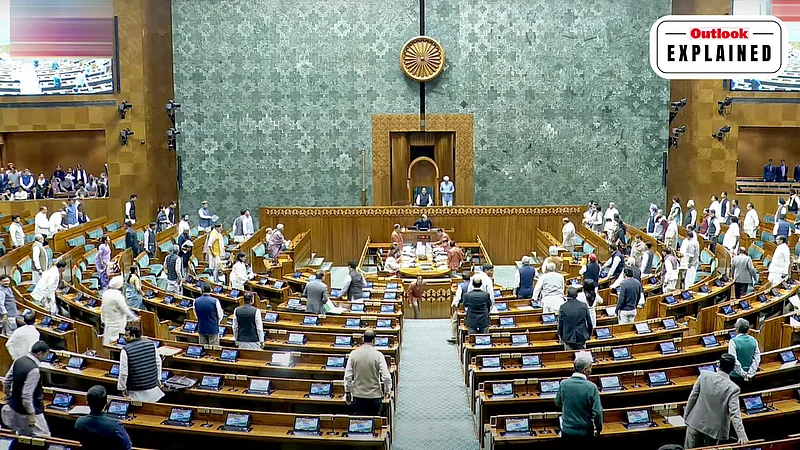
The Bills propose a 50% increase in Lok Sabha seats for every state and Union Territory, while keeping states’ relative share of the House unchanged.
They would use the latest published Census figures available when the law takes effect to redraw constituencies, with the new seat allocations and boundaries frozen until 2051.
One-third of Lok Sabha and Assembly seats would be reserved for women after the first delimitation exercise under the proposed amendment.
The delimitation Bills cleared by the Union Cabinet would increase Lok Sabha seats in every state and Union Territory by 50%, while keeping each state’s share of the House unchanged. The proposed exercise would also redraw constituencies and trigger one-third reservation for women in Parliament and state Assemblies.
The Constitution (132nd Amendment) Bill and the Delimitation (Second) Bill are due to be introduced in the Lok Sabha, which begins a four-day special sitting on Monday. They mark the government’s second attempt this year: its earlier Constitution (131st Amendment) Bill was defeated on April 17, after which the linked Bills were withdrawn.
Delimitation determines the number of seats allotted to states and how constituency boundaries are drawn. The new Bills would change the process in five key ways.

50 % Seat Increase For Every State
A proposed amendment to Article 334A would require a 50% increase in each state’s and Union Territory’s Lok Sabha seats, as well as in the total number of seats in every Assembly. Because the increase would apply uniformly, states would retain their current relative share of Lok Sabha seats.


Law Minister Arjun Ram Meghwal said the uniform increase would enhance representation “while maintaining the existing relative distribution of seats among the states”.
The Bills do not specify how fractional increases would be rounded. Hindustan Times reported on Friday that half-seats are likely to be rounded up, except in states and Union Territories that have only one seat, which may remain unchanged. On that basis, the Lok Sabha could expand from 543 seats to between 816 and 824.

Women’s Quota Linked To The New Exercise
The Bills propose that one-third of Lok Sabha and Assembly seats be reserved for women, including seats reserved for Scheduled Castes and Scheduled Tribes. The quota would take effect after the first delimitation exercise conducted once the proposed constitutional amendment comes into force.
Parliament approved women’s reservation in 2023 through the 106th Constitution Amendment, or the Nari Shakti Vandan Adhiniyam. That law linked implementation to a delimitation based on the first Census conducted after its passage. The new amendment would remove that condition.
The delimitation commission would decide which constituencies are reserved for women and rotate those seats. Seats reserved for SC and ST women would rotate only among constituencies already reserved for those communities. The quota would last for 15 years from the commencement of the 2023 Act, unless Parliament extends it.
Delimitation Frozen Until 2051
The proposed amendment would retain the current state-wise distribution of Lok Sabha seats and increase each state’s allocation by 50%. State shares have been tied to the 1971 Census since 1976.
Constituency boundaries within states would be drawn using the latest published Census figures available when the amendment takes effect. Current boundaries are based on the 2001 Census. If the law takes effect before newer Census figures are published, the 2011 Census would be the latest available data.
The new seat allocations and boundaries would remain in place until 2051. Under the existing framework, the freeze was due to end after publication of figures from the first Census conducted after 2026.
Delimitation Commission
The Delimitation (Second) Bill requires the Centre to set up a three-member commission as soon as possible after the law comes into force. It would be chaired by a serving or retired Supreme Court judge appointed by the Centre. The other members would be the Chief Election Commissioner or a nominated Election Commissioner, and the State Election Commissioner of the state concerned. In Meghalaya and Nagaland, the governor would nominate the third member.
For each state, the Lok Sabha Speaker and the state Assembly Speaker would nominate five MPs and five MLAs as associate members. They could submit dissenting proposals but would not vote on or sign the commission’s decisions.
The commission would publish draft boundaries, invite objections and hold public hearings in each state. Its final orders would have the force of law once published in the Gazette of India and could not be challenged in court. They would apply from the next election; sitting MPs and MLAs would serve out their terms.
Maximum Strength
The amendment would raise the Lok Sabha’s constitutional ceiling to 850 members: up to 815 elected from states and 35 representing Union Territories. The maximum strength of a state Assembly would rise from 500 to 650 seats.
The actual size of each House would depend on the 50% increase and the proposed ceilings. Uttar Pradesh’s 403-member Assembly, for instance, would exceed the current 500-seat cap after a 50% increase, making the higher ceiling necessary for the proposed expansion.