Trump and Xi revive cooperation talk, but Taiwan remains the biggest fault line between Washington and Beijing.
The US-China trade truce is extended, while tariffs, rare earths and technology restrictions remain unresolved.
Xi invokes the Thucydides Trap as both sides try to contain competition and avoid military confrontation.
US President Donald Trump and Chinese President Xi Jinping sought to project cooperation at the White House on Thursday, but their summit also exposed the limits of that engagement, with trade, Taiwan, artificial intelligence and the risk of military confrontation still unresolved.
Xi’s second state visit to the United States began with a formal welcome, where Trump described their relationship as a “truly great friendship” and said the two countries could work towards a better future. Xi, while speaking of friendship and cooperation, placed greater emphasis on preventing the rivalry between Washington and Beijing from becoming a conflict.
The meeting produced a short-term economic outcome: the existing US-China trade truce was extended by two months, according to Reuters. But the extension leaves questions over tariffs, Chinese purchases, rare-earth supplies and technology restrictions for further negotiations.
Xi also urged Washington to handle Taiwan with “prudence” and called for opposition to Taiwanese independence, while there was no immediate sign that the Trump administration would change its established language. On AI, the two leaders put forward different approaches, with Xi calling for the technology to remain under human control.
The meeting showed that Washington and Beijing remain willing to engage, but the ceremony did not remove the disputes defining the relationship.


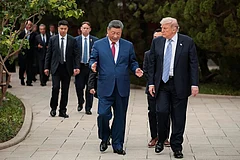
Trump and Xi put cooperation on display
Trump and First Lady Melania Trump greeted Xi and his wife, Peng Liyuan, at the South Portico of the White House as a military band played. Xi arrived in a black Hongqi N701, the Chinese presidential vehicle comparable with the US president’s “Beast”. The two couples stood briefly on a red carpet before heading inside.
Trump invoked the history of US-China cooperation during World War II.
“Just as our people worked together to win that war, President Xi and I will continue working together to forge a better future for both of our nations,” Trump said.
He said he and Xi had forged a “truly great friendship” since his first election in 2016.
That was a marked shift from Trump's language during the 2019 trade war, when he asked whether Xi was a bigger “enemy” than Federal Reserve Chair Jerome Powell as the dispute between Washington and Beijing escalated.
Xi said he was visiting the US at Trump’s invitation to “carry on our friendship, expand cooperation, and promote the well-being of both our peoples”. He also addressed the strategic rivalry.
“We should coexist in peace. As I have said many times, China and the United States as two major countries stand to gain from cooperation and will both lose in confrontation,” Xi said.
The tone was a contrast with the rhetoric surrounding the earlier trade war. In 2018, China's foreign ministry described US tariff threats as “typical bullying”, framing the dispute as a fight between “unilateralism and multilateralism, protectionism and free trade”.
He referred to the “Thucydides Trap”, the theory that competition between a rising power and an established power can lead to war.
“We do not need to avoid mentioning competition, but our competition should be a healthy one, and should be kept within bounds. It should be a race of catching up with one another, not a wrestle in which when either wins, or loses,” Xi said.
“China and the US must hold the line of no conflict and no confrontation between us. We can certainly find the right path for our two great countries to get along on this planet. Our two militaries should maintain regular dialogue and improve mechanisms for crisis communication and prevention. The Thucydides Trap can be overcome,” he said.
Reuters reported that the ceremony followed Xi’s earlier hospitality in Beijing, where Trump was taken to a Ming dynasty temple and a walled-off garden retreat rarely opened to foreigners. In Washington, troops wearing wigs and tri-corner hats marched in formation in a Rose Garden redesigned to resemble a Trump golf club. Fighter jets and bombers flew overhead, with the noise reportedly causing Trump to flinch.
The White House press corps was also shown Marine One and the redesigned South Lawn, including a helipad bearing the presidential seal. Asked about the substance of his discussions with Xi, Trump said: “He loves good granite. Great meeting.”
No major US television network aired live footage of the White House meeting or ceremonies.
Trade truce buys time, but leaves major questions open
The clearest economic result was an extension of the US-China trade truce, but Reuters reported that it would last only two months.
US Treasury Secretary Scott Bessent said the extension would give Washington and Beijing “more time to see what we can do on the economic front”. It had been due to expire in November.
The extension came after US and Chinese officials held further talks in Washington to work through what Bessent called “unfinished business” ahead of the summit.
The extension does not settle disputes over tariffs, Chinese purchases, rare-earth supplies and US technology restrictions. Reuters reported that Bessent said Beijing was meeting a requirement to buy 25 million metric tonnes of soybeans, but was behind on a pledge to purchase $17 billion in other agricultural goods. US officials have also said rare-earth deliveries were falling short.
For companies, tariff rates remain lower than during the earlier trade confrontation, but uncertainty remains. The extension keeps negotiations going rather than delivering a final settlement.
Taiwan and AI show where the rivalry remains
Taiwan was another major issue where the warmer rhetoric met continuing disagreement.
According to China’s official news agency, Xi told Trump that Beijing hoped the United States would “handle the Taiwan question with prudence”. Its English-language service also reported that Xi hoped Washington would oppose Taiwanese independence.
That would be tougher than Washington’s long-standing position that it does not “support” Taiwanese independence. Reuters reported no signs that the Trump administration planned to change its wording. There was no immediate White House readout.
US officials have long avoided explicitly stating opposition to Taiwanese independence, and any change in that language would raise questions about Washington’s Taiwan policy and could face opposition in Congress.
The exchange underscored the gap between the warmer tone of the summit and one of the most sensitive security disputes between Washington and Beijing.
AI produced another contrast.
Trump, who has said AI should be called “super intelligence”, or SI, said in a social media post that he wanted “to leave it exactly where it is” and rely on the US Department of Justice rather than impose new guardrails. He also said China held the same position, according to Reuters.
Xi presented a different approach.
“We have both the capability and responsibility to develop and manage AI for good and ensure that the development of AI is always under human control and serves the well-being of the people,” Xi said.
AI is another arena in which Washington and Beijing are trying to manage cooperation while competing over technology. Alphabet’s Sundar Pichai, OpenAI’s Sam Altman and Nvidia’s Jensen Huang were among technology figures expected at Trump’s state dinner for Xi.
A warmer tone does not mean the rivalry is over
Xi also proposed measures aimed at increasing contact between the two countries.
He said a pair of pandas would make their home at Zoo Atlanta “in a few days” and that Beijing planned to invite 100,000 young Americans to China for exchanges and study over the next five years. He also called for an increase in direct flights.
Trump’s emphasis on their shared wartime history pointed towards cooperation, while Xi’s warnings about confrontation pointed to the limits of that cooperation.
The summit did not produce a broad settlement. Its clearest economic result was a two-month trade-truce extension, alongside discussion of military communication, crisis prevention, direct flights, student exchanges and the panda programme.
The central disagreements remain: the trade truce is temporary, tariffs and other economic issues are still under negotiation, Xi pressed Trump over Taiwan, and the leaders differed on AI.
The contrast between ceremony and substance was central to the meeting. Trump described a “truly great friendship”, while Xi said the two countries must “hold the line of no conflict and no confrontation”.
The meeting did not erase the US-China rivalry. Instead, it showed both sides trying to manage it, with trade talks continuing and Xi pressing for safeguards against military confrontation. The two countries have bought themselves more time; whether that produces a broader agreement remains unresolved.