The Syrian Muslim Brotherhood says it will remain an independent organisation as Syria rebuilds its political system
A presidential media adviser had previously argued that the Brotherhood should dissolve after Assad’s fall
The group is now calling for political pluralism and a permanent constitution to be approved by referendum
The Syrian Muslim Brotherhood has said it will remain an independent organisation as Syria builds its post-Assad political system. In a Sunday statement, its Shura Council described the group as a national organisation with independent decision-making, reaffirmed what it calls its moderate Islamic approach and backed national unity, equal citizenship and organised political pluralism. It also called for a permanent constitution to be put to a popular referendum.
The position comes amid a separate debate over whether the Brotherhood should dissolve. In August 2025, Ahmad Mwaffaq Zaidan, a media adviser to Syrian President Ahmed al-Sharaa, published an opinion article arguing that the organisation should dissolve and adapt to the country's new political circumstances. His article was a political argument, not a government decree or a formal order dissolving the Brotherhood.
The question, therefore, is no longer simply how the Brotherhood opposes the state. It is how a movement shaped by decades of repression, exile and opposition fits into a Syrian political system that is being rebuilt after Assad's fall.


Why Is Its Future Being Debated?
The Brotherhood's latest statement places its future within Syria's ongoing political transition. It welcomed the start of work by the People's Assembly and said the body should exercise its legislative role in completing the transition and establishing organised political pluralism. It also called for a permanent constitution reflecting Syrians' aspirations and said it should be submitted to a popular referendum.
Syria does not yet have that permanent constitutional settlement. The Constitutional Declaration signed in March 2025 was designed to regulate the transitional period and was explicitly described by the drafting committee as a framework rather than a replacement for a permanent constitution. The People's Assembly is to exercise legislative authority until a permanent constitution is adopted and new elections are held under it.
That puts the Brotherhood's organisational question alongside a broader one: how political organisations from the opposition era will operate within the institutions of the post-Assad state.

Who Are Syria’s Muslim Brotherhood?
The Syrian Muslim Brotherhood says it was founded in 1945 under Mustafa al-Sibai, who became its first general supervisor. On its own website, the organisation describes itself as an Islamic movement involved in social and political life and presents its political project as rooted in Islamic values.
Its own documents also present a specifically Syrian political project. A 2004 programme described the Brotherhood as one of Syria's political forces and called for dialogue and cooperation with different political, social and religious currents.
That description should be treated as the organisation's own characterisation rather than an independent assessment of its ideology. It is nevertheless important to the present debate because the Brotherhood has consistently sought to distinguish its Syrian political project from a simple description of itself as an external or purely transnational organisation.
Why Did It Clash With Assad?
The Brotherhood's confrontation with the Syrian state became violent in the late 1970s.
A US State Department historical account says the Syrian Muslim Brotherhood led an armed insurgency against the regime from 1976 until it was suppressed in 1982. In February 1982, government forces crushed the Islamist opposition centred on Hama, using artillery in parts of the city and causing many thousands of deaths and injuries, according to the account. Public manifestations of opposition then remained very limited for decades.
The Brotherhood's own historical account identifies the rise of Hafez al-Assad in 1970, the 1980 law criminalising Brotherhood membership and the 1982 Hama confrontation as major stages in its conflict with the state.
The effect was to push the organisation out of open political life inside Syria for decades. Its history became closely tied to repression, exile and political activity outside the country. That experience remains relevant because many of the questions now being asked about the Brotherhood concern an organisation whose institutional development was shaped by its absence from Syria.

What Role Did It Play?
The 2011 uprising brought the Brotherhood back into the political opposition, but it was only one component of a much broader movement.
A UN Commission of Inquiry report in 2012 described the Syrian National Council as a diverse body that included members ranging from the Muslim Brotherhood to secular formations and representatives of local coordination committees. The report therefore provides an important distinction between the Brotherhood and the wider Syrian opposition.
The Brotherhood's own records also identify the Syrian uprising of 2011 and its participation in opposition structures among the major stages in its recent history.
Its wartime political documents were also directed towards a broader national audience. The 2012 "Covenant and Charter" called for a democratic, pluralist and republican system, equal citizenship and political participation through free and fair elections.
That provides an important bridge to the present: the Brotherhood was no longer describing its political role solely in terms of opposition to Assad, but also outlining what it said a future Syrian political system should look like.
How Did Its Politics Evolve?
The Brotherhood's political documents show continuity in its Islamic identity alongside changes in how it describes political participation and the Syrian state.
Its 2004 political programme presented a future Syria based on dialogue with different political and social currents and described the organisation as one part of Syrian political life.
The 2012 "Covenant and Charter" went further in spelling out support for a democratic and pluralist system, equality of citizenship and political rights.
In August 2025, the Brotherhood's Shura Council described its position towards the new political order as supporting the building of a modern civil state with an Islamic reference. The same statement called for effective participation by Syria's different communities, a pluralist political programme and free parliamentary elections.
Its October 2025 "Common Life in Syria" document similarly described Syria, in the Brotherhood's formulation, as a democratic state based on political pluralism, peaceful transfer of power through elections, citizenship, rule of law and separation of powers.
These are the Brotherhood's stated political positions. They show how the organisation has sought to combine its Islamic reference with a political programme centred on participation, elections and pluralism.
What Changed After Assad?
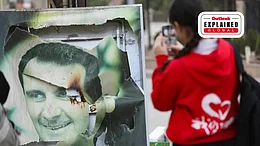
The fall of Bashar al-Assad's government on December 8, 2024 fundamentally changed the political environment in which the Brotherhood had operated.
The UN Secretary-General said the fall of the regime created an opportunity for Syrians to build a stable and peaceful future, while stressing the need for an orderly, inclusive and comprehensive political transition. A year later, the Secretary-General described the next phase as an effort to rebuild institutions and widen civic participation.
For the Brotherhood, this removed the central political opponent around which much of its modern history had been organised.
The question therefore changed. Under Assad, the issue was how the Brotherhood could oppose a state that had outlawed and repressed it. After Assad, it became how an organisation that had spent decades in opposition and exile would operate inside a state whose institutions were themselves being reconstructed.
That shift provides the context for the subsequent argument over dissolution.
Why Were Dissolution Calls Made?
A public argument for dissolving the Brotherhood came in August 2025 from Ahmad Mwaffaq Zaidan, identified by Al Jazeera as the Syrian president's media adviser. Syrian state media has also identified Zaidan as an adviser to the presidency on media affairs.
In his article, Zaidan argued that the Brotherhood should dissolve itself in response to the new political circumstances. He referred to the organisation's long absence from Syria, its ageing membership and the loss of political participation caused by decades of exile. He also pointed to examples of Islamist movements in other countries that had adopted new organisational forms or names.
His argument was explicitly presented as his own view. The article did not announce a government decision to dissolve the organisation.
That distinction is central to the story. The available material establishes a political argument for dissolution, rather than a formal state order already requiring the Brotherhood to disband.

Why Does It Want To Stay?
The Brotherhood has rejected dissolution and instead argues that it should remain an independent Syrian organisation while participating in the new political system.
Its September 27 Shura Council statement says the group will remain a national organisation with independent decision-making and will continue what it calls its moderate Islamic approach. It also stresses national unity, equal citizenship, rejection of sectarian and factional politics, dialogue with different political forces and organised political pluralism.
That position is consistent with the direction of its recent political documents. Its 2025 Shura Council statement described the Brotherhood as a Syrian national organisation independent in its decision-making, while its "Common Life in Syria" document called for political participation, elections, rule of law and legal space for political and civil-society organisations.
The organisation is therefore arguing for adaptation without dissolution: retaining its institutional identity while operating within the political and legal framework of the new Syria.
Why Does The Referendum Matter?
The constitutional question is the second major part of the Brotherhood's latest position.
The group has welcomed the People's Assembly but says the transition should lead to a permanent constitution that reflects Syrians' aspirations and is submitted to a popular referendum.
The demand matters because the constitutional framework currently governing Syria was designed for the transition. The committee that drafted the Constitutional Declaration said in March 2025 that the document was intended to organise the transitional period and was not a substitute for a permanent constitution. The People's Assembly's legislative authority is also tied to the adoption of that permanent constitution and subsequent elections.
The Brotherhood is therefore placing its organisational position within a wider constitutional question: how the permanent rules of the post-Assad state will be decided and what role Syrians will have in approving them.

What Could Its Future Mean?
The Syrian Muslim Brotherhood's future is being debated in circumstances very different from those that shaped most of its modern history.
Under Hafez and Bashar al-Assad, the organisation's political life was defined by confrontation, repression and exile. During the civil war, it became one part of a wider opposition landscape. After Assad's fall, it faces a different question: how an organisation built around opposition to the old political system fits into a new state whose institutions and constitutional rules are still being established.
The competing positions are now clear. Zaidan's August 2025 article argued that the Brotherhood should dissolve and adapt to the new political environment. The Brotherhood's September 2026 statement rejects that course and calls instead for continued organisational independence, political pluralism and a permanent constitution approved through a referendum.
The debate is therefore no longer primarily about the Brotherhood's opposition to the Assad regime. It is about whether a longstanding opposition organisation will retain a distinct institutional identity within the new Syrian political order, and how that organisation will participate in the constitutional settlement that emerges from the transition.