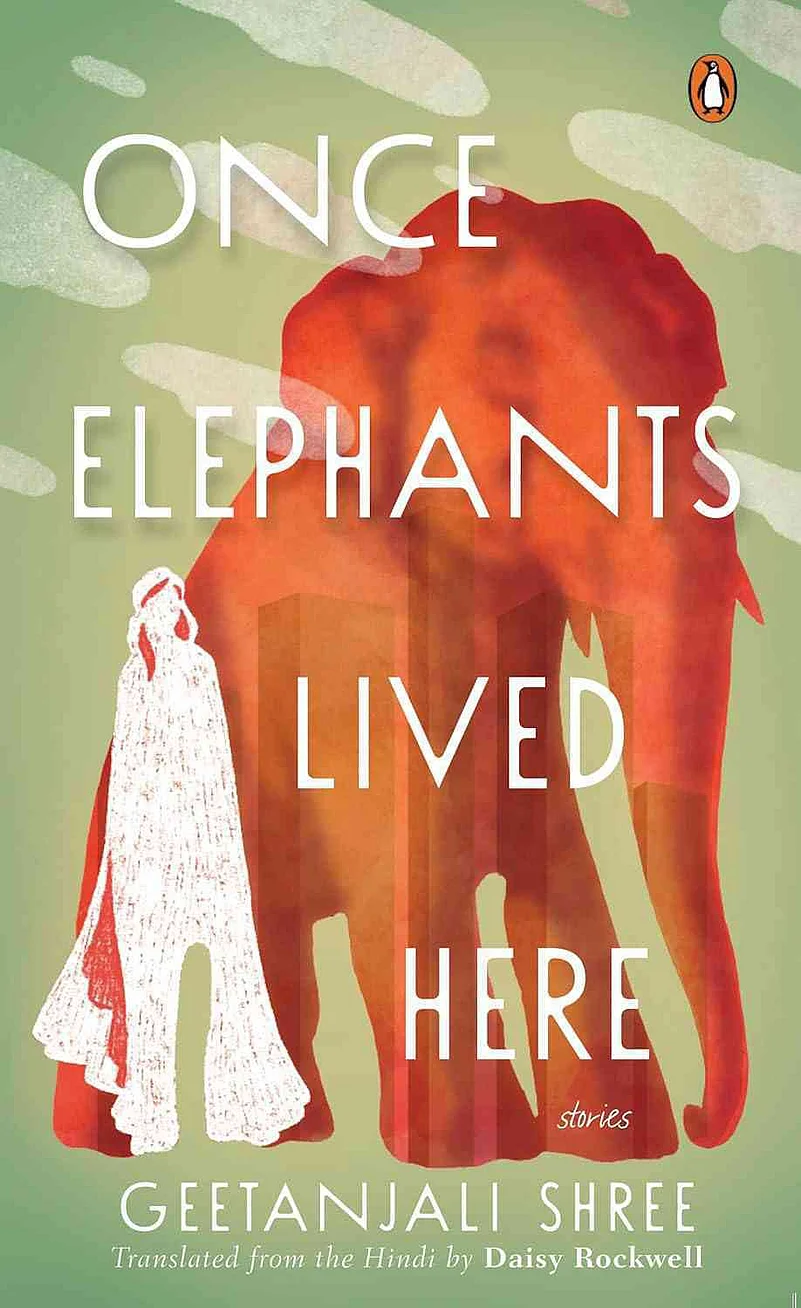
The stories in Once Elephants Lived Here (Penguin Random House) do not offer the reader the familiar comforts of plot, progression and resolution.
Geetanjali Shree writes about grief, ageing, desire, violence, loneliness and memory in these stories.
She is equally interested in what happens to language when experience itself refuses to remain orderly.
Geetanjali Shree's Once Elephants Lived Here (translated from Hindi by Daisy Rockwell) lives in unsettled territory. The stories in the collection do not offer the reader the familiar comforts of plot, progression and resolution. They wander, double back, contradict themselves and occasionally seem to lose their way. But this apparent disorder is not a failure of form. It is the form. Shree writes about grief, ageing, desire, violence, loneliness and memory, but she is equally interested in what happens to language when experience itself refuses to remain orderly. Her sentences can hesitate, turn playful, become absurd and suddenly arrive at something painful. Reality slips. The dead enter the living. The ordinary becomes strange.
If the International Booker prize-winning Tomb of Sand brought this sensibility to an international audience, Once Elephants Lived Here allows us to look at some of the literary impulses that preceded that recognition. The scale is smaller, but the ambition is not.
Ghostly Footprints of the Vanished
The title story begins with a city divided by a river that has experienced communal violence and subsequently reinvented itself through the language of development and modernity. But cities do not forget simply because they have been redeveloped. Into this city walks an old woman who is apparently ordinary, yet, her presence makes the city's carefully arranged categories unstable. She crosses boundaries as though they were temporary inventions. She belongs everywhere and nowhere. She becomes a question walking through the streets: who owns a place after violence? Who decides who belongs? And what happens to those who cannot, or will not, fit into the city’s new geometry?


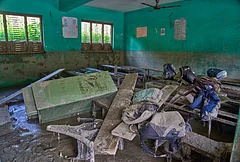

The elephants of the title belong to this landscape of disappearance. They are not a neat allegory. They are a reminder of a world that once existed here and has since been cleared, renamed and rebuilt. “Once” belongs to memory. “Here” belongs to the present. Between the two words lies the whole burden of the collection.
Shree does not turn communal violence into a sermon. Its presence is more disturbing because it enters ordinary life. A street is no longer merely a street. A neighbour is no longer merely a neighbour. The violence continues in the meanings attached to places and people long after the physical event ends.
When Reality Begins to Slip
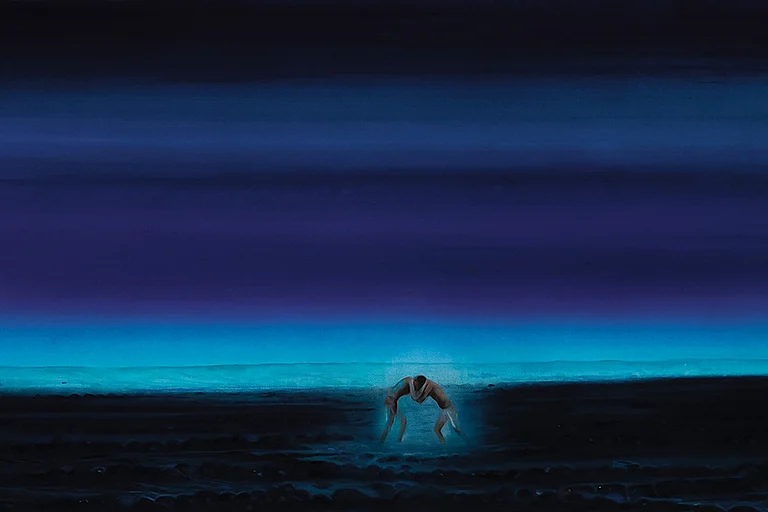
Again and again, Shree takes something ordinary and tilts it until it reveals its hidden absurdity. In ‘Out for a Spin’, a woman goes walking around her housing complex and finds herself unable to stop. The more she moves, the more clearly the limits around her become visible. In ‘So Much Sky’, another familiar world is turned upside down. A woman at a writers' retreat falls in love with the sky while the other participants appear to be robots. The robots are rational and functional. The human being is the one behaving irrationally, falling in love with something as useless and immeasurable as the sky.
Here, Shree asks the important question: what if the irrational is one of the last things that makes us human? What if wonder, desire and vulnerability are not interruptions to a rational life but its essential content?
In ‘Butterflies’, memory, perception and grief begin to overlap. The story does not resolve ambiguity because grief itself does not resolve anything. It alters the proportions of the world. The absent become present. The present becomes uncertain. In such a world, conventional realism can begin to look like an inadequate instrument. Shree breaks the instrument and listens to what remains.
The Syntax of Ruins
Shree's worlds are populated by things that refuse to stay in their assigned places: the dead among the living, the past inside the present, the absurd inside the ordinary, desire inside old age, memory inside geography. Her narratives therefore refuse to remain still. She is not breaking narrative conventions simply to show that they can be broken. She is asking a more fundamental question: can a fractured world be represented by an entirely orderly sentence?
Her language is similarly porous. It moves between registers, drawing on colloquial speech, Urdu, English, idiom, humour and rhythm. Language does not merely carry the story. It performs the instability the story is about.
Long before the International Booker came her way, Shree had already built an important body of Hindi fiction. Her Mai examines motherhood and the restricted inner lives of women. Hamara Shahar us Baras confronts communal violence and its aftermath. Tirohit (translated by Rahul Soni as The Roof Beneath their Feet) explores desire, domestic space, female identity and unstable memory. Khali Jagah (The Empty Space), turns towards terrorism, grief and the void left by violence.
Across these books, the same preoccupations recur: mother and daughter, home and exile, body and memory, history and fiction, reality and imagination. Shree is drawn to the moment when one category begins to leak into another.

Daisy Rockwell’s Magic
The challenge of translating Shree lies less in individual words than in the movement between them. Her sentences can begin as observations, turn into memories, interrupt themselves with humour and arrive somewhere unexpectedly lyrical. A translator who tidied everything up would destroy something essential.
Rockwell’s translation allows Shree's sentences to breathe and misbehave. Repetition is not always corrected. Ambiguity is not rushed towards explanation. The narrator's interruptions and self-consciousness remain visible. In the title story, particularly, the act of storytelling itself becomes part of the story and Rockwell allows that instability to cross into English.
Shree's prose does not derive its power from grammatical perfection. It derives it from movement. Comedy can suddenly become grief. A solemn thought can acquire an absurd edge. A sentence can seem to wander and still arrive exactly where it needs to. Rockwell does not make the English artificially exotic or ‘Indian’. She makes it flexible enough to accommodate Shree's particular imagination. Translation here becomes an act of allowing two linguistic worlds to remain different while making conversation between them possible.
The Small Things and the Big Ruins
The collection is memorable because of Shree’s refusal to separate the political from the intimate. A city scarred by communal violence, a woman walking endlessly around a housing complex and a grieving narrator in Kerala may seem to inhabit different fictional universes. Yet, all these stories are concerned with enclosure. They ask what happens when human beings find themselves inside structures they did not create.
The political enters the private life through memory and fear. The absurd enters ordinary existence through repetition. The past refuses chronology. The human being becomes strange to herself.
Shree's refusal of closure can occasionally feel withholding to readers who are accustomed to the conventional short story. They may want the narrative to explain itself, arrive somewhere. Shree often refuses that request. Perhaps that refusal is the point. Why must every wound become a lesson? Why must every mystery be solved? A story can leave a disturbance rather than a conclusion. It can make a familiar street strange, turn an ordinary walk into a philosophical problem, or allow grief to occupy the space where certainty once lived.
Shree does not necessarily give us answers; she changes the shape of the questions.
The elephants of the title are gone from the landscape, but they remain in the imagination. The city has rebuilt itself, but its buried histories continue to inhabit the present. The grieving narrator may not know exactly what she has seen, but the uncertainty becomes a form of knowledge. The woman walking in circles cannot stop.
Perhaps neither can we. We move through histories, losses and inherited fears, returning to places we thought we had left behind. We draw borders and call them permanent. Memory has other plans.
That may be the deepest achievement of Once Elephants Lived Here. Shree shows how the past continues to inhabit the structures of the present. The elephants may have vanished. The borders may have hardened. The cities may have rebuilt themselves. But memory keeps walking. And in Shree's fiction, it never quite walks in a straight line.
(Ashutosh Kumar Thakur is a Bengaluru-based literary critic, translator, bilingual writer and curator)