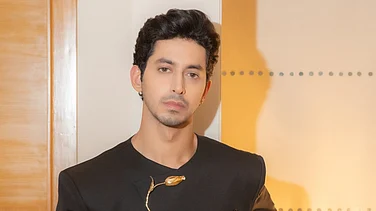
Mirzapur: The Movie is arriving in theatres on September 4.
Ahead of its release, Harshita Gaur reveals what's new things she has done in the film.
Gaur also reflects how projects like Mirzapur series and now film have constantly pushed her to evolve.
Harshita Gaur’s career growth has been quiet and steady. From becoming a household name with her breakout role as the fiery Sanyukta in Sadda Haq to her nuanced portrayal of Dimpy Pandit in Mirzapur series and Tanvi Sachdeva in Agra Affair, we have seen her evolution as a fine artiste sharpening her craft over the years.
In an exclusive interview with Outlook, Gaur opens up about her upcoming film Mirzapur: The Movie, her compelling body of work, how digital space has contributed to her growth as an actor and more.
Directed by Gurmmeet Singh, Mirzapur: The Movie is the theatrical extension of the crime thriller franchise created by Amazon MGM Studios and Excel Entertainment. Ali Fazal, Pankaj Tripathi, Divyenndu, Rasika Dugal and Shweta Tripathi, among others, are part of the film set for release on September 4.
Excerpts from the interview:
We have seen Dimple's arc grow across all three seasons. What differences can we see, or expect to see, from her character in the upcoming movie?

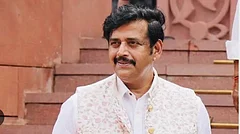


The overall essence remains the same since it's based on season one, but my character definitely has new nuances. What's especially exciting is that I got the opportunity to dance in the film. In season one, every character had a clear arc, and the movie builds naturally on those character graphs. Because of that, I got to explore a lot of new things this time around.

What is the timeline of events in the movie?
It is set directly between episodes six and seven of Mirzapur season one. Once you finish episode six, you watch the movie, which seamlessly leads into episode seven. It fits perfectly into the timeline while offering audiences something fresh.
What new things can we expect from the movie or the characters?
The dynamics between the characters are all similar—and they have to be, otherwise it wouldn't feel like Mirzapur. But because it's so well-written, it feels like seeing familiar themes from a fresh perspective.
In every season, you’re the only one who stays calm. Can we expect you to wield a gun in the movie?
The movie is set during Season 1, before any major deaths occur. At this point in the story, Dimpy hasn’t reached a moment that forces her to pick up a gun. We're offering a fresh perspective while keeping the core essence of Season 1.
Is it difficult for a character to keep her moral compass intact in a show full of morally ambiguous characters?
As an actor, no—that’s just the job. But as the character, yes. I think it’s difficult for Dimpy because she lives in a very violent world yet chooses not to be violent. That is a major decision that aligns with her morals, but it’s hard to stick to. Even though she chooses to step away, she isn't truly out of it—she's still completely surrounded by violence.
All three seasons of Mirzapur have received praise, as well as backlash on social media. However, this didn't harm the show's overall success or viewership. As an actor and as an individual, does this trolling affect you?
Not at all. If someone is offering genuine criticism, they have every right to do so. We create content for an audience, and they can choose whether or not they like it. If someone sincerely points out something they didn't enjoy, I respect that and will definitely try to learn from it. However, you can easily tell the difference when people are just trolling for the sake of it—and that doesn't affect me at all.

You’ve made a significant transition from television to major streaming projects like Mirzapur and Agra Affair. How has the digital space influenced your growth?
The digital space has contributed immensely to my growth. I was fortunate to work on Sadda Haq, where I learned so much as the show's protagonist—the character gave me plenty to sink my teeth into. The challenges I faced while shooting laid a solid foundation for my growth as an actor. Later, on Mirzapur, working alongside accomplished seniors offered even more opportunities to learn. Overall, I’ve been lucky to be part of projects that have constantly pushed me to evolve.
How did Mirzapur change things for you? Are you more selective with the scripts that come your way now?
I’ve always been selective in life, and I don't regret it at all. Everything I've done has come from a truly genuine place. Naturally, Mirzapur played a huge role in that—because it became such a massive success, it helped me connect with people, land good auditions, and secure great work.
How are agency and character development portrayed through the female characters in Mirzapur: The Movie?
I would say all the women in Mirzapur are truly dabangg. They are written so beautifully by a writer (Puneet Krishna) who is a true feminist and deeply values what every woman brings to the table. Take Sheeba (Chadha) ma'am, who plays my mother—she is essentially a housewife and doesn't even talk back to her husband, yet you still see her strength. The writing makes it clear that your occupation doesn't define your power. Whether you are a housewife, picking up a gun, standing against violence, or working in government, you are strong. Every woman just needs to recognise that strength within herself and bring it forward. That is exactly how every female character in Mirzapur has been written.
In a cast full of impactful characters, what is the key to standing out?
It’s a blessing to work with such amazing actors because you get to learn so much. But essentially, when you're acting, you shouldn't focus on standing out—you should focus on blending in. If you aren't blending into the scene, you aren't doing a good job; you're only thinking about yourself instead of the scene. I prefer to focus on the scene as a whole. If I remain true to my character—even if I only have a single line—people will naturally take notice. You don't enter a scene to stand out; you enter it to give your best, and everything else relies on how authentically the audience perceives your truth.