An ankle ligament tear has ended Neeraj Chopra's 2026 season, ruling him out of the Asian Games and Diamond League Final
A grueling cycle of injuries, back and adductor issues, and biomechanical strains have increasingly tested his elite consistency
Facing a surging new tier of Asian rivals, Chopra now pivots to a long-term recovery, handing India's continental mantle to Rohit Yadav
Neeraj Chopra's 2026 athletics season has come to a premature end after the Indian javelin star suffered a severe ligament tear in his ankle during training, ruling him out of the upcoming Asian Games in Aichi-Nagoya, Japan, as well as the rest of the year.
Having narrowly scraped through to qualify for the elite six-man field in the season-ending Diamond League Final in Brussels, Chopra will now be forced to sit out that showcase event entirely as well along with the Asian Games.
Recent Struggle With Injuries
It marks the second consecutive year that injury has abruptly cut short his campaign; toward the end of the 2025 season, he aggravated a chronic lower back/disc injury during training and, despite carrying the problem to compete at the World Championships in Tokyo in September 2025 where he finished eighth. Late-season aggravation forced him into an extended nine-month rehabilitation and recovery period that kept him sidelined through the rest of 2025 and delayed his entry into the 2026 season until June.
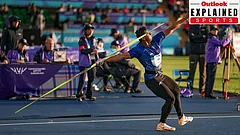


Even before that, Chopra has had to constantly manage his physical limits, navigating a series of high-profile physical hurdles—most notably his persistent adductor muscle injury that severely hampered his training and throwing mechanics in the lead-up to the Paris 2024 Olympics.
After navigating a demanding nine-month rehabilitation window that delayed his entry into the 2026 season until June, his progression was slowly building back up. Following a fourth-place finish at his return in Doha (85.69m) and a silver-medal throw at the Commonwealth Games (85.83m), he finally looked to be establishing progressive consistency.
This latest ankle setback compounds a grueling phase of recent injury struggles, intense rehabilitation cycles, and frustrating battles to recapture his peak form.
Biomechanics And The Toll of Elite Javelin
The recurrence of these physical roadblocks is closely linked to the sheer explosive demands of elite javelin biomechanics and the natural physical toll of competing at the highest level for years. Elite javelin throwers place immense, violent stress on the lumbar spine, ankles, and shoulder joint during the final blocking and release phase, where violent deceleration forces multiply body weight manifold.
To protect his vulnerable lower back and adapt to his body's changing requirements, Chopra consciously restructured his athletic profile—swapping traditional, high-mileage middle-distance running (such as 800-meter training) for sharper 100-meter sprints, targeted core stabilization, and explosive medicine ball conditioning.
Coupled with his age and years of high-intensity international competition, managing workload tolerances has become a delicate tightrope walk, requiring constant fine-tuning between raw power output and structural preservation.
The Loss Of Throne
Compounding these physical hurdles, Chopra has also seen his once-uncontested continental throne challenged by a formidable new tier of Asian throwers. Most notably, Sri Lanka's young rising star Rumesh Pathirage has emerged as a major roadblock, aggressively dismantling Chopra's historical hegemony over the region.
The shifts have been starkly visible in recent high-stakes encounters: at the Commonwealth Games, Pathirage clinched a historic gold medal while Chopra had to settle for a hard-fought silver (85.83m), and at the Lausanne Diamond League, Pathirage edged out Chopra by an agonizingly slim margin of just nine centimetres—winning with an 88.14m throw to best Chopra's season-best mark of 88.05m.
Alongside Pakistan's global icon Arshad Nadeem, this surge of elite regional talent has transformed men's Asian javelin into one of the most fiercely competitive fields in world athletics, effectively closing the era of Chopra's unchallenged dominance.
A closer look at his tactical trajectory reveals a telling trend: while Chopra has managed to retain an admirable baseline of elite consistency—frequently hovering safely in the top tier and grinding out 85m-plus throws even amidst physical adversity—he currently appears to be lacking the explosive, over-the-top power required to consistently breach the 90-meter barrier and push past fierce rivals on the ultimate step of the podium.
The King Who Ruled
This relative plateauing comes despite a peerless trophy cabinet that features nearly every major gold medal in the sport. Over a glittering career, Chopra has cemented his status as a legend by securing the Olympic Gold (Tokyo 2020) and an Olympic Silver (Paris 2024), a World Athletics Championship Gold (Budapest 2023) alongside a World Silver (Eugene 2022), and the prestigious Diamond League Trophy (2022) complemented by multiple runner-up finishes.
He is also a two-time Asian Games Gold medalist (Jakarta 2018, Hangzhou 2023), a Commonwealth Games Champion (Gold Coast 2018) in addition to his recent Glasgow silver, an Asian Championships Gold medalist (Bhubaneswar 2017), a South Asian Games Gold medalist (Guwahati 2016), and a World U20 Champion (Bydgoszcz 2016) where he famously set the junior world record. Having conquered every summit in global athletics, his current struggle is no longer about proving his pedigree, but rather managing his battered frame against a hungry new generation of challengers.
A Desperate Search For Guidance
These competitive pressures also coincided with a turbulent period in his coaching setup. Following the departure of German biomechanics expert Dr. Klaus Bartonietz—who guided him to historic Olympic and World Championship success—Chopra briefly partnered with legendary Czech javelin icon Jan Zelezny.
Though Zelezny helped Chopra finally breach the elusive 90-meter barrier in Doha, the high-profile partnership hit logistical and stylistic roadblocks. Zelezny’s rigid training requirements and centralized setups across the Czech team did not entirely align with Chopra’s body and scheduling needs, leading to a mutual parting of ways.
Chopra subsequently returned to his roots, choosing to collaborate with his early childhood mentor and domestic coach, Jaiveer Singh, alongside his long-standing support staff to rely back on his natural throwing rhythm.
Passing On The Baton
With both Neeraj Chopra and Kishore Jena absent from the upcoming continental showpiece, a massive share of the responsibility falls on fellow Indian thrower Rohit Yadav to spearhead the nation's javelin campaign and keep the Indian flag flying high at the 2026 Asian Games.
At the previous Asian Games in Hangzhou, Chopra and Jena delivered an unforgettable, historic 1-2 finish for India on the podium, with Chopra successfully defending his crown by clinching the gold medal with a season-best throw of 88.88m, while Jena bagged a sensational silver with a personal best of 87.54m.
While Chopra shifts his complete focus toward a cautious rehabilitation and long-term recovery, Indian athletics faces a transitional moment as its premier icon looks toward a carefully managed path back to full health.