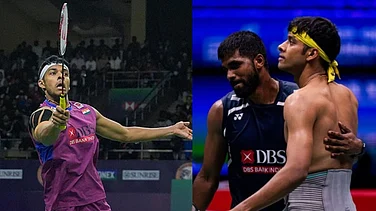
The BWF World Championships 2026 ended with France winning two historic golds through Thom Gicquel-Delphine Delrue and Alex Lanier
Treesa Jolly and Gayatri Gopichand ended India's 15-year wait for a women's doubles Worlds medal
New Delhi delivered a packed, passionate seven-day badminton spectacle
If there was one word that could explain the 2026 BWF World Championships at the Indira Gandhi Indoor Stadium in New Delhi, it was unpredictable.
France won two historic gold medals in New Delhi, with both marking firsts for the country at the BWF World Championships. Thom Gicquel and Delphine Delrue became France's first mixed doubles world champions, before 21-year-old Alex Lanier followed them by becoming the country's first men's singles champion.
An 18-year-old American, Garret Tan, ranked 92nd in the world, walked into the tournament and walked out having stunned India's top men's singles player Lakshya Sen.
A 21-year-old Indian, Ayush Shetty, meanwhile, knocked out reigning world champion and world No. 1 Shi Yu Qi on the opening day.
And those were only some of the twists packed into seven days of badminton in New Delhi.
The 30th edition produced first-time champions, unexpected medal contenders, painful exits and results that repeatedly challenged the established order. France found its golden generation, South Korea added two titles, and the podiums reflected a sport that is steadily becoming more global.


For India, where doubles has so often been synonymous with Satwik Rankireddy and Chirag Shetty, the biggest doubles story in New Delhi came from the other side of the draw.
Treesa Jolly and Gayatri Gopichand turned an injury-hit season into a historic women's doubles bronze, ending India's 15-year wait for a medal in the discipline at the World Championships and keeping the country's remarkable streak of winning at least one medal at every edition since 2011 alive.
They became only the second Indian women's doubles pair to win a World Championships medal, after Jwala Gutta and Ashwini Ponnappa in 2011.
For France, New Delhi became the backdrop to a breakthrough that had been a long time coming. Thom Gicquel and Delphine Delrue became the country's first mixed doubles world champions before 21-year-old Alex Lanier followed with France's maiden men's singles title.
It was also a remarkable full-circle moment: France's first-ever World Championships medal had come in India, when Pi Hongyan won women's singles bronze in Hyderabad in 2009. Seventeen years later, another Indian city witnessed France go from its first medal to two historic golds.
BWF World Championships 2026 Theme - Unpredictability
If the World Championships had a script, someone kept tearing it up.
The men's singles top seed Shi Yu Qi was knocked out in the opening round by India's Ayush Shetty, while an 18-year-old American ranked 92nd in the world, Garret Tan, stunned Lakshya Sen. Canada also reached the podium, and several disciplines produced first-time champions.
South Korea enjoyed a memorable campaign, with An Se Young winning the women's singles crown and Baek Ha-na and Lee So-hee claiming the women's doubles title.
China, meanwhile, finished with one gold and a strong haul of silver and bronze medals, with Liang Wei Keng and Wang Chang winning the men's doubles title.
An Se Young's victory was perhaps the closest thing the tournament had to a predictable result. Elsewhere, the old hierarchy kept shifting.
That was perhaps the defining feature of these Worlds. It was not simply about established stars losing; it was about new players and nations finding themselves in positions that once seemed reserved for the traditional powers.
And India was right in the middle of that unpredictability.
Indian Glory: Treesa-Gayatri, Giant-Killers And Lady Luck
India's campaign was a mixture of historic success and missed opportunities, with Treesa and Gayatri ultimately providing the result that mattered most.
The pair arrived in Delhi after an injury-marred season, with questions over their form and progress. Instead, they produced their strongest run of the year.
Their quarter-final against China's Jia Yi Fan and Zhang Shu Xian was the breakthrough. After losing the opening game, the Indians fought back to win 16-21, 21-15, 21-13, guaranteeing themselves a medal and ending India's 15-year wait for another women's doubles podium finish.
The semi-final against world No. 1 Liu Sheng Shu and Tan Ning became one of the week's defining moments. Treesa and Gayatri took the opening game 21-18 and briefly made another upset seem possible before the Chinese pair found their rhythm and won the next two games 21-13, 21-8.
The defeat did little to diminish the achievement. India had its medal, women's doubles had another chapter in its World Championships history, and the medal streak remained alive.
The rest of India's campaign was far more unpredictable.
Ayush Shetty's opening-round victory over Shi Yu Qi was one of the biggest shocks of the tournament. The 21-year-old walked onto court against the reigning world champion and world No. 1 and walked off with a victory that could become part of Indian badminton folklore.
His run eventually ended against Alwi Farhan, where his inability to find an effective second plan exposed an area he will need to develop. At 6'4", Ayush possesses obvious physical advantages, but men's singles is becoming increasingly unforgiving, with players throughout the top 20 capable of producing big results.
Then came Garret Tan.
The American teenager arrived in Delhi ranked 92nd in the world and left having beaten Lakshya Sen. It was one of the biggest shocks of the championships, but perhaps Lady Luck was literally sitting in his corner that day - in the form of the two women in Tan's coaches' chair, guiding him through one of the biggest matches of his young career.
Tan embraced the occasion while Lakshya struggled to find the consistency and confidence required to prevent the upset. For the American, it was the kind of victory that can change how a young player sees himself on the international stage. For Lakshya, the defeat will require a serious rethink.
Unnati Hooda also came close to a breakthrough. At 18, she pushed a higher-ranked opponent into a tense contest and had opportunities to finish the match but could not close it out. Her defeat should be viewed through the lens of a young player learning how to handle the biggest moments.
PV Sindhu, now 31, faces a different challenge. Her defeat to Wang Zhi Yi was another reminder that the next stage of her career will require adaptation, particularly in the mental and tactical areas that once made her so difficult to beat.
Satwik Rankireddy and Chirag Shetty's early exit was another disappointment, although there were mitigating circumstances. Satwik was dealing with a shoulder injury and the pair had limited competitive preparation. Without the full force of Satwik's trademark smash, one of their biggest weapons was inevitably compromised.
The absence of a singles medal for the second successive World Championships, however, remains the bigger concern for Indian badminton. That will be one of the key areas to watch when the Asian Games begin in September.
France's Golden Revolution
If Treesa and Gayatri gave India its defining story, France gave the tournament one of its most extraordinary.
Gicquel and Delrue had already shown their potential by winning bronze in Paris last year, but in New Delhi they went a step further. They defeated China's Jiang Zhen Bang and in the semi-final before beating top seeds Feng Yan Zhe and Huang Dong Ping in a tense three-game final to become France's first mixed doubles world champions.
Lanier then added another piece of history. The 21-year-old produced a commanding performance against Japan's Kodai Naraoka, winning 21-11, 21-11 to become the first Frenchman to win the men's singles crown.
The significance went beyond the two titles.
France's first World Championships medal had also come in India, when Pi Hongyan won women's singles bronze in Hyderabad in 2009. Seventeen years later, New Delhi became the setting for France's biggest badminton breakthrough.
Hyderabad had given French badminton its first taste of the podium. New Delhi gave it its first taste of gold - twice.
Delhi Showed Up: “Pullela Pullela, Jolly Good Jolly Good”
If the Indian team could have produced more on court, Delhi certainly delivered off it.
The Indira Gandhi Indoor Stadium was packed throughout the week, and the atmosphere remained remarkably strong even when Indian players were not involved. Fans travelled from Mumbai, Coonoor, Bihar, Arunachal Pradesh and other parts of the country, bringing posters, flags and chants with them.
The Treesa-Gayatri semi-final captured that atmosphere perfectly.
Around 8,000 fans packed the stadium as the Indians took on Liu Sheng Shu and Tan Ning, turning the arena into a wall of sound. “Pullela Pullela, Jolly good Jolly good,” “Come on, queen,” “You win this for PV Sindhu,” and “Come on Treesa, come on Gayatri” rang around the stands, with every Indian winner bringing another surge of noise.
Treesa and Gayatri eventually lost, but the crowd did not turn away. Instead, the players were applauded for a run that had already guaranteed India a medal.
As a female journalist covering a tournament where many of the biggest stars and loudest supporters were women, that stood out. From Sindhu and Treesa-Gayatri to An Se Young and Akane Yamaguchi, female athletes were at the centre of the week, while young girls filled the stands to watch players they looked up to.
I too found myself noticing how much of the energy around the championship came from women - as athletes, fans and members of the media.
Then there were the small things that become important when you spend long days covering a major sporting event. Anyone who has covered enough tournaments knows the loo is usually poo. This time, thankfully, it wasn't.
Sanitary pads and tampons were available at the championships, something that made a genuine difference during long working days for women at the venue.
And, mercifully, there were no monkeys, no birds creating chaos and no bird poop becoming an unexpected subplot.
The badminton was allowed to remain the story.
And there was plenty of it worth remembering.
For India, one bronze from 11 entries will inevitably leave questions, particularly in singles. But Treesa and Gayatri ensured the country did not leave its home World Championships without a medal, while Ayush's giant-killing victory, Unnati's near miss and the emergence of a new generation offered reasons to look ahead.
For France, New Delhi will be remembered as the tournament where years of progress finally turned into gold.
For Delhi, it will be remembered for full stands, loud chants, travelling fans and a crowd that embraced badminton beyond the fortunes of its home players.
And for the World Championships themselves, perhaps the defining memory will be how little went according to plan. Yet if New Delhi's successful hosting of the 2026 Worlds is any indication, India could soon have another major badminton week to look forward to.
India has already bid to host the 2028 Thomas and Uber Cup, putting itself in line for another opportunity to bring the sport's biggest stars back home.
After seven days in New Delhi, unpredictable was perhaps the only predictable thing about the 30th BWF World Championships.
Badminton World Championships 2026: Medal Winners
Men's Singles
Gold: Alex Lanier (France)
Silver: Kodai Naraoka (Japan)
Bronze: Chou Tien Chen (Chinese Taipei), Victor Lai (Canada)
Women's Singles
Gold: An Se Young (South Korea)
Silver: Akane Yamaguchi (Japan)
Bronze: Wang Zhi Yi (China), Pornpawee Chochuwong (Thailand)
Men's Doubles
Gold: Liang Wei Keng and Wang Chang (China)
Silver: Aaron Chia and Soh Wooi Yik (Malaysia)
Bronze: Kim Won Ho and Seo Seung Jae (South Korea), Lee Jhe Huei and Yang Po Hsuan (Chinese Taipei)
Women's Doubles
Gold: Baek Ha-na and Lee So-hee (South Korea)
Silver: Liu Sheng Shu and Tan Ning (China)
Bronze: Treesa Jolly and Gayatri Gopichand (India), Li Yijing and Luo Xumin (China)
Mixed Doubles
Gold: Thom Gicquel and Delphine Delrue (France)
Silver: Feng Yan Zhe and Huang Dong Ping (China)
Bronze: Amri Syahnawi and Nita Violina Marwah (Indonesia), Jiang Zhen Bang and Wei Ya Xin (China)