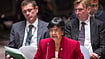
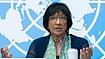
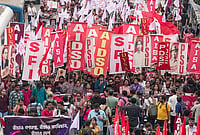
AISA president Neha Bora has emerged as a prominent face of protests against CEC Gyanesh Kumar over SIR.
Founded in 1990, AISA is the student wing of CPI(ML) Liberation.
The organisation has a history of Left-wing campus activism and protests, including against CAA-NRC.
Student movements rarely bring down ministers. This one has already managed it once, and now it has a bigger target. Neha Bora and the Cockroach Janta Party (CJP), both part of the campaign that forced out the education minister, have become the focal point of protests against Gyanesh Kumar, the chief election commissioner, over alleged irregularities in the Special Intensive Revision (SIR).
Bora is national president of the All India Students’ Association (AISA), one of several groups, the CJP among them, whose agitation ended with the resignation of the then education minister Dharmendra Pradhan.
The July agitation was a significant moment in this trajectory. Members of AISA, the Students’ Federation of India (SFI) and the All India Students’ Federation (AISF) joined Sonam Wangchuk in a hunger strike amid demands for the resignation of then Education Minister Dharmendra Pradhan.
Pradhan resigned soon after, though the extent to which the agitation contributed to his departure remains a separate question. However, for her, the journey to the protest stage began well before she became the face of a student organisation.


An army family meant a childhood spent moving from city to city, though her roots lie in Khatima, a small town in Uttarakhand. Away from political rallies, she is also a theatre artist, a pursuit that sits alongside her life in student politics.
Her academic journey has largely unfolded in Delhi, from a BA at Delhi University to an MA at Ambedkar University, and now a PhD. It was through student agitations that Bora began attracting wider public attention this year.
At Jantar Mantar, she joined protests demanding Pradhan’s resignation over alleged paper leaks and irregularities in the NEET examination. The current confrontation over electoral rolls has brought her back to the same protest grounds, this time with the focus on the Election Commission.
Bora’s journey is inseparable from the organisation she leads. To understand the politics she brings to the streets, it is worth looking beyond the current protests to AISA’s own evolution, from the fractures of India’s communist movement to a student organisation that has made campuses and public demonstrations arenas of political contest.

The Making Of AISA
It is not the first time that her organisation is on the streets against the decisions of the state. To understand the history of AISA, one has to understand the history of communist parties in India.
AISA was founded on 9 August 1990 and claims that it is a revolutionary student movement. It is the student wing of the Communist Party of India (Marxist-Leninist) Liberation, also known as CPI(ML)L. The CPI(ML)L was born from a faction of the CPI(ML) that led the Naxalite movement in West Bengal in 70s and 80s.
The Communist Party of India was formed in 1925 through the Kanpur Conference under the chairmanship of M. Singaravelu Chettiar. AISF, the student wing of CPI, was formed in 1936. However, in the year 1964, the CPI saw a split, and the CPI (Marxist), or CPI(M), became an independent party.

The CPI(M) formed government in Bengal, leading short-lived United Front coalition governments in 1967 and 1969. However, on the issue of an attack on a tribal youth in Naxalbari village by the local landlord’s men, rebel cadres of the party - Charu Mazumdar and Kanu Sanyal launched an armed uprising.
In 1972, Mazumdar was arrested by the police, and he eventually died in jail. Indian Express quoted Partha Chatterjee’s book, in which he writes, “Several hundreds were killed by the police in fake encounters, and thousands were put in prison.”
The revolutionary movement further split into the Dakshin Desh, that become the MCC in 1975; the People’s War Group (PWG); the Party Unity; and the CPI(ML)L, the parent party of AISA.
CPI(ML)L left the path of armed struggle, and Subrata Dutta (Jauhar) became its first General Secretary in 1974. The three factions of the revolutionary movement continued with the armed struggle.
AISA has emerged as a major student union representing the left in North India after its foundation in 1990. It has won several student union election in the Jawaharlal Nehru University(JNU). AISA has also won presidential elections in Banaras Hindu University and Allahabad University in 90s.
What Does AISA Believe In?
AISA describes itself as a revolutionary student movement, and its stated aim is "A New India and A New World". Its website promises the revolutionary transformation of society, and it claims the legacy of Bhagat Singh and Chandrasekhar.
Notably, its methods are those of the campus left: processions, demonstrations, seminars, street plays, film screenings and revolutionary songs.
The ideology comes from its parent. AISA is the student wing of the CPI(ML) Liberation, whose own programme begins with the "minimum programme of accomplishing new democratic revolution in India".
Its own manifesto calls AISA a revolutionary, democratic students' organisation that has led struggles for the democratisation of campus life.
On campus, the agenda is more practical. In Delhi University Students' Union polls, AISA promised more DTC buses and better connectivity for every college, affordable hostels, safety for women and gender minorities, and queer-affirmative counselling.
In an earlier DUSU manifesto it attacked the ABVP over hooliganism on campus, took aim at the NSUI, and complained that the DMRC would not give students Metro passes. AISA has also taken its politics off campus. In 2019 it was among the groups that helped organise the agitation against the CAA and the NRC.
Its critics say the revolutionary language matters more than the campus demands. One critical commentary in Swarajya argues that most students who share AISA's clips online know little about its history or its parent party's programme. AISA's supporters see a student body that fights for fees, safety and campus democracy and sits in the tradition of Indian left politics.
For now, the question for AISA is whether the energy of the past few months can last. It helped to force out an education minister in July, and under Bora it is now part of a larger confrontation with the Election Commission.