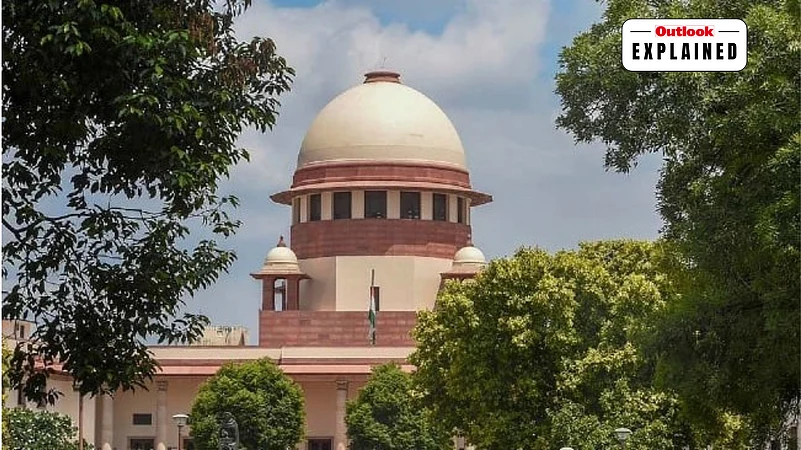
The Supreme Court has reaffirmed that governments cannot unilaterally withdraw FIRs or end criminal proceedings against protesters.
While the executive may seek to withdraw a prosecution, the decision requires an independent Public Prosecutor's request and the approval of the competent court.
The ruling reinforces judicial oversight, ensuring criminal cases cannot be terminated solely on political considerations.
The Supreme Court's recent observations on criminal cases filed against student protesters have revived an old legal question: can a government simply withdraw an FIR once a protest ends or political circumstances change? The issue gained prominence after the Court urged the Centre to consider withdrawing cases against students who participated in protests, while emphasising that such decisions must be taken in accordance with the law.
The remarks have triggered debate over the powers of governments, the role of courts and the limits of executive discretion. The short answer is that governments can seek to end criminal proceedings in certain cases—but they cannot erase an FIR or halt a prosecution on their own.
What did the Supreme Court clarify?
The Supreme Court was hearing petitions concerning criminal cases registered against students involved in recent protests when it observed that the Union government could consider withdrawing appropriate cases if the circumstances justified such a course. At the same time, the Court made it clear that the legal process prescribed under the Code of Criminal Procedure (now the Bharatiya Nagarik Suraksha Sanhita, 2023) must be followed.



The Court did not direct that all FIRs be withdrawn, nor did it hold that protesters were immune from prosecution. Instead, it reiterated a long-established legal principle: while governments may decide that continuing a prosecution is no longer in the public interest, the final decision rests with the judiciary.

Can a government simply withdraw an FIR?
No. A government cannot simply cancel or erase an FIR through an executive order.
An FIR is the formal record of information relating to the commission of a cognisable offence. Once it has been registered, the investigation proceeds under the supervision of the investigating agency. Neither the state government nor the Union government has the legal authority to delete the FIR merely because it has changed its political position or wishes to end the matter.
If the investigation finds no evidence of an offence, the police may file a closure report before the jurisdictional magistrate. Alternatively, if sufficient evidence exists and a chargesheet has already been filed, the prosecution may seek permission from the court to withdraw from the case. In both situations, the judiciary—not the executive—has the final say.
This distinction is central to India's criminal justice system, ensuring that criminal proceedings cannot be terminated solely by political decisions.
What's the difference between closing an FIR and withdrawing a prosecution?
The two processes are often confused but are legally distinct.
A closure report is filed by the investigating agency when it concludes that no offence is made out or that there is insufficient evidence to prosecute. The report is submitted to the magistrate, who may accept it, reject it or direct further investigation.
Withdrawal of prosecution, on the other hand, takes place after criminal proceedings have begun. Under Section 360 of the Bharatiya Nagarik Suraksha Sanhita, 2023 (which replaces the earlier Section 321 of the Code of Criminal Procedure), a Public Prosecutor may, with the consent of the court, withdraw from the prosecution of any accused before judgment is pronounced.
The prosecutor cannot act solely on government instructions. Courts have consistently held that the Public Prosecutor must independently conclude that withdrawal would serve the interests of justice, and the trial court must examine whether that decision is legally justified.
What role do courts play?
Whenever a Public Prosecutor seeks to withdraw a prosecution, the trial court must decide whether granting permission would advance the administration of justice. Courts examine factors such as the nature of the allegations, the evidence collected, the stage of the proceedings and whether the request has been made in good faith or for political considerations.
The Supreme Court has repeatedly held that the power to withdraw prosecution cannot be exercised for partisan or extraneous reasons. The judiciary therefore acts as an independent check on executive decisions, ensuring that criminal law is not used—or abandoned—for political convenience.
This is why governments cannot unilaterally terminate criminal cases once they have entered the judicial process.
Why are "heinous offences" treated differently?
Courts have consistently distinguished between prosecutions arising from political demonstrations, public protests or minor law-and-order incidents, and those involving serious crimes such as murder, rape, terrorism or offences affecting national security.
Where allegations involve grave violence, loss of life or offences against society at large, courts are generally reluctant to permit withdrawal merely because the government requests it. Such crimes are viewed as offences against the public, not just against an individual complainant.
By contrast, cases arising from peaceful political protests, student demonstrations or public movements may be viewed differently if the government can demonstrate that continuing the prosecution would no longer serve the public interest. Even then, judicial approval remains mandatory.
The distinction reflects the principle that the seriousness of an offence affects not only the accused and the government but society as a whole.
What does this mean for future protests?
The Supreme Court's observations do not create a new legal power. Rather, they reaffirm the existing framework governing criminal prosecutions.
Governments remain free to review cases arising from protests and decide whether continued prosecution is warranted. But any attempt to withdraw criminal proceedings must pass through the Public Prosecutor and receive the approval of the competent court.
For protesters, this means that criminal cases are not automatically erased following a change in government or a political settlement. Each case must be assessed on its own facts, and courts retain the ultimate authority to determine whether the interests of justice favour continuation or withdrawal.
The ruling also reinforces a broader constitutional principle: while elected governments may shape criminal justice policy, they cannot exercise unchecked control over the fate of criminal proceedings. That responsibility ultimately belongs to an independent judiciary.