The Supreme Court issued notice on two pleas linked to the October 12 march towards the court in New Delhi.
The petitions seek regulation of protests near courts and contempt proceedings against Rahul Gandhi, Mallikarjun Kharge, Akhilesh Yadav and Mahua Moitra.
Chief Justice Surya Kant said the court was not sitting in ivory towers and was aware of developments outside its premises.
While hearing pleas over an October 12 march towards the court, the Supreme Court on Wednesday said it was “not sitting in ivory towers.” A bench of Chief Justice of India Surya Kant and Justice Joymalya Bagchi issued notice on two pleas seeking similar reliefs.
The petitions ask for tighter rules on protests and processions near courts and seek criminal contempt action against political leaders, including Lok Sabha Leader of Opposition Rahul Gandhi, Congress president Mallikarjun Kharge, Samajwadi Party chief Akhilesh Yadav and Trinamool Congress MP Mahua Moitra. The cases stem from an October 12 march to the Supreme Court by political leaders and supporters over matters linked to the Election Commission of India and Chief Election Commissioner Gyanesh Kumar. The march followed the CJI's refusal to let the Leaders of Opposition in the Lok Sabha and Rajya Sabha meet him and hand over a memorandum, saying the issues were already before the court.


The hearing also led to an order to preserve CCTV and other digital material linked to the events.
March And Petition
Senior advocate Gaurav Bhatia, appearing for the petitioner, told the court that it was wrong for the Supreme Court to be dealing with a political march. He said the episode should not have taken place and pointed to the distress among lawyers over what happened. Bhatia told the bench that about 200 lawyers had signed a memorandum saying the conduct amounted to “browbeating”.
“Nobody can browbeat us,” the CJI said. Bhatia nevertheless said the attempt itself was worrisome and sought preservation of CCTV footage, contending that a pregnant lady journalist was pushed during the march.
The CJI said such efforts were weak and drew no attention. “We are not sitting in ivory towers. We know what statements they make outside and what they say in Court. We know everything,” the CJI said. He added that the court kept track of events beyond its premises.
FIRs And Footage
The court told all law enforcement agencies to keep CCTV footage and any other digital records or material they gathered on the October 12 events.
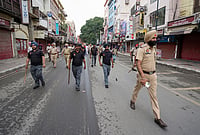
The Delhi Police registered four FIRs over alleged violations of prohibitory orders in and around Connaught Place and the Supreme Court. Two FIRs were registered at Tilak Marg police station, while Mandir Marg and Barakhamba Road police stations registered one each. The orders had been imposed under Section 163 of the Bharatiya Nagarik Suraksha Sanhita (BNSS).
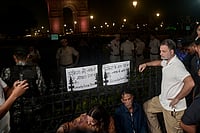
The march drew thousands of protesters, including opposition leaders and supporters, in central Delhi after two days of police action against protesters.