Jaishankar questioned what the Pakistan-Saudi-Turkey defence pact had done in response to the three countries’ existing security challenges.
The pact commits Pakistan, Saudi Arabia and Turkey to closer defence cooperation and treats an armed attack on one as an attack on all.
Jaishankar also spoke about India’s ties with Bangladesh and Pakistan, stressing mutual interests and the impact of terrorism on India’s foreign policy.
External Affairs Minister S Jaishankar has questioned the immediate value of the new Pakistan-Saudi Arabia-Turkey defence pact, asking what it had done in response to the ‘live military situations’ facing each of the three countries.
Speaking at the Economic Times World Leaders Forum, Jaishankar was asked whether India was worried about the Mecca Joint Defence Agreement signed by Pakistan, Saudi Arabia and Turkey. “You think about it. There are live military situations that each of the three countries is facing. What has this pact done in response to that?” he said.
The remarks came as the three countries move to deepen defence cooperation under an agreement that says an armed attack on one would be treated as an attack on all. Reuters reported after the signing that the pact does not specify the military commitments or defence obligations that would follow such an attack.
What the Pakistan-Saudi-Turkey pact says
Under the agreement, Pakistan, Saudi Arabia and Turkey will strengthen political and military coordination, including through mechanisms for senior political and military officials to coordinate on defence and security. Turkey’s defence ministry said the three countries would establish mechanisms bringing together senior political and military officials, conduct joint exercises and expand defence-industrial cooperation.


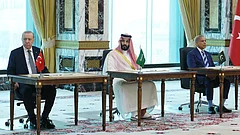
Reuters reported on August 13 that the planned cooperation would cover land, sea, air and cyber exercises, alongside areas including unmanned systems, electronic warfare and artificial intelligence. The countries also plan greater defence-industrial cooperation, including joint development, production and technology transfer.
Turkish Foreign Minister Hakan Fidan has compared the collective-defence provision with NATO’s Article 5, under which an attack on one member is treated as an attack on all.
The three governments have described the pact as defensive and said it is not directed against a particular country. Reuters also reported that the agreement would complement, rather than replace, the countries’ existing alliances and security arrangements.
Pakistan has longstanding defence ties with Saudi Arabia and is the only nuclear-armed country in the grouping. Turkey has a large conventional military and an established defence industry, while Saudi Arabia has significant financial and regional influence.
The agreement was signed amid continuing security tensions in West Asia.
Jaishankar, however, did not announce any specific Indian response to the agreement. He instead questioned what the pact had done in response to the security challenges already confronting its members.
Jaishankar on Bangladesh, Pakistan
Jaishankar also referred to India’s earlier security concerns involving Bangladesh, saying: “In Bangladesh, we had large numbers of terrorists and separatists who were living openly in Dhaka and carrying out operations against us a little over a decade ago.”
Jaishankar was referring to an earlier period in India-Bangladesh relations when New Delhi had raised concerns about militant and separatist groups operating from Bangladeshi territory. Relations between the two countries have faced renewed strain since the ouster of former Bangladesh prime minister Sheikh Hasina in 2024, after mass protests forced her from office.
Bangladesh has sought Hasina’s extradition, while India has said the request is being examined through established processes, according to Reuters. Reuters has also reported on Dhaka’s efforts to secure a response from New Delhi on the request.
Speaking about India’s relations with its neighbours, Jaishankar said ties had to satisfy the “test of mutual interest”. “It has to work for them, it has to work for us,” he said, adding that India could not expect its neighbours to act only in New Delhi’s interests.
On Pakistan, Jaishankar described the country as ‘unique’, saying he did not know of another country that uses terrorism ‘so systematically’ and in such a sustained manner to attack and pressure a neighbour. He said the history of terrorism originating from Pakistan affects public opinion in India and therefore has a bearing on the country’s foreign-policy choices.