With the poll season just around the corner, the Bharatiya Janata Party-National Democratic Alliance (BJP-NDA) combine has its task ready, as this is the first election after the Gen-Z protests have caught the imagination of the people, and for the first time, the Union government is facing protests by students and opposition parties in its third consecutive term.
With little over three months left for the first round of direct political contests between the BJP and Congress that can shape the way for the 2029 general elections, the leadership of the ruling party has decided to first put its house in order and to retain the state governments in Uttar Pradesh (UP), Uttarakhand, Goa and Manipur while trying to return to power in Punjab.
“The Congress and the opposition parties are holding these protests in Delhi, but the fact is that these protests are limited to the national capital only. The mood in the states is different. We are confident that BJP and NDA will be able to retain governments because they have a known leadership in each state, while Congress has no prominent face in any of the election-bound states,” says a senior BJP leader involved in the party’s campaign.
If the Lok Sabha performance of the BJP in these five election-bound states can be considered, then the BJP won only 39 out of the 102 Lok Sabha seats. Although the BJP faced severe losses in UP, the worst performance remained in Punjab and Manipur, where it could not win a single seat.



Course Correction
Taking a lesson from its performance in UP in the 2024 general elections, where the BJP-NDA combine won fewer seats as compared to the Congress and Samajwadi Party (SP) alliance, the BJP is trying to identify and correct its past mistakes.
The confidence within the INDIA bloc is visible because it won 43 Lok Sabha seats and led in 224 assembly segments in UP, while the BJP-NDA combine won 37 seats and led in 179 assembly segments. It is for the first time in a decade that the NDA is facing a contest in UP, where the opposition is riding high on its performance in national polls.
The BJP leadership has identified two problem areas for the party to rectify before the polls. Senior leaders believe that the BJP must be cautious in ticket distribution and must win back its voter base, especially non-Jatav Dalits and a portion of the non-Yadav Other Backward Classes.
BJP must be cautious in ticket distribution and must win back its voter base.
“There is no challenge at the top. The opposition cannot counter the popularity of PM [Narendra] Modi and Yogi Adityanath [UP chief minister]. The BJP has to win back its voter base and pacify its workers who are annoyed with the importance being given to outsiders who have joined the party,” says the BJP leader quoted earlier.
The BJP has to also contend with growing pressure from its NDA partners who are demanding a larger share in seat distribution. In 2022, the BJP contested 376 seats in UP and won 255 seats. The NDA won 273 out of the 403 seats in the assembly. Soon after the assembly polls, Rashtriya Lok Dal (RLD) under Union minister Jayant Singh joined NDA with its eight Members of Legislative Assembly (MLAs) along with Om Prakash Rajbhar’s Suheldev Bharatiya Samaj Party (SBSP) with its six MLAs, taking the total count of NDA to 284 in the assembly.
However, the RLD hopes to contest at least 50 seats in the 2027 Assembly polls. Although RLD’s voter base is limited to western UP, it wants to expand its base in central and eastern parts of the state. In fact, RLD recently appointed Aishwarya Raj Singh, a member of the royal family of Basti, as its UP chief. Basti is in eastern UP.
The case is no different for smaller parties like the SBSP and Nishad Party which contested 17 and 10 seats, respectively, in the 2022 polls but are now demanding at least 30 and 20 seats, respectively. To further strengthen its alliance, the BJP has reached out to Raghuraj Pratap Singh or Raja Bhaiya of Jansatta Dal (Loktantrik). The BJP leadership is facing similar pressures in Goa as well, where its alliance partner, Maharashtrawadi Gomantak Party has demanded a greater number of seats before the polls.
Punjab Puzzle
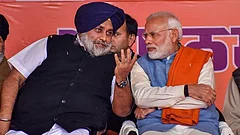
After a gap of over six years, the 2027 Punjab elections are likely to see the return of Shiromani Akali Dal (SAD), one of BJP’s oldest allies, within the NDA as the leadership of the two parties continue to hold talks to streamline the seat-sharing arrangement.
Even though the final announcement is expected to be made sometime this month, the two parties have to find answers to two crucial questions: who will be the CM if NDA returns to power and will the SAD join the Union cabinet or the alliance will be limited to Punjab?
With a cabinet reshuffle expected soon, it is possible that the presence of SAD will not just be visible in Punjab but also in the Union council of ministers. The SAD leadership walked out of NDA in September 2020, almost 24 years after Parkash Singh Badal, the chief of the SAD, gave unconditional support to former prime minister Atal Bihari Vajpayee in 1996.
“The SAD is open to the idea of BJP contesting almost 50 seats in Punjab. The question of who will be the chief minister is also not a debate because the face of the campaign will be Sukhbir Singh Badal with the backing of PM Modi,” says a senior SAD leader.
While it has been almost three months since SAD chief Sukhbir Singh Badal met Modi in New Delhi and signalled a return of the alliance in Punjab and also at the national level, the discussions have dragged on because of the differences between the state unit of the BJP and the central leadership.
While the state unit of the BJP is keen for an alliance, especially after the BJP failed to win a single seat in Punjab during the Lok Sabha polls, the central leaders of the BJP, including the Union home minister, Amit Shah, prefers that the BJP should go alone and develop its voter base among the three crucial social groups, the Jatt Sikhs, Hindus and the Scheduled Caste community.
The Delhi leadership deputed Ravneet Singh Bittu, former Union minister, to garner support of the prominent Jatt Sikh community. The party initially chose four leaders to lead the BJP’s campaign in Punjab. Apart from Bittu, the BJP appointed Kewal Singh Dhillon, a prominent Jatt Sikh leader, as the state president. The task of reaching out to farmers and the Hindu population was given to Sunil Jakhar, the former BJP chief in Punjab and Nayab Singh Saini, Haryana CM, who has been regularly travelling to Punjab at least for the past six months.
“The alliance between the BJP and the SAD is like a marriage of convenience because both parties need each other in Punjab for their political relevance. But it is difficult to say if they would be able to play a dominant role again in the state politics,” says Jagrup Singh Sekhon, former political-science professor at the Guru Nanak Dev University, Amritsar.
MORE FROM THIS ISSUE


Gyan Verma is Associate Editor, Outlook