



Hung Cao claimed insurance costs for a single commercial transit had surged from $54,000 to $64 million.
Iranian restrictions, tanker attacks and the US blockade have disrupted commercial traffic through the Strait of Hormuz.
Oil and LNG shipments remain below pre-war levels despite a partial recovery in the third quarter of 2026.
A senior United States Navy official has claimed that insurance costs for commercial ships transiting key Middle Eastern waterways have risen to $64 million for a single crossing, raising questions about the impact of the US-Israeli war on freedom of navigation through the Strait of Hormuz.
Acting US Navy Secretary Hung Cao made the remark during his confirmation hearing before the Senate Armed Services Committee on November 17. Lawmakers questioned the cost of the US-Israeli war on Iran and its impact on freedom of navigation. Cao compared the current figure with $54,000 before the conflict, but did not explain how the $64 million estimate had been calculated.
The figure has not been independently verified. Attacks on commercial ships, Iranian restrictions and falling traffic have nevertheless severely disrupted passage through the Strait.
What did Hung Cao say about shipping insurance in the Middle East?
During an exchange with Democratic Senator Elissa Slotkin, Cao was asked whether commercial ships could transit either the Strait of Hormuz or the Bab el-Mandeb without a formal US military escort. He replied that they had been unable to do so even before the war, citing Iran's use of unmanned surface vessels to target commercial ships. Slotkin then asked whether a commercial vessel carrying petroleum products would have needed an escort a year earlier. Cao cited an insurance rate of $54,000 for one transit, replied “Not always” when pressed, and said the figure had risen to $64 million.


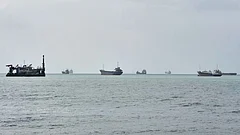


Slotkin argued that commercial vessels no longer enjoyed the same freedom of navigation as before the war. “We do not have the same freedom of navigation that we had a year ago,” she said during the hearing.
Cao told Slotkin the US controls both chokepoints. President Trump says the Navy is successfully escorting ships, while Iran says it controls passage.
Michelle Bockmann, an analyst at maritime intelligence company Windward, told Al Jazeera that Cao had not provided enough information to establish what the amount covered.
“He gave no context. Is he talking about additional premiums for war risk insurance which are set as a percentage of hull value?” Bockmann said. “If so, it depends on the vessel type and the rate paid in order to get proper perspective.”
S&P Global’s Platts reported in July, quoting Marsh broker Marcus Baker, that additional war-risk premiums had risen from 1–3 per cent of a ship's hull value weeks earlier to 7.5–10 per cent. For scale, that implied about $21 million to insure a large crude tanker, and an ENOC executive put the cost of moving an oil cargo through the strait at $10–20 million.
Is the Strait of Hormuz open to commercial shipping?
The Strait of Hormuz has not been sealed to all commercial traffic. Some vessels continue to cross, but Iran has imposed restrictions, demanded that ships use approved routes and threatened vessels it considers unauthorised. Iranian lawmaker Amir Hayat Moqaddam said ships from India, China, Iraq and Qatar were exempt from the restrictions, Al Jazeera reported.
Figures published by the UK Maritime Trade Operations (UKMTO) illustrate the scale of the disruption. Its November 13 transit overview recorded 308 combined inbound and outbound transits during the seven days ending November 11: 169 inbound and 139 outbound. This was approximately 65 per cent below pre-conflict levels.
The total combines AIS-derived crossings with transits reported through the US Naval Cooperation and Guidance for Shipping (NCAGS) programme. UKMTO said 82 of the 308 transits were observed through AIS; the remaining 226 were reported through the US NCAGS programme and could not be independently verified by the agency.
The latest available IMF PortWatch observation, for November 8, showed three AIS-derived transits. The daily estimate is not directly comparable with UKMTO's seven-day total and may miss vessels that switch off or manipulate their tracking systems.


The US blockade is a separate issue. CENTCOM first imposed a blockade on Iranian ports on April 13, suspended it on June 18 and resumed enforcement on July 14. A November 18 advisory from the Joint Maritime Information Center (JMIC), with an appended USNAVCENT-NCAGS update, said the blockade applies to all Iranian ports and coastal areas and covers vessels of all flags entering or leaving them without authorisation.
The advisory states that the blockade “will not impede neutral transit passage through the Strait of Hormuz to or from non-Iranian destinations”. Neutral vessels may still be subject to inspection, while ships suspected of violating the blockade can face interception, diversion or capture.
Why is shipping through the Strait of Hormuz dangerous?
On November 17, ADNOC Logistics and Services said one of its vessels was attacked while transiting the Strait of Hormuz, leaving one crew member unaccounted for and 11 injured. The remaining crew were evacuated, the company said. Maritime security firm Vanguard Tech identified the vessel as the Liberia-flagged product tanker Navig8 Messi, according to Seatrade Maritime. UKMTO's warning, published on November 18, recorded the incident date as November 17 and placed the tanker 13 nautical miles north of Khasab; it also reported one crew member missing.
UKMTO also published a separate time-late report on November 18 of a tanker struck about six nautical miles north of Khasab while transiting outbound through the Strait. It said the crew were safe but did not identify the vessel. In a post that day, Union Shipping Minister Sarbananda Sonowal identified a Liberia-flagged tanker, MT Navig8 Messi, as having been targeted by a projectile while approaching the Strait. He said all three Indian seafarers and the rest of the crew were safe and accounted for, with one Indian officer taken to hospital for first-aid treatment and medical evaluation. Sonowal's account differs from ADNOC's on the date and crew status of the Navig8 Messi incident; the available reports do not establish whether he was referring to the November 17 attack or a separate incident on November 18, or whether the tanker in UKMTO's six-nautical-mile report was the same vessel.
The International Maritime Organization's register listed 138 confirmed incidents in the Strait of Hormuz and the wider Middle East as of November 17, alongside 25 confirmed seafarer fatalities.
The latest JMIC advisory, issued on November 18, maintained the regional maritime threat level at SEVERE, warning that further deliberate hostile activity was likely under prevailing conditions. It said vessels should expect a sustained naval presence, increased monitoring and hailing by Iran's Islamic Revolutionary Guard Corps, possible attacks on vessels transmitting AIS signals and congestion near anchorages.
The advisory advised masters to monitor VHF Channel 16, make their transit intentions clear and report unusual activity to maritime reporting centres.


Why does the Strait of Hormuz matter to the global economy?
The Strait is the principal sea route connecting the Persian Gulf with the Gulf of Oman and the Arabian Sea. Before the conflict, it carried about one-fifth of the world's oil supplies, making any sustained disruption significant for energy markets and countries dependent on Gulf exports.
Data from the US Energy Information Administration (EIA) show how sharply flows have fallen. Average oil shipments through the Strait declined from 21.1 million barrels per day in the second quarter of 2025 to 15 million in the first quarter of 2026 and 5.1 million in the second quarter of 2026.
Flows recovered to 9.1 million barrels per day in the third quarter of 2026. That was an increase from the previous quarter, but remained about 57 per cent below the second quarter of 2025. EIA says its 2026 Hormuz estimates draw on Vortexa tanker-tracking data supplemented by additional analysis. It cautions that AIS data have become especially unreliable since late February and that the estimates are revised frequently.
Liquefied natural gas (LNG) flows followed a similar pattern. They fell from 11 billion cubic feet per day in the second quarter of 2025 to 0.8 billion in the second quarter of 2026, before recovering to 1.4 billion in the third quarter.
The Strait of Hormuz remains physically navigable, but commercial shipping has not returned to normal, with vessels facing restrictions, security risks and sharply higher insurance costs.







