Donald Trump denies that Washington is negotiating with Iran but predicts an outcome to the conflict fairly soon.
Iran says indirect talks continue through Pakistan and Qatar, but Washington has not confirmed Tehran’s account.
Brent crude rises above $111 a barrel amid renewed regional tensions and uncertainty over the Strait of Hormuz.
US President Donald Trump has denied that Washington is negotiating with Iran, while predicting that the conflict between the two countries will reach an outcome “fairly soon”. His remarks on Wednesday, October 21, came amid continued diplomatic activity through regional mediators, disagreements over Iran’s nuclear programme and uncertainty over the Strait of Hormuz, a key route for global oil shipments.
“No, I think we’re not negotiating,” Trump told reporters, according to Anadolu Agency. He added that the United States would have “something one way or the other” that would happen “fairly soon”.
The comments contrast with Trump’s earlier statements that Washington and Tehran were engaged in “productive discussions”. They also come as Iran continues to press for the lifting of the US naval blockade and sanctions before broader negotiations on its nuclear programme can proceed.
Trump’s remarks do not establish whether all diplomatic communication has stopped. On October 21, Iranian Foreign Minister Abbas Araghchi said indirect talks with Washington were continuing through mediators Pakistan and Qatar. He also claimed that the US had accepted Iran’s seven-day proposal but was seeking additional terms. Araghchi said the Strait of Hormuz would remain closed until Washington accepted Tehran’s conditions. His account of US acceptance has not been independently confirmed by Washington.

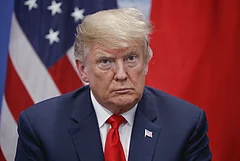


Trump Says Iran War Could End Soon, Denies Talks
Trump’s latest remarks contrast with his October 8 statement that Washington and Tehran were having “productive discussions”. He also said the United States would not attack Iran before the November 3 midterm elections. “We will not be attacking Iran at any time prior to the Midterm Elections to be held in the United States on November 3rd,” Trump wrote on Truth Social, according to Reuters.
He also maintained that Iran would never be allowed to acquire a nuclear weapon and said the conflict would end soon. However, his latest denial of negotiations has raised questions about the status of diplomatic efforts and whether the two sides have made progress towards a settlement.
At a rally in South Carolina on October 21, Trump said the United States could leave the conflict immediately but wanted to ensure that any outcome would last.
“It’ll end very soon. We could leave now, but we want to make sure it lasts for a long time,” he said, according to Anadolu Agency.
The remarks indicate that Trump expects an outcome, but they do not establish whether that outcome would involve a negotiated settlement, a unilateral US decision to end military operations or another development in the conflict.
Iran’s Hormuz Proposal Remains Stalled
Iran has put forward a seven-day proposal linking the reopening of the Strait of Hormuz to changes in US policy. The proposal, conveyed through mediators, sought the lifting of the US naval blockade, relief from restrictions on Iranian oil exports and the release of frozen Iranian assets.
According to Al Jazeera, Iran’s original seven-day proposal envisaged reopening the Strait of Hormuz before negotiations on its nuclear programme began. Tehran made the plan conditional on Washington lifting its naval blockade, easing oil sanctions, releasing frozen Iranian assets and ending hostilities across the region. Trump rejected that proposal on September 26, Al Jazeera reported.
In a later development, Araghchi said on October 21 that Washington had accepted Iran’s seven-day proposal but was seeking additional terms. The US has not independently confirmed his account.
The central disagreement concerns the order in which the two sides would address their demands. Iran wants the blockade, sanctions and regional hostilities dealt with before broader nuclear negotiations begin. Washington, meanwhile, has insisted that Iran’s nuclear programme must be addressed as part of a comprehensive settlement.
A Reuters report citing three Iranian officials and an Iranian insider, said they believed Tehran was prolonging the stalemate in an attempt to weaken Trump politically ahead of the US midterm elections. The officials also expressed concern about renewed US and Israeli attacks. Their assessment should not be treated as confirmation of an officially declared Iranian strategy.
One Iranian official told Reuters: “Iran is preparing for renewed Israeli and US attacks, not for a deal with America to end the war.”
That assessment reflects the views of the officials cited by Reuters, rather than a publicly confirmed Iranian government strategy. The report also described the economic pressure on Tehran, including restrictions on oil exports and the effects of the US blockade.
The competing demands have left the two sides without a publicly confirmed agreement on the terms of a settlement. Although Araghchi said Washington had accepted Iran’s seven-day proposal, the US has not publicly confirmed that account, and no agreed timetable for reopening the Strait of Hormuz or ending the conflict has been announced.

Brent Crude Oil Tops $111 As Iran War Tensions Escalate
Oil prices rose on Thursday, October 22, as renewed Houthi attacks in Saudi Arabia heightened concerns about a wider regional conflict and possible disruption to crude supplies. Reuters reported that Brent crude futures climbed $2.82, or 2.59%, to $111.64 a barrel at 0626 GMT, while US West Texas Intermediate crude gained $2.24, or 2.31%, to $99.39. These were intraday prices, not closing figures.
The Strait of Hormuz is central to these concerns. Before the conflict, the waterway carried roughly one-fifth of global oil and liquefied natural gas flows. Disruption to shipping through the strait can restrict exports from Gulf producers, raise transportation and insurance costs, and increase pressure on fuel prices in importing countries.
Iran’s proposal to reopen the waterway has therefore become a key part of the diplomatic dispute. Tehran has linked normal maritime passage to the lifting of the US blockade and other concessions, while Washington has sought a broader agreement that also addresses Iran’s nuclear programme.
The latest oil-price movements underline the uncertainty facing energy markets. A durable settlement could ease fears about supply disruptions, but continued military tensions and the absence of an agreed diplomatic framework leave prices vulnerable to further volatility.
What Happens Next In The US-Iran Conflict?
Trump’s prediction that the conflict will end soon remains unconfirmed, with Washington and Tehran yet to reach a publicly announced agreement on sanctions, the US naval blockade, Iran’s nuclear programme or the reopening of the Strait of Hormuz.
Until the two sides bridge their differences, uncertainty over diplomacy and maritime security will continue to pose risks to the region and global energy markets.