A Citizen of Elsewhere
My parents were moving out of our old family house into a more retirement-friendly home. When I was back in Oklahoma for Christmas three years ago, they had tasked me with packing anything from the old house that I might want to take back with me to Singapore.
It had been almost two years since my wife and I had taken ownership of our new flat on the west side of the island, but many of our walls remained bare. We viewed every inch of our economically sized unit as priceless; decisions to fill that limited real estate had to be taken with utmost care. We had set about our “nesting” process slowly, acquiring those familiar knick-knacks that make up a home with methodical circumspection.
While phoning my wife from Oklahoma, I jokingly referred to this exercise of looting my childhood home as “editing”. So far, not many rooms had been “edited”. Halfheartedly at first, and then more seriously as my departure to Singapore and my parents’ move-out day drew near, we began to dismantle the house.
What to Claim as Mine?
Despite the time difference, I had been able to fall straight asleep the first three nights without issue. This was uncommon: normally, I powerlessly dozed in the afternoon. Finally, my discipline to stay awake had borne fruit! But my body had trip-wired a jet lag surprise—and on the fourth night, I snapped wide-awake at 3am. Unable to drift off again, I figured that checking what items I wanted to claim was as good a time in the middle of the night as any.




So I tiptoed down the stairs in the wintery dark like a rebellious teenager while my parents snored. After conjuring coffee from a pod, I floated, ghost-like, through the hallways, inspecting pictures and paintings on the walls—of plants and birds, sea swells crashing against coastline bluffs, a river winding its way through the clay-banked valley of mountains; old maps of Africa, the Mediterranean, and India “Orientalis”, with icons of dragonic whales and mermaids.
I marvelled at how these natural scenes and musty parchments created a faintly somber-hued 18th-century Romantic atmosphere in my childhood that I seldom found in friends’ homes. Maybe it was these same ancient maps and visions of galleons furling their sails as they drew into Milano or Genoa that had drawn me to settle in a faraway country like Singapore—and to become a translator.
I crept with my steam-whispering coffee into the living room. A lamp with a crimson shade stood on a foldable wood table by a white two-seater; the lamp cast an opium den glow. A giant oaken bookshelf stood with its back against the in-facing wall, stuffed full of books with worn spines. The volumes of my great grandfather, a bookseller also named John Vater, held talismanic, transportive titles: Magda: Queen of Sheba; Beijing, City of the Lost Sand…
I observed, even as a child, that this room possessed a quality of dignified aloofness from the rest of the house—a portal to Elsewheres, cracked open by angular shadows and the crinkling of yellowed pages as the sentient, mahogany bookshelf stilly inhaled and exhaled, dreaming multitudinously of the fantasy worlds and futures that would populate its shelves.
Today, the fondness I felt for the room strikes me as strange, given that it was the room I spent the least amount of time in as a boy. It was big and airy, rife with shadows, dangerous compared to the house’s other cubbyhole-safe, well-lit rooms. Still, it was here I discovered my love for books.
Time Travel
I spent many lazy summer afternoons plucking classics from the shelves while lawnmowers buzzed outside in the torpid heat. Each time I returned home from college, my modest increase in knowledge equipped me to identify new titles on the shelf; it was as if the bookcase itself was the author, penning the books in my absence or while my family slept.
That night, drawn in by the lamp’s crimson allure, I ventured into the room’s time folds in space with a boy’s timid, tentative footsteps. Knowing the house was soon to be sold, I overcame my fearful reverence and resolutely plunked myself down on the couch. The words of Nathaniel Hawthorne rustled in my mind. “Soon, likewise my old native town will loom upon me through the haze of memory…. a cloud-land, with only imaginary inhabitants…. Henceforth, it ceases to be a reality of my life; I am a citizen of somewhere else.” I dreamt of a ghost boy turning pages on the bunched-up rug, who also winter-dreamed of me.

MORE FROM THIS ISSUE



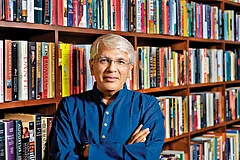
John Vater is a writer & translator whose books include the translations Register Me as Kulbhushan and The Play of Dolls. He is the co-author of More than the Eye Can See: Memoirs of Gopinath Pillai