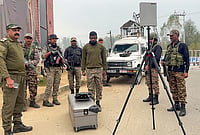
Rescuers are searching mud-covered sites in Nepal and Tibet after deadly flash floods swept through the Himalayan border region.
Nepal has reported 1,924 missing people, while China says 554 remain unaccounted for.
A newly formed lake is being monitored after authorities warned of another possible surge of water and debris.
Rescuers in Nepal and China on Friday searched through thick mud and debris for people trapped by flash floods along the Himalayan border, pulling survivors from buried sites and using helicopters to evacuate stranded people as death tolls reported by authorities neared 600 and nearly 2,500 remained unaccounted for.
The floods struck on Wednesday after a collapse involving bedrock and a glacier in the Himalayas sent water, rock and debris through valleys in Tibet and Nepal. More than 3,700 people have been rescued in Nepal, but the search has been complicated by destroyed infrastructure, heavy mud and the threat of further flooding from a newly formed lake at high altitude. Authorities in both countries have warned that the lake could release more water and debris into already devastated areas.
Search continues at flattened China border crossing
On the Chinese side of the border, a rescue team rappelled down wooded mountain slopes into the severely damaged Gyirong Port area, where the once-busy border crossing between China and Nepal was largely destroyed.
The team descended into the site from the surrounding mountain slopes, according to China Central Television. Satellite images showed that the area where travellers passed through border control to enter or leave China had been flattened into a muddy expanse.
“As far as I can see, it’s nothing but debris,” rescue official Zou Mingqi told state media.
Associated Press reported that around 680 rescuers eventually reached the Gyirong area by foot and via rafts. CCTV footage showed some rescuers being dropped into the area from drones and calling out, “Anyone, anyone?” as they searched the site.


It was not immediately known how many people were inside the border checkpoint building when the floods hit.
China's state media reported that seven people had died on its side of the border by Friday and that 554 remained missing. State television also showed villages being evacuated and Chinese leaders directing the relief response.
Information about survivors and victims on the Chinese side remained limited. Chinese authorities maintain tight media controls around major disasters, and state media coverage has largely focused on rescue workers and instructions from senior leaders rather than individual victims.
In Nepal, the country's disaster-management authority reported 579 deaths on Friday, while Nepali police later put the number of deaths at 553. The number of people listed as missing in Nepal nearly doubled to 1,924 after more local residents were added to the tally.
Combined figures from Nepal and China put the number of missing at almost 2,500. Hundreds are foreigners who were in the region for work, trekking or pilgrimage.
Army searches hydropower tunnel buried in mud
In Nepal's Rasuwa district, the country's worst-hit district, the army was deployed to rescue people believed to be trapped inside a tunnel at the Upper Trishuli-1 Hydropower Project.
More than 100 people were believed to be trapped inside the tunnel, while the army said it had rescued 350 people from the tunnel so far. Thick layers of mud have made it difficult to locate the tunnel's entry and exit points.
Video from the scene showed rescuers pulling and pushing a man covered in mud out of the tunnel.
“It is complicated to find the entry and exit points of the tunnel because everything has been covered by mud,” Army spokesperson Brig. Gen. Raja Ram Basnet said.
Nepal's disaster-management authority said 3,253 people had been airlifted by helicopter from the disaster area. Thousands of people have also been evacuated from affected areas, while others continued to wait for rescue.
Associated Press reported that neighbouring countries have also provided financial support for Nepal's response, including Sri Lanka. Kanni Wignaraja, regional director for Asia and the Pacific at the United Nations development agency, said Sri Lanka had sent $1 million despite its own financial difficulties.
“Sri Lanka has its own huge fiscal problems, but it has just sent $1 million immediately to the Nepal government,” Wignaraja said.
New lake raises fears of further flooding
Rescue operations were temporarily complicated by warnings about a new lake that formed high in the Himalayas after the initial flash floods, which were triggered by a glacier collapse.
Nepali police issued another alert on Friday after receiving information that a dam on the Tibet side had burst. Security personnel, rescue workers and relief teams were told to remain on high alert and move to safer locations if necessary.
It was unclear whether the reported dam breach was connected to concerns about the newly formed lake.
CCTV said the lake was located more than 10 kilometres from Gyirong Port and at an elevation of about 2,950 metres. Nepali and Chinese authorities had previously warned that the lake was already overflowing and could release more water and debris.
Rescue workers travelling towards the disaster zone were temporarily ordered to stop because of the risk. People in potentially affected areas were also urged to move to safer ground.
Later monitoring data from China's Ministry of Water Resources showed that the lake had reduced in size. State broadcaster CCTV reported that its water level had fallen by 10 metres from its high point on Thursday morning.
Glacier and bedrock collapse sent torrent downstream
Scientists who examined satellite images said bedrock beneath a glacier high in the Himalayan region had collapsed, taking part of the glacier with it. The rockfall was so severe that it registered as a magnitude 5.2 event.
The rocks and melted water then swelled the rivers in the valleys below, causing a torrent that swept buildings, bridges and earth downstream across Tibet and Nepal.
Survivors in Timure, the closest Nepalese village to the Chinese border, described the speed of the disaster. Around 1,500 people had lived in the village.
Customs officer Karbir Gaire was at his office at about 8 a.m. on Wednesday, working on his computer, when he felt the ground shake.
“Right after the shake, I noticed a black storm coming towards us,” he recalled from Kathmandu, where he is back with family. “We all immediately started running out, and within a few seconds, we were climbing uphill on the opposite side of our office building. I think those 10 or so seconds saved some of us.”
Fifteen of Gaire's colleagues are missing.
“It was like a Hollywood movie scene. I don’t call it a flood. It was a tsunami.”
Foreigners among hundreds still missing
The disaster has left families in several countries waiting for information about relatives who were in the affected region, with many still hoping for news of loved ones who remain unaccounted for.
Nepal's tourism board has said that more than 500 foreigners are among the missing. About 90 Americans were also unaccounted for.
Indian spiritual guru Jaggi Vasudev, also known as Sadhguru, said in a post on X that 77 people returning from Mount Kailash in groups organised by his Isha Foundation were at the immigration centre in Gyirong when the flooding struck.
Vishnuram Ramaswamy, who works at a private company in Puducherry in southern India, said he had spoken to his mother and two sisters on Wednesday morning while they were on the pilgrimage. He said the trip had been highly anticipated and that his mother had always wanted to make the journey.
“This was the last we spoke to them,” he said. “They have been unreachable since.”
Nepal had initially decided not to allow foreign teams and experts to participate in rescue operations. On Friday, however, the government reversed that decision and said foreign teams and experts would be allowed to assist with the response.
The Kathmandu Post reported that the reversal appeared to have come under pressure from other countries, particularly those whose citizens remain unaccounted for.
The Nepal government has also shared a public list of people it has rescued, while information about those affected on the Chinese side has remained more limited.