External Affairs Minister S Jaishankar confirmed 320 Indian nationals are missing in Nepal and 400 remain stranded in Tibet following catastrophic border flash floods.
India has dispatched 57.5 tonnes of emergency relief materials and deployed an 11-member medical team alongside tunnel rescue experts to assist Kathmandu.
MEA spokesperson Randhir Jaiswal stated that 153 stranded Indians from Tibet and 63 workers from the Trishuli-One project have been safely rescued.
At least 320 Indian nationals remain missing in Nepal, while another 400 are stranded in Tibet after severe border flash floods. The Ministry of External Affairs (MEA) stated that India is prepared to provide Kathmandu with all possible assistance to manage the crisis.
External Affairs Minister S Jaishankar welcomed 21 Indian nationals from Tamil Nadu who returned to New Delhi on Friday afternoon. The group arrived in the national capital a day after reaching Kathmandu from the flood-hit areas of Nepal, expressing gratitude to the Nepalese Army for rescuing them.
Nepal's toll from the flash floods climbed to 579 as more bodies were recovered during ongoing search and rescue operations, local authorities stated. MEA spokesperson Randhir Jaiswal said, "As far as the number of people [Indians] whom we are not able to contact or who are missing, the figure at this point in time is 320."



Taking to X, President of Nepal Ram Chandra Paudel shared his condolence for the loss of Indian lives. He wrote, "We also offer our heartfelt condolences and profound sympathy to the Government and the people of India for the tragic loss of Indian lives in the disaster of August 26, 2026."
"On behalf of the Government and the people of Nepal, I extend our deepest gratitude to Your Excellency Smt Droupadi Murmu for your kind concern and also for the generous support and solidarity extended by your government following the recent calamity in Nepal," he added.
Status of Stranded Indians
The MEA stated that 153 Indian nationals stranded in Tibet have safely entered Nepal. Sixty-three Indian nationals, working at the Trishuli-One hydropower project, were also rescued, Jaiswal said. Around 100 people of Indian origin who hold other nationalities also remain uncontactable, having likely gone for the Kailash Mansarovar Yatra.
Jaiswal said the 400 Indians stuck in Tibet are safe and have been in touch with their families. The Indian embassy in Beijing is coordinating with local Chinese authorities to work out their evacuation.
India Dispatches Emergency Aid
Jaishankar chaired a meeting with senior officials to take stock of the situation in Nepal, particularly the efforts to locate missing Indian nationals. India's envoys in Kathmandu and Beijing also attended the meeting virtually. "Discussed the relief and rescue efforts underway in Nepal today. Our Embassies in Kathmandu and Beijing provided an updated picture in respect of the status and well-being of Indian nationals," Jaishankar said on social media. "The concerned MEA Divisions apprised us of the further relief supplies to be sent to Nepal. We give highest priority to this issue."
Three military aircraft delivered urgent aid. Since Wednesday night, India has flown 57.5 tonnes of cargo to Nepal, including a 10-tonne shipment sent Friday evening. A medical team of 11 doctors and paramedics also arrived with a reconnaissance group to assess tunnel rescue operations.
Jaishankar said he spoke to the Nepalese foreign minister on Friday morning to offer a range of support. "Right now, the main thing is that in one place where there is a hydroelectric project, there could be possibility of people who may be in a tunnel. So, we are sending a team to help with the experts," he said.
Jaiswal said India has offered to provide Bailey bridges to Nepal, along with technical teams, to help restore road connectivity in the flood-affected regions at the earliest. "We have also made a specific offer to the Nepal authorities to dispatch NDRF teams along with their associated equipment that can help in ongoing search and rescue operations and bring relief assistance to people impacted by the tragedy," he said. "We await a response from the government of Nepal on this front. We stand ready to offer any assistance that the Nepal authorities might require."
Scale of Border Devastation
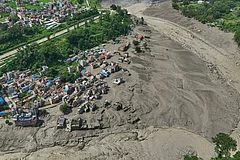
The catastrophe was triggered on Wednesday by a glacial collapse that sent ice, mud, rocks and fast-moving water surging through a valley in Nepal, destroying entire settlements in its path. Nearly 2,500 people are missing across the region, with China reporting seven dead and 554 missing, according to state broadcaster CGTN.
About 1,924 people remain missing. This figure includes hundreds of foreign nationals from India, Malaysia, Australia and the US, Nepal’s National Disaster Risk Reduction and Management Authority stated on X.
Kathmandu deployed around 15,000 personnel to conduct difficult rescue operations. These teams are searching mud-covered villages and hydropower plants where workers are trapped inside tunnels. The military has "intensified its operations" and "deployed special teams and is actively collecting bodies at a rapid pace", the prime minister’s office stated on social media.
New hazards slow the rescue. Rivers blocked by sludge and rubble have formed unstable lakes upstream, threatening more floods. Prime Minister Balendra Shah dismissed claims that Nepal rejected international help, saying the government is working with India, China and other partners.
Rebuilding will require massive funding. In a Bloomberg Television interview on Friday, Finance Minister Swarnim Wagle said the nation needs at least "a few billion dollars" to overcome the destruction. This pressure forces the $45bn economy to seek global funding for its reconstruction.
Nepal Reverses Aid Policy
Kathmandu has reversed its ban on foreign rescue teams. Diplomatic pressure from nations with missing citizens forced the government to allow international search-and-rescue operations in the flood-hit Bhotekoshi region. Officials previously announced on Wednesday that local teams could manage the disaster alone without external help.
However, within a day, authorities decided to seek limited international assistance in specialised areas, including tunnel rescues, DNA testing and forensic examinations. A senior government official told The Kathmandu Post, "We received massive pressure from the international community to allow at least search-and-rescue teams and some experts because their citizens have also gone missing in the floods. We are allowing a limited number of experts in certain areas."