






Nepal demanded "climate compensation” from major greenhouse-gas emitters, including China, the United States and India
Nepal have suffered destruction amounting to $4 billion-$7 billion
Death toll had crossed 1,000, reaching 1,050, while around 4,000 people remained missing
Nepal has demanded “climate compensation” from major greenhouse-gas emitters, including China, the United States and India, following the devastating floods, arguing that countries that have contributed significantly to global warming should help vulnerable nations deal with the cost of climate disasters.
The demand comes as Nepal faces an enormous reconstruction bill. Preliminary government estimates have put the destruction at $4 billion-$7 billion, while Kathmandu has estimated recovery costs at around $5 billion.
Devastating Floods In Nepal
On August 26, a massive mass of glacier and mountain material broke away from the north face of Langtang Lirung, at an altitude of around 17,000 feet. The resulting cascade sent a huge mixture of water, rocks and debris down the Bhote Koshi River along the Nepal-Tibet border and into the Trishuli River system.
The torrent swept away roads, homes and other infrastructure.
A week after the disaster, the death toll had crossed 1,000, reaching 1,050, while around 4,000 people remained missing, including 583 foreign nationals.
The scale of the destruction has left Nepal facing a reconstruction challenge far beyond its own financial capacity. Kathmandu is therefore seeking international support, but it wants that assistance framed as a question of climate justice, rather than simply humanitarian aid.



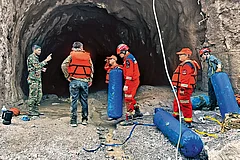

Why Does Nepal Want Compensation?
Nepal's argument rests on a basic disparity: the country contributes very little to global greenhouse-gas emissions but is highly vulnerable to the effects of a warming climate.
Foreign Affairs Minister Shisir Khanal told the Kathmandu Post that Nepal would no longer treat post-disaster assistance simply as humanitarian aid. Instead, he said Kathmandu was shifting its approach from “aid” to “justice and compensation”.
“This is not a matter of charity; it is a matter of legal and moral liability,” Khanal said.
He specifically named China, the United States and India, saying they have a “historical responsibility” towards vulnerable countries.
“China, which is the world’s top emitter, the United States at number two, and India at number three — have a historical responsibility to compensate vulnerable nations like Nepal,” Khanal said.
Khanal described the disaster as something far beyond an ordinary flood.
“This was not a standard flood,” he said, pointing to reported wave heights of 20 to 30 metres and speeds of up to 180 kilometres per hour. He described the event as a “Himalayan Tsunami”.

Climate Change Linked To Disaster
Nepal has linked the increasing risks in the Himalayas to climate change. However, scientists have said it is still too early to conclusively establish that climate change caused this particular disaster.
Maheshwar Dhakal, Nepal's climate change chief, told The New York Times: “Those who have contributed the least are suffering the most.”
The wider concern is that rising temperatures are changing glaciers and increasing instability across the Himalayan region, which is already prone to avalanches, landslides and flash floods.
Saswata Sanyal, a disaster risk resilience expert at the International Centre for Integrated Mountain Development in Kathmandu, told Hindu BusinessLine that climate change has been playing “a large role in the Hindu Kush Himalayas”, contributing to complex disasters affecting downstream communities.
Y Nithiyanandam, professor and head of the Geospatial Programme at The Takshashila Institution, Bengaluru, told The Indian Express that the Himalayas are already a naturally fragile mountain system.
“What climate change may be doing is increasing the underlying vulnerability,” he said.
Prime Minister Balendra ‘Balen’ Shah has also highlighted the changing risks. In a Facebook post, he said the disaster indicated that risks in the Himalayan region were increasing alongside climate change.

Why Are China, US and India on Nepal's Radar?
The three countries are among the world's biggest greenhouse-gas emitters.
China is the world's largest annual carbon dioxide emitter, accounting for roughly 29-33 per cent of global CO₂ emissions. The United States is second, with annual emissions of around 6.2 billion metric tonnes, while India is also among the world's largest emitters, producing roughly 4.4 billion metric tonnes of CO₂-equivalent annually.
Nepal's position is that major emitters should bear greater responsibility for the consequences of climate change faced by vulnerable countries.
There are also concerns about infrastructure development in the Himalayas. China has constructed major hydropower projects in Tibet, while India is pursuing projects including the proposed 11,000-MW Siang Upper Multipurpose Project in Arunachal Pradesh.
However, no direct link has been established between these projects and the August 26 disaster.

What Has Nepal Asked For?
Nepal has taken two separate steps. Finance Minister Swarnim Wagle and Forests and Environment Minister Geeta Chaudhary sent a letter to the co-chairs of the board of the Fund for responding to Loss and Damage, asking it to respond rapidly under its existing framework.
The letter says the disaster has affected a fragile transboundary mountain river system and that the full extent of the losses is still being assessed.
Dhakal, Nepal's representative on the fund's board, told the Kathmandu Post that the letter does not put a monetary figure on the losses.
“Almost all major donors and global development partners are members of the board, and Nepal's claims and potential risks are well-established, so the board must compensate us,” he said.
Separately, Khanal has launched a diplomatic push for climate compensation from major emitters. Nepal's diplomatic missions are lobbying for reconstruction support, while Shah is expected to raise the issue at the United Nations General Assembly.
















