Pakistan, Qatar, Indonesia and Türkiye signed the Badr MoU in Doha to expand defence manufacturing, technical training and research cooperation
The agreement is separate from the Makkah Joint Defence Agreement signed by Pakistan, Saudi Arabia and Türkiye in August 2026
Pakistan has said the Makkah alliance is defensive and its forces would not cross into Yemen to launch attacks against the Houthis, leaving its role in defending Saudi territory central to the regional security debate
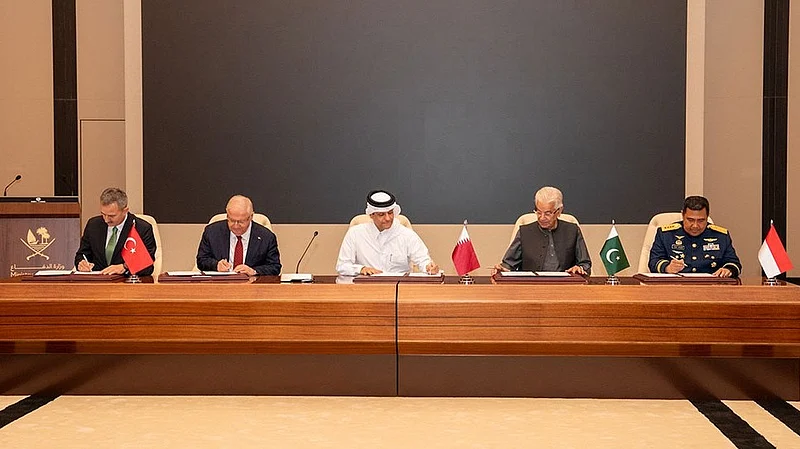
Pakistan, Qatar, Indonesia and Türkiye signed a defence industry cooperation agreement in Doha on Wednesday, even as Pakistan’s newly established Makkah Alliance for Defence with Saudi Arabia and Türkiye faces questions over how its collective-defence commitments will be implemented amid continued Houthi attacks on the kingdom.
The four countries signed the multilateral memorandum of understanding (MoU), named Badr, to strengthen defence manufacturing, technical military training and research and development (R&D).
The agreement brings together the defence ministries of the four countries, alongside Pakistan’s Defence Industrial Production Organization and Türkiye’s Presidency of Defence Industries. It seeks to pool their industrial capabilities, encourage joint production and technology transfer, and develop defence capacity to meet the needs of allied and friendly countries.
Pakistan Defence Minister Khawaja Asif said the agreement reflected a shared commitment to regional peace and stability. He said the countries would explore opportunities for industrial collaboration, technology transfer and greater self-reliance in defence production.


Unlike a mutual-defence treaty, the Badr MoU is focused on cooperation in defence industries and does not, in the official descriptions, establish a collective military response obligation.

Makkah Alliance Under Scrutiny
The agreement comes as Pakistan’s separate defence arrangement with Saudi Arabia and Türkiye faces its first major test. The three countries signed the Makkah Joint Defence Agreement on August 7, 2026.
On October 5, the alliance’s Strategic-Political and Defence Committee held an emergency meeting in Riyadh following attacks on Saudi cities and infrastructure. The committee announced plans to implement collective-defence commitments, including measures to provide agreed military forces and capabilities for rapid deployment in the kingdom.
Pakistan has condemned subsequent Houthi attacks, including the targeting of King Khalid International Airport in Riyadh. Islamabad also joined Saudi Arabia, Egypt and Türkiye in an October 11 statement calling for an immediate and unconditional halt to the attacks.
However, Pakistan’s Foreign Office clarified on October 9 that the Makkah Alliance was defensive in nature and that its forces would not cross into Yemen to launch attacks against the Houthis. The forces would instead be used to defend the territory and sovereignty of the member countries.
The distinction leaves the alliance’s operational response to further attacks on Saudi Arabia a key question, even as Pakistan expands defence-industrial cooperation with other regional partners.