Delhi Police has planned a ‘fail-safe plan’ for the CJP protest, deploying personnel across all 15 districts.
Police have designated 37 blocking points in New Delhi district and detention centres across all 15 districts.
Following July’s deployment lapses, police will stop protesters within their districts and assign specific points to units.
Delhi Police has ordered a district-wide deployment across the capital ahead of the Cockroach Janta Party (CJP) protest scheduled at Jantar Mantar on October 10, with all districts, units and battalions directed to report at designated assembly points at 11 am for briefing and deployment.
The force has drawn up what senior officers described as a “fail-safe plan” following two lapses during the CJP agitation in July, The Indian Express reported. The upcoming protest is expected to draw multiple organisations, prompting heightened security arrangements in the New Delhi district.
Senior officers said the deployment is intended to maintain law and order and ensure that the agitation remains peaceful. Police have refused permission for protests at Jantar Mantar, planned to stop protesters within their respective districts and designated detention facilities across the capital.

Permission And Detention
Delhi Police has refused all applications seeking permission to hold a dharna or protest at Jantar Mantar on October 10. According to The Indian Express, the force has also planned to restrict protesters within their own districts, establish dedicated detention centres across all 15 districts and set up 37 blocking points in the New Delhi district, with each point assigned to a specific district or unit.
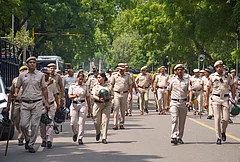


Delhi Police Commissioner Anurag Kumar met senior officers at police headquarters on Thursday to finalise the strategy.
“It was first decided not to grant any permission for anyone to hold any kind of dharna or protest at Jantar Mantar on October 10. All district heads were directed to set up special detention centres in their districts and to stop all protestors within their own districts only,” a senior officer told The Indian Express.
Police have also checked hotels and guesthouses across the capital and instructed them not to accommodate new visitors suspected of arriving for the protest. The establishments have been asked to inform local police if they spot anyone suspicious, the officer said.
A source told the newspaper that police had also decided to stop senior protest leaders. Women police personnel will march in front, with male personnel behind them. The force has also decided to deploy women personnel equipped with small body-worn devices, following inputs that women protesters could be positioned at the front of demonstrations, the source said.

Lessons From July
The deployment strategy marks a departure from the arrangements made during the July agitation, when district police were instructed to guide students and others travelling to Jantar Mantar to join the protest.
This time, district units have been directed to intensify patrolling and prevent people from travelling to the protest venue from within their jurisdictions. Those who refuse to turn back are to be taken to detention centres, according to the report.
The new plan has been communicated to all districts and units, including the Delhi Police Academy (DAP) and the Foreigners Regional Registration Office (FRRO), for law and order duties in the New Delhi district in connection with the protest called by the CJP and other organisations at Jantar Mantar and elsewhere in the district.
“We made two mistakes last time. First, we failed to assess the number of protesters, and second, we deployed different units and districts at the same place. This time, we have decided to assign one specific point to one unit or district,” a senior officer told The Indian Express.
District, unit and battalion heads have been asked to nominate liaison officers and ensure that personnel report punctually to their designated assembly points for briefing and deployment.

Where Will Police Personnel Assemble?
The deployment plan assigns specific assembly points to different district units across the capital.
Central: Ranjit Singh Flyover near Barakhamba Road red light
North: Election Commission of India
East: Roundabout near Gymkhana post office, Safdarjung Road
North-East: Roundabout near Sunehri Bagh Masjid
Shahdara: In front of Parliament Street police station
Dwarka: Roundabout near Buta Singh
Outer: Roundabout near Windsor Place
West: Kartavya Path–Man Singh Road crossing near India Gate
North-West: Janpath–Tolstoy crossing near Janpath Metro station
Rohini: Jai Singh Road near the MHA building
Outer North: Roundabout near Gol Dak Khana
South: In front of the Registrar of Companies office, Sansad Marg
South-West: KG Marg–Firoz Shah Road crossing
South-East: Gate No. 1, Major Dhyan Chand Stadium
Specialised units have been assigned separate reporting points. The Crime Branch and the first and second battalions of the Delhi Armed Police will report in front of Transport Bhawan. The Economic Offences Wing and the Special Police Unit for Women and Children will assemble in front of Parliament Street police station, while Licensing, FRRO and the fifth, sixth and seventh DAP battalions will report at 11 Murti.
Vigilance and the Delhi Police Academy will report at Vijay Chowk, while the Welfare unit will assemble at Ranjit Singh Flyover near Barakhamba Road red light. Other specialised units, including the Special Cell, have also been assigned designated points. The Special Cell will be deployed at the Pink Booth, C-Hexagon, India Gate.
Delhi Traffic Alert
Delhi Traffic Police has issued an advisory warning of possible traffic disruptions across New Delhi and Central Delhi on October 10, 2026, in view of the law and order situation.
Diversions may be enforced from 6 am, depending on the prevailing situation, with movement likely to be affected at 30 points, including Dhaula Kuan Flyover, Mandi House, Connaught Place, Jantar Mantar Road, Windsor Place, Tolstoy-Janpath Crossing, Patel Chowk and Gol Dak Khana.
Commuters travelling to railway stations, inter-state bus terminals (ISBTs) and the airport via New Delhi and Central Delhi have been advised to plan their journeys in advance, allow extra travel time and avoid non-essential travel.
The police said traffic restrictions would be adjusted according to real-time ground assessments. Commuters can check updates and alternative routes on the Delhi Traffic Police website and its social media platforms, or call helpline numbers 1095 and 011-25844444.