



Nuremberg's promise of accountability for crimes against humanity has been applied selectively, with Dresden, Hiroshima, and the Bengal Famine going unpunished.
The pattern continued through the Nakba, apartheid South Africa, and East Timor, with figures like Henry Kissinger never held to account.
The piece argues this impunity persists today, citing Gaza, Trump's strikes on Iran, and Russia's war in Ukraine as evidence.
The 20th century made a solemn promise to history. At the Palace of Justice at Nuremberg, in the ruins of a war that had consumed fifty million lives, the judges of the four Allied powers declared that individuals, however high their office, could be held accountable for crimes against humanity. In Adolf Eichmann’s trial in Jerusalem in 1961, that principle was reaffirmed with surgical precision. Bureaucratic obedience, the defence of every apparatchik and desk-bound killer in history, was ruled as no defence at all. Moral responsibility, the tribunal held, does not dissolve in a chain of command.
Now, 70 years on, one is compelled to ask what remains of that promise. The honest answer is that though the Nuremberg principle has not been repealed, very little of it remains when, in practice, it has been selectively applied and conveniently forgotten inside the very institutions created to uphold it.
The selectivity begins, uncomfortably, with the victors of the Second World War themselves. The Allied firebombing of Dresden on the nights of 13 and 15 February 1945 incinerated a largely civilian city and killed tens of thousands of people. It was, by any forensic reading of the laws of war, an act of collective punishment against a civilian population. No one was tried. No one was charged. Arthur Harris, who directed the RAF bombing campaign, was celebrated rather than prosecuted.



When The Victors Escaped Justice
Then came Hiroshima and Nagasaki, where the United States extinguished two cities and approximately two hundred thousand lives in a calculated act of mass destruction, an act that, had it been committed by the losing side, would surely have featured prominently in any war crimes tribunal. Instead, it was dressed in the language of necessity and has been defended in that language ever since. The first lesson of the post-Nuremberg order, therefore, emphasises that the principle applies only to the vanquished, while the victorious retain the privilege of acting as the jury.
Nor does the indictment of Western impunity end there. Winston Churchill's wartime administration oversaw the Bengal Famine of 1943, in which an estimated three million people died as a result of deliberate policy decisions that engaged in the export of grain from a starving province. Heartlessly, not one relief shipment was sent. Moreover, Churchill's own recorded contempt for the Indian population he held responsible for "breeding like rabbits" was unpardonably racist. That a famine of such dimensions, so clearly shaped by colonial policy, produced no accountability whatsoever tells us something important about whose lives the international order was designed to protect.
Colonial Crimes Without Accountability
For a moment, let us move on to the most foundational crime that haunts the present most directly. The Nakba, the systematic dispossession and expulsion of over seven hundred thousand Palestinians in 1947, was made possible, in the most direct and historically traceable sense, by British policy. The Balfour Declaration of 1917 promised a national home for the Jewish people in Palestine without their consent, and with calculated disregard for the rights of the Arab majority who lived there. The British Mandate administered Palestine in ways that systematically armed and enabled the Zionist project while suppressing Palestinian political organisations.
When Britain departed in 1948, having created the most inflammable conditions for conflict, it left behind a catastrophe it had engineered and for which it has never once been held accountable. The Nakba is, among other things, a British crime. That this remains unsayable in polite diplomatic company is itself an indictment.
The pattern repeats across decades and continents. The apartheid regime in South Africa sustained itself for nearly half a century, constructing a system of racial domination so comprehensive that legislation was used to strictly enforce where human beings could sleep, love, and be buried, while Western governments traded with Pretoria, sold it arms, and defeated resolutions on sanctions at the United Nations.
Ronald Reagan vetoed the Comprehensive Anti-Apartheid Act. Margaret Thatcher called Nelson Mandela's ANC a terrorist organisation. No architect of apartheid was ever tried for crimes against humanity, though the evidence for such a prosecution was vast and meticulously documented.
Take the case of East Timor, where the Indonesian military's occupation from 1975 onwards killed an estimated one third of the population through massacre, famine, and forced displacement, with weapons supplied by the United States, the United Kingdom, and Australia, and with the explicit foreknowledge of Henry Kissinger, who had given his blessing to the invasion the day before it began. Kissinger died in 2023 at the age of one hundred, laden with honours and having faced no legal consequence whatsoever for his role in one of the late twentieth century's most grievous genocides.
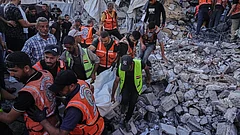
All of which brings us to Gaza and Lebanon, and to the question that can no longer be deferred. Since October 2023, over seventy-two thousand Palestinians have been killed, the majority of them women and children. Entire residential neighbourhoods have been erased. Hospitals have been bombed. Schools designated as shelters have been struck. Famine has been deliberately engineered through the blockade of food and medical supplies. These are not allegations. They are documented, photographed, filmed, and verified by the United Nations. The International Court of Justice has found it plausible that genocide is being committed. The ICC has issued arrest warrants for Israeli Prime Minister Benjamin Netanyahu.
And yet the United States, under Donald Trump, continues to supply Israel with the weapons used to carry out this destruction, and has wielded its Security Council veto to ensure that no binding international resolution interrupts it. A government that funds, arms, and diplomatically shields the conduct of an operation producing mass civilian casualties is not a bystander to potential war crimes. It is, under any coherent reading of international law, a co-belligerent.
But Gaza is not the only count in the indictment. Donald Trump's decision to join Israel in bombing Iran without legal justification represents a recklessness that history will struggle to categorise as anything other than criminal. Iran had no active war with the United States. Its people had no quarrel that diplomacy could not have addressed.
What followed the strikes was cascading devastation in the closure of the Strait of Hormuz, with oil prices convulsing global markets, while the savings of ordinary working people and retirees were wiped out. Trump did not merely authorise a military strike. He exported misery to millions, and he did so with the serenity of a man who has never once been made to answer for anything. Meanwhile, Vladimir Putin's war in Ukraine has produced its own archive of atrocities.
When Power Shields War Crimes
In the face of the dark times we inhabit, the institutions of international order have nonchalantly remained moribund. In this vacuum of enforcement, every government with sufficient firepower knows that the Nuremberg promise was, in the end, for the defeated and the weak. If this is the common truth, the recovery of the Nuremberg principle, then, requires the willingness to apply law with symmetrical rigour to Dresden as to Auschwitz, to Gaza as to Beirut, to Bucha as to Baghdad.
The question is whether we still possess the moral seriousness and the institutional courage to insist on the implementation of international law. The answer, thus far, has been a silence so deafening that it can be heard in every rubble-strewn street from Rafah to Rubizhne, from Beirut to Bakhmut.
Disclaimer: The views expressed are those of the author and do not necessarily represent the views of the organisation.















