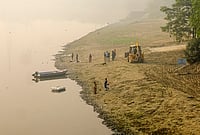
The Kolkata–Sairang Express derailed near Digaru in Assam on November 11.
The Centre has significantly increased railway investment in the region, commissioning 1,840 km of tracks between 2014 and 2025.
The explainer examines whether safety systems, including Kavach, track inspections, maintenance and disaster preparedness, are keeping pace with expansion through the Northeast’s challenging terrain.
The derailment of the Kolkata–Sairang Express near Digaru railway station in Assam on November 11 has brought renewed attention to railway safety in the Northeast, a region where the government has been undertaking an ambitious infrastructure expansion drive.
The locomotive and five coaches of the train, which was travelling from Kolkata to Sairang in Mizoram, derailed at around 6:54 am while it was being received at Digaru station to give precedence to another train. The Northeast Frontier Railway (NFR) initially attributed the incident to the loco pilot's inability to control the train's speed. While the exact cause remains subject to investigation, a video from the locomotive cabin in which the crew appears to refer to a braking problem have also raised questions that investigators will need to examine.
The incident comes at a time when railway connectivity in the Northeast is undergoing a significant transformation. From extending railway lines to state capitals that remained disconnected for decades to constructing tunnels and bridges through difficult mountainous terrain, the Centre has made the region a major infrastructure priority. However, the expansion also presents a larger challenge: ensuring that the construction of new railway lines is accompanied by adequate investment in maintenance, technological safeguards and disaster preparedness. The question is not merely how quickly India can connect the Northeast to the national railway network, but whether it can ensure that these connections remain safe and reliable.




The Northeast's Railway Transformation: Connecting Difficult Terrain
Railway connectivity in the Northeast has historically been constrained by its geography. The region's mountainous terrain, extensive river systems, heavy monsoon rainfall and vulnerability to landslides have made railway construction considerably more challenging than in the plains.
The Centre's recent infrastructure push has sought to address this connectivity gap. According to a Ministry of Railways statement presented in Parliament in March 2026, the average annual budget allocation for railway infrastructure projects and safety works in the Northeast increased from Rs 2,122 crore during 2009–14 to Rs 10,440 crore in 2025–26, nearly five times higher. Between 2014 and 2025, 1,840 km of new railway tracks were commissioned in the region, compared with 333 km between 2009 and 2014.
One of the most significant developments has been the commissioning of the 51.38-km Bairabi–Sairang railway line in September 2025, which connected Mizoram's capital Aizawl to the national railway network for the first time. The project is a major engineering undertaking, involving 45 tunnels and 153 bridges, including 55 major bridges. Some of the bridges rise more than 70 metres above the ground, with the tallest reaching 114 metres.
Other projects, including the Jiribam–Imphal line in Manipur and the Dimapur–Kohima line in Nagaland, are also intended to improve connectivity to areas that have historically remained outside the railway network. Beyond passenger mobility, these projects have economic and strategic significance. Better railway links can reduce the cost of transporting goods, improve access to remote communities and strengthen connections with areas bordering Bangladesh, Bhutan, China and Myanmar.
However, the engineering challenges do not end when a railway line is commissioned. The geological conditions of the Northeast, particularly in its hill states, require specialised maintenance and continuous monitoring. Maintaining these structures over the coming decades will require equally sustained investment, specialised personnel and regular inspections.

Can Safety Keep Pace With Expansion?
The expansion of railway infrastructure has been accompanied by investments in safety measures, including track maintenance, electrification, weather monitoring and automatic train protection systems. However, the extent to which these safeguards cover the growing network remains an important question.
One of the most prominent safety initiatives is Kavach, India's indigenous automatic train protection system. It is designed to assist loco pilots in maintaining permitted speeds and automatically apply brakes in certain situations, including when a train approaches a signal at danger or exceeds prescribed speed limits. However, Kavach is not a comprehensive derailment-prevention mechanism and cannot independently address track fractures, defective rolling stock, landslides or structural failures involving bridges and tunnels.
Its deployment in the Northeast remains an area requiring attention. In a statement presented to Parliament in March 2026, the Railway Ministry said that Kavach work and tendering were underway for 235 route kilometres in the region, while approvals had been granted for another 1,197 route kilometres. This indicates that the system's coverage is still being expanded.
Track maintenance is another crucial component. Railway authorities use track-recording equipment, ultrasonic flaw detection and mechanised maintenance systems to identify defects and monitor track conditions. These measures help detect cracks, irregularities and other problems that may not be immediately visible during routine inspections. However, their effectiveness depends on the frequency of inspections, the availability of trained personnel and the speed with which identified defects are addressed.
The financial dimension is also significant. The government has reported a substantial increase in railway infrastructure allocations in the Northeast, but the figures cover infrastructure projects and safety works together.
The Digaru derailment should not be treated as evidence that the Northeast's railway expansion has compromised passenger safety. The exact cause remains to be established, and the incident occurred on an existing railway section in Assam, not on the newly commissioned Bairabi–Sairang line in Mizoram. Nevertheless, it provides an opportunity to examine whether the region's expanding railway network is receiving adequate safety investments alongside construction funding.
India's railway expansion in the Northeast is essential for reducing regional isolation, strengthening economic integration and improving access to essential services. But connectivity cannot be measured only by the kilometres of tracks laid or the number of bridges and tunnels constructed. It must also be measured by the reliability of services, the resilience of infrastructure and the ability of railway authorities to prevent accidents and respond to emergencies.