Rahul Gandhi tells students to question the “system”, linking examination leaks, education and institutional accountability to his wider political argument.
Aspirants raise concerns over years of recruitment delays, withheld posts, contractual appointments and the risk of becoming overage while waiting for government jobs.
Students express varied political views, with some seeking practical solutions on education and jobs, while others say their political preferences are changing.
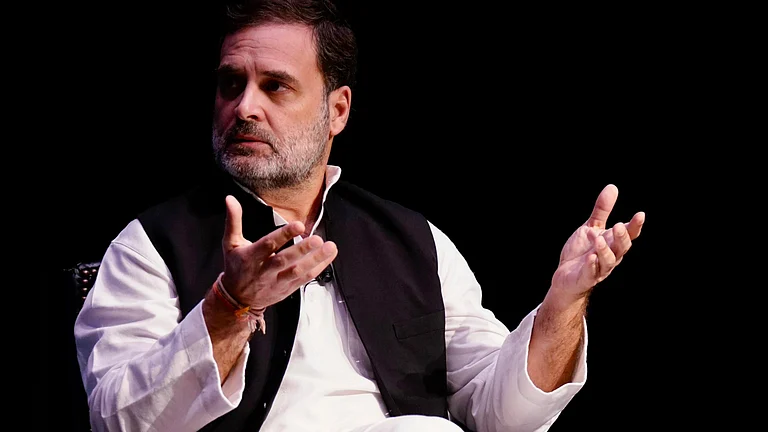
By the time Rahul Gandhi arrived at the Bharat Jodo Maidan in Indore, tens of thousands of students had gathered to hear him. Addressing the ‘Chhatron Ki Goonj’ programme on Saturday, the Congress leader and Leader of Opposition in the Lok Sabha alleged that a powerful “system” had taken control of the country and did not want students to question it.
The event, themed ‘System vs Students’, was aimed at students whose concerns are increasingly tied to jobs, recruitment and examinations. Gandhi told the gathering that students were central to India’s future and that the country could not become strong without them.
“Ten lakh posts of teachers are vacant in the country. One lakh schools, including 55 per cent in UP and MP, have been closed,” said Gandhi.
Gandhi also alleged that National Security Adviser Ajit Doval controlled several aspects of public life, including social media, and was involved in snooping. He said students were willing to question the “system”, including the influence of industrialists Gautam Adani and Mukesh Ambani and the role of Jay Shah, but faced resistance from what he described as “andhbhakts”.
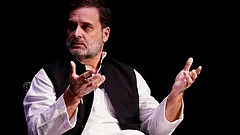
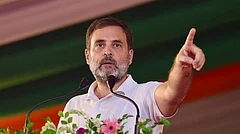

“The struggle is against the system. What is this system? The system has various layers. At the top level sit six individuals who run it...” Gandhi said, alleging that the Prime Minister, Home Minister, Doval, Adani, Ambani and institutions exercised disproportionate influence.
He framed curiosity as the defining difference between a student and an “andhbhakt”. “The system feels threatened by students. Why? Because students ask questions,” Gandhi said, pointing to questions about Jay Shah’s role in cricket administration, the concentration of business, the functioning of the judiciary and other institutions, and the Election Commission.
For Gandhi, questioning was not simply a student trait but a form of resistance. “That is why the system does not want students; it wants ‘andhbhakts’,” he said, arguing that students were prepared to ask why schools and colleges were deteriorating, infrastructure was failing and examination papers were leaking.
Pointing to the difference between the Congress-led UPA government and the NDA government, Gandhi said the current government has allocated only 2.6 per cent of the budget to education, compared with at least 4.6 per cent under the UPA government.
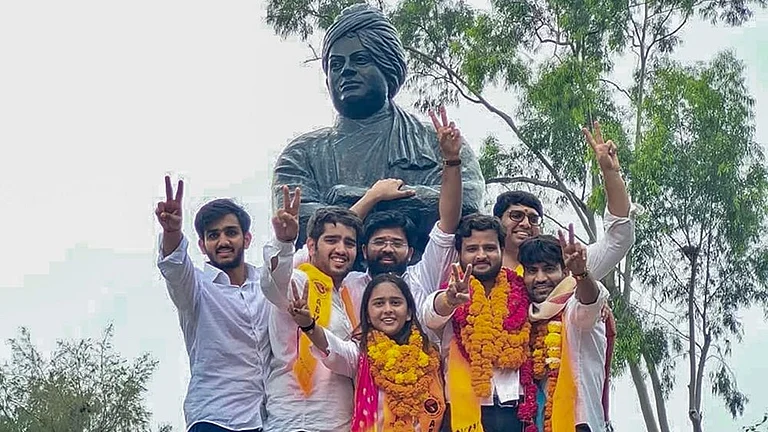
The event came on the same day that the Congress-backed NSUI was routed by the RSS-affiliated ABVP in the Delhi University Students’ Union (DUSU) polls. The high-stakes contest followed a recent Gen Z-led protest and the Satya Niketan building collapse that claimed the lives of five DU students.
Indore, meanwhile, offered the Congress a different student constituency. The city is one of central India’s major education and coaching hubs, drawing aspirants from across Madhya Pradesh and neighbouring states who spend months, and often years, preparing for civil services, SSC and other competitive examinations.
Their concerns at the programme were largely practical: recruitment delays, unfilled vacancies, examination disputes and the prospect of becoming overage while waiting for government jobs. Gandhi’s broader political argument was therefore met with questions rooted in the everyday uncertainty of competitive-exam aspirants.
“That is why the system does not want students; it wants ‘andhbhakts’,” he said. “While a student asks questions and remains curious, an andhbhakt lives in a delusional world of their own. While a student is fearless, an andhbhakt is a coward.”

He returned to the issue of examinations and paper leaks. “An andhbhakt will never ask why the condition of our schools and colleges has become like this. Why has our infrastructure broken down? Why are our papers leaking? A student is the one who raises this voice,” Gandhi said.
For the students in the audience, however, these were not abstract questions.
An MPSC aspirant told Gandhi that recruitment in Madhya Pradesh had been affected for eight years, with 13 per cent of posts allegedly kept on hold across different stages of examinations, including prelims, mains and interviews.
“Young people like me are left waiting. We are overage for eight years now. There are so many students across the state who are in a bad situation,” said the aspirant.
The student also raised concerns about vacancies being left unfilled and posts being filled through contractual appointments.
“Look, the system here is such that we protest and demand that they open up recruitments, but the results just get put on hold. A lot of posts never even get announced and are just filled on a contract basis,” the student said.
Among those in the crowd was Nandini, originally from Khandwa. She is studying for the UPSC examinations. She had appeared for NEET in 2024 and 2025 before deciding to continue her preparations in Indore. “In 2024, the examination paper leaked and in 2025, a similar situation occurred,” she explained.
For some students, Gandhi’s appeal was less about political identity and more about whether he addressed practical concerns. “He gives options on practical things,” said student said.
Nandini put the priority more plainly: “We are also spiritual, but we need education and jobs. We don’t want only fights. If we have elected someone, they should work for us.”
For Sheetal Dhote, a BCA student from Betul preparing for banking examinations, that frustration has also translated into a change in political preference. She voted for the BJP in the last election but said she would not do so next time. “We want change,” she said.
Kavita Barde, from Khargone, has studied BSc Nursing and is in Indore preparing for examinations for government medical jobs. “I am here to listen to Rahul Gandhi. I am preparing for exams and examination leaks worry us a lot,” she explained.
The students gathered around Gandhi’s programme therefore came with different political views, but many shared a more immediate preoccupation: whether years spent preparing for an examination would eventually lead to a job, or another wait.

Away from the venue, the same concerns surfaced in less political language.
Bholaram Ustad Marg, a little away from the Bharat Jodo Maidan where the programme was being held, is one of Indore’s student hubs. At Bhagat Singh Chai and around the coaching centres, students were more interested in what happens to their education and careers than in political rhetoric.
Ranjana, who has completed a BSc in Mathematics, is in Indore preparing for the SSC examinations. She had attended a Congress-organised programme for students the previous day, but said her participation in such events would depend on her classes and preparation.
Arjun, from Rewa, was outside Bhagat Singh Chai after completing his graduation in Economics. He is now preparing for competitive examinations and said he might attend Gandhi’s programme with a couple of friends, largely to see what it was about.