Loudspeakers during the Kanwar Yatra have pushed Delhi noise levels past 100 decibels.
Peak sound readings touched 110.3 dB near Kalkaji during the pilgrimage.
Residents along Yatra routes have reported sleepless nights and heavy bass disturbance.
Delhi's residence had to go through sleepless night as Kanwariya's traversed through the city, pushing noise levels above 100 decibels across parts of the national capital.
During spot checks on Saturday and Sunday night, Hindustan Times recorded peak sound levels of 105.2 decibels near Kalindi Kunj, 110.3 dB near Kalkaji temple and 95.2 dB at the Ashram flyover as trucks carrying large sound systems played devotional music along the Yatra routes.
Near Kalindi Kunj, where two camps had been set up for kanwariyas, HT reported seeing six trucks carrying boomboxes pass within 20 minutes. Even from a distance, sound readings ranged between 95 dB and 99 dB.
The disruption has come alongside increased pilgrim movement through the capital. Several major stretches, including the DND Flyway, Ashram, New Friends Colony, CV Raman Marg, Kalkaji flyover and Outer Ring Road, are expected to see congestion as the Yatra coincides with weekday traffic.

How Loud Is 110 Decibels?
A reading of 110 dB is not merely twice as intense as 55 dB. The difference in sound intensity is substantially larger. For comparison, the World Health Organization places normal conversation at around 60 dB and a motorcycle at about 95 dB. Sound of around 110 dB is comparable to someone shouting very close to a person's ear.



High sound levels can become harmful depending on both their intensity and the duration of exposure. WHO guidance links excessive exposure to noise with effects including hearing impairment, tinnitus and sleep disturbance.
There is, however, an important difference between the peak levels recorded during HT's checks and the ambient noise standards prescribed under Indian law.
India's noise limits are generally expressed as dB(A) Leq, which represents an average sound level over a specified period. A peak reading of 110.3 dB therefore does not by itself establish that the average noise level in an area remained at 110 dB.

What Does Indian Law Actually Allow?
The Noise Pollution (Regulation and Control) Rules, 2000 prescribe different permissible levels depending on the area and time of day. According to the Central Pollution Control Board, noise in a residential area is restricted to 55 dB during the day and 45 dB at night.
In commercial areas, the permissible limits are 65 dB during the day and 55 dB at night. Notified silence zones have still lower limits of 50 dB during daytime and 40 dB during night-time.
Loudspeakers and public-address systems face additional restrictions.
At the boundary of a public place where a loudspeaker is being used, the noise level cannot exceed 10 dB above the ambient standard for that area or 75 dB, whichever is lower.
This means 75 dB should not be treated as a uniform legal limit for loudspeakers. In a residential area with a daytime ambient limit of 55 dB, for instance, the applicable ceiling at the boundary of the public place would ordinarily be 65 dB.
The rules also require written permission from the competent authority before loudspeakers or public-address systems can be used.
What Are The Rules After 10 PM?
Restrictions become stricter once night-time begins. Under the Noise Pollution Rules, 10 pm to 6 am is classified as night-time, and loudspeakers and public-address systems cannot ordinarily be used outdoors during this period.
The Supreme Court has also prohibited the use of loudspeakers and sound amplifiers between 10 pm and 6 am, except in circumstances permitted under law.
State governments do have limited powers to relax the restriction on specified cultural, religious or festive occasions. Loudspeakers may be allowed until midnight on notified occasions for a maximum of 15 days in a calendar year.
Such relaxations have to be formally notified and do not amount to permission for unrestricted noise.
Why Delhi Is Struggling To Keep The Noise In Check?
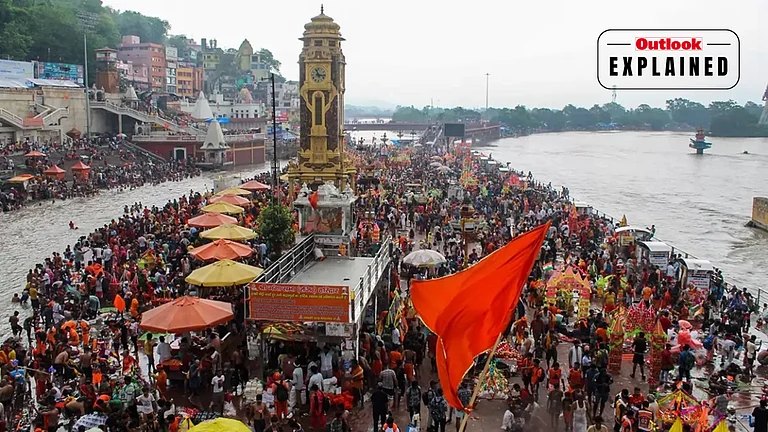
The high-decibel sound is unfolding alongside a large policing operation involving crowd control, traffic regulation, security and movement of thousands of pilgrims.
Delhi Police said it had deployed more than 1,533 police personnel and 250 paramilitary personnel, along with 27 PCR vans, five Prakhar vans and 107 motorcycles.
A senior police officer from the southern range told HT: “Till now, we have deployed more than 1,500 personnel to maintain security in the national capital and no incident has taken place. We have been successful in coordinating with the kanwariyas.”
The officer added that deployment was being increased as pilgrim numbers rose and that police were trying to ensure processions did not move through residential areas.