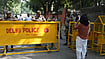
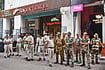
Delhi imposed extensive security restrictions ahead of the October 10 protest called by CJP.
Entry and exit gates at 45 Metro stations were closed, at least 245 trains were cancelled.
The measures came amid Supreme Court concerns over disruption to public transport.
Delhi was placed under an unprecedented security blanket on Saturday ahead of a protest called by the Cockroach Janta Party (CJP), the All India Students’ Association and other groups demanding the resignation of Chief Election Commissioner Gyanesh Kumar over alleged irregularities in electoral rolls.
Entry and exit gates at 45 Delhi Metro stations were closed, at least 245 trains arriving at or departing from New Delhi and Hazrat Nizamuddin railway stations were cancelled, and mobile internet services were suspended within a four-kilometre radius of the Janpath–Kartavya Path crossing. Barricades were erected across the Capital and at its borders as police and paramilitary forces prepared to prevent protesters from reaching central Delhi.
The measures followed Delhi Police’s denial of permission for the October 10 demonstration, citing procedural shortcomings, alleged violations during earlier protests and public safety concerns. CJP leaders, however, said the protest would go ahead.

30,000 Police And Paramilitary Personnel Deployed
By Friday evening, around 30,000 police and paramilitary personnel had been mobilised for the security operation, according to reports. Union Home Secretary Govind Mohan also wrote to states and Union Territories, informing them that the proposed assembly had been prohibited and asking them to coordinate with Delhi Police to prevent any breach of public order and safeguard critical infrastructure.


Delhi Police drew up a plan to intercept protesters within individual police districts before they could reach central Delhi. In the New Delhi district, officers identified 37 designated blocking points, with specific units assigned to each location.
Authorities also identified around 30 temporary detention facilities across Delhi’s 15 districts, including police buildings and sports complexes such as Rajiv Gandhi Sports Complex, Chhatrasal Stadium and Yamuna Sports Complex. The arrangements were intended to prevent police stations near the protest site from being overwhelmed.
According to an Indian Express report, Around 600 low-floor buses were commissioned to transport detained protesters. Delhi Police deployed 7,000-8,000 personnel on the ground, with the number potentially rising to 15,000 if required. They were to be supported by 221 companies of Central Armed Police Forces, comprising around 23,000 personnel brought in from Jammu and Kashmir, West Bengal and Chhattisgarh. The deployment included five companies of all-women forces.
Supreme Court Questions Sweeping Restrictions
The security measures came under scrutiny in the Supreme Court on Friday. A Bench led by Chief Justice of India Surya Kant expressed concern over the closure of Metro stations and the cancellation of trains, warning that security measures should not bring public transport and everyday life to a standstill.
“You cannot use a hammer to kill a fly,” the Bench observed while hearing a petition challenging the restrictions. The court said authorities could regulate movement to prevent unlawful gatherings but could not impose a blanket prohibition on public transport.
Delhi Police had initially asked the Delhi Metro Rail Corporation (DMRC) to shut entry and exit gates at 57 stations and reduce train frequency on affected routes. Following the court’s intervention, DMRC revised the list to 45 stations, with entry and exit gates scheduled to remain closed from 9 pm on Friday until 6 pm on Saturday. Interchange facilities were to remain available at the affected stations, except at New Delhi Metro station.
The court’s observations highlighted the need to balance public safety with the rights of residents and commuters who depend on public transport.
245 Trains Cancelled, Mobile Internet Suspended
Indian Railways cancelled at least 245 trains scheduled to arrive at or depart from New Delhi and Hazrat Nizamuddin stations on Saturday, including 75 Mail and Express trains. The cancellations affected services such as Rajdhani, Shatabdi, Humsafar and Tejas Express trains.
Northern Railway said Mail and Express trains scheduled to reach the two stations between 4 am and 2 pm on October 10 would be cancelled at their originating stations. The decision was attributed to anticipated severe road congestion around the railway stations and concerns about passengers’ ability to reach their destinations.
A separate order suspended mobile internet services for 24 hours, from 10 pm on Friday to 10 pm on Saturday, within a four-kilometre radius of the Janpath–Kartavya Path crossing. The restriction was issued on public security grounds.
Security checks were intensified at Delhi’s borders with Noida, Faridabad and Gurugram. Police officers said vehicles were being checked for the number of occupants and whether passengers were carrying protest signs, posters or banners.
The restrictions extended to commercial and public institutions. The New Delhi Traders Association advised shops, offices and restaurants in Connaught Place to remain closed on Saturday. Liquor shops were ordered to shut on Friday and Saturday, while several schools and colleges shifted classes online. The Patiala House and Rouse Avenue courts were scheduled to function virtually.
Some hotels were also reportedly asked to turn away certain categories of guests, including people carrying local identification documents and students or young people arriving from outside Delhi.

Opposition Meets President Murmu, Plans To Approach CJI
The security operation unfolded as Opposition leaders stepped up their campaign against the Election Commission. A delegation of the INDIA bloc met President Droupadi Murmu on Friday evening and submitted a memorandum alleging “vote chori” by the Election Commission and the central government.
Leader of Opposition Rahul Gandhi said the Opposition would submit a similar memorandum to Chief Justice Surya Kant on Monday.
Leaders of the Aam Aadmi Party and Left parties also alleged that their members in several states had been detained at their homes to prevent them from travelling to Delhi for the protest. In Gujarat, activists were reportedly detained at police stations or their residences. Some alleged that police had made them sign undertakings promising not to travel to the Capital. There were also allegations that students were removed from trains at Itarsi in Madhya Pradesh.
These claims were made by opposition leaders and activists and were not independently established in the accounts cited.
Police Cite July Protest As Reason For Tight Security
Senior police officers described two lapses during CJP’s July protest against the NEET-UG paper leak as reasons for the extensive arrangements this time. They said authorities had underestimated the number of participants in the July 20 march towards Parliament and deployed personnel from different units and districts at the same locations.
For the October 10 protest, police said each designated blocking point would be assigned to a specific unit or district to improve coordination and prevent demonstrators from reaching central Delhi.
The July protest had continued beyond the one-day permission granted by police and drew a much larger crowd than organisers had initially indicated. Police alleged that clashes injured personnel and involved damage to public property; the allegations remain part of the police account of the demonstrations.
CJP remained defiant despite the denial of permission and the security restrictions. In a post on X, the party accused the government of being afraid of peaceful protest and compared the measures with restrictions imposed during the Emergency.
In a communication to CJP leader Saurav Das, DCP (New Delhi District) Sachin Sharma said permission for a demonstration had to account for the rights of other citizens and residents. The letter cited traffic congestion, safety concerns and disruption to public life as reasons for regulating protests.
The stand-off has brought the right to assemble peacefully into focus, with the police citing public order and security while the protesters insist on their right to demonstrate against the Election Commission.