



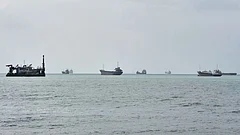
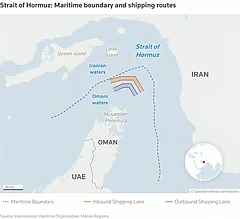
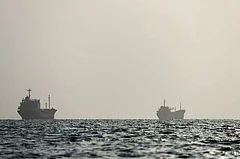
Oil tankers from Qatar, the UAE and Kuwait have reportedly continued moving through the Strait of Hormuz while using tactics such as switching off tracking systems.
Continued oil flows through the key chokepoint could be limiting the impact of the US-Iran conflict on global crude prices, despite heightened risks to commercial shipping.
The Strait remains under severe threat, with UKMTO reporting attacks and harassment of vessels, while Brent crude has risen to around $89 a barrel as US-Iran peace talks lose momentum.
Oil producers of the Middle East have secretly been shipping fossil fuels keeping their transponders turned off for several months through the Strait of Hormuz, Bloomberg reported. The report added that the oil tankers’ shipping from Qatar, UAE and Kuwait have been holding back the fuel prices.
Global oil rates have defied market expectations of a massive spike. Crude prices remain in check as of August 2026. Market analysts previously expected open warfare to double energy costs overnight. Historically, the Strait of Hormuz is the world's most sensitive oil chokepoint. Conflict in this narrow waterway typically triggers immediate global energy crises. A fifth of global daily oil consumption passes through this specific transit route.

Oil Tankers Keep Moving Through Hormuz
As per the report, it is difficult to analyse the amount of oil being transited from the Strait of Hormuz because the operation is covert. Tankers are bypassing the conflict zone by utilising automatic identification system transponder manipulation. Vessels routinely turn off their electronic trackers in a practice known as going dark. Crews simultaneously conduct ship-to-ship transfers at sea. These tactics successfully obscure both the origin and final destination of the crude oil cargos.

Fleet operators maintain transit through the high-risk zone by employing non-Western financial networks. Alternative insurance workarounds allow these vessels to continue operations without standard Western coverage. These alternative mechanisms bypass traditional maritime compliance structures entirely.
This unregulated shipping network functions as an economic shock absorber. The hidden supply chain ensures that energy markets do not panic over surface-level military threats. Observers said that the network's "secret shipping through Strait of Hormuz" serves as a critical, unacknowledged pressure valve for global energy markets.
Why Oil Prices Haven’t Surged Further
Previous US sanctions and enforcement mechanisms are being selectively bypassed or explicitly tolerated.
Energy analysts are adjusting their risk premiums downward. Real-time maritime volume data reveals steady crude outflows from the region, despite aggressive military posturing by American and Iranian naval forces. The continued physical supply overrides geopolitical fear factors in commodity pricing.
Earlier in February, The US Department of the Treasury’s Office of Foreign Assets Control (OFAC) sanctioned over 30 individuals, entities, and vessels enabling illicit Iranian petroleum sales and Iran’s ballistic missile and advanced conventional weapons (ACW) production, as part of Treasury’s ongoing campaign of maximum pressure on Iran.

The UKMTO report on Sunday said that there is a ‘severe’ regional threat in the Strait of Hormuz. There were three confirmed attacks last week. IRGC attacks, attempted attacks, and/or harassment activity persisted. These actions continue to demonstrate Iran’s intent to assert presence along key transit lanes and maintain pressure on transiting vessels. Commercial traffic through the Strait of Hormuz remained at reduced levels. Independent tracking data indicated suppression with single-digit numbers or nil tankers transiting in both directions, the report added.

According to Reuters, as Iran-US peace talks continue to dwindle, oil prices are rising. Brent crude futures rose as much as 1% to $88.28 per barrel and were last trading up 72 cents at $89.20.















